

Day 289/365 Speed Demon: A Study in Panning and Motion
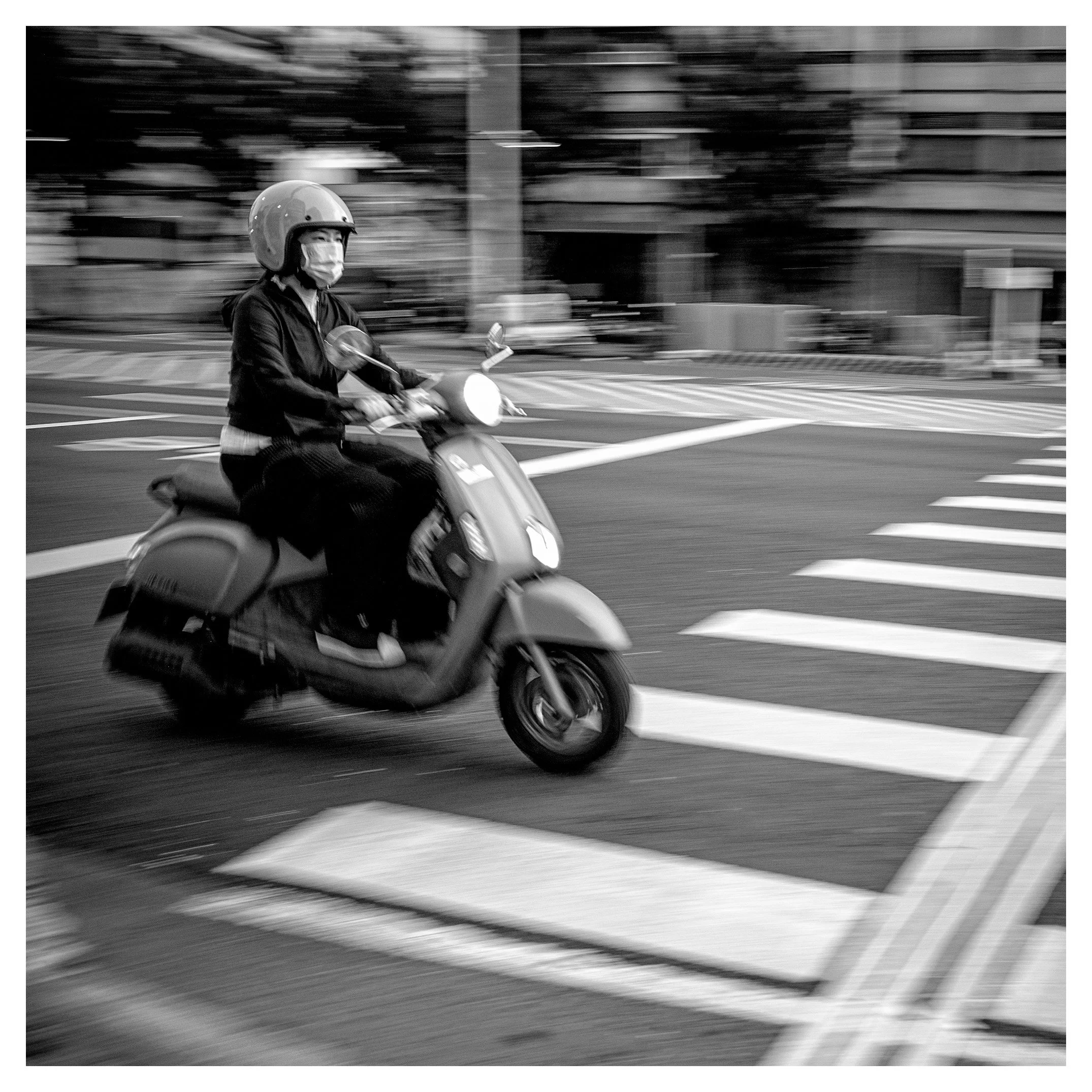
A helmeted rider cuts through a Kaohsiung intersection, the world around her dissolved into streaks while she stays perfectly sharp. A textbook study in the panning technique, and everything that has to go right for it to work.
Camera Model: Ricoh GR III
Shutter Speed: 1/50 sec
Aperture: f/3.5
ISO: 200
The Critique
This is a genuinely well-executed panning shot, and it’s worth being clear about how demanding that actually is technically before praising the result. Panning requires your camera’s speed to match your subject’s speed almost perfectly — too fast blurs the subject, too slow leaves the background sharp, and you need constant velocity from start to finish. Common shutter speed guidance for motorcycles and scooters sits somewhere between 1/60s and 1/125s, and this frame was shot at 1/50s — on the slower, more difficult end of that range, which makes the crisp sharpness on the rider’s helmet and face even more impressive. The technique fails constantly in practice; professional photographers warn that a good hit rate might be one usable frame out of many attempts, so what you’re looking at here represents real, practiced skill rather than a lucky accident.
The composition itself does smart things beyond the technical execution. The rider is positioned left of center with the crosswalk stripes extending into open space ahead of her, giving her direction of travel room to breathe rather than crowding her against the frame edge — exactly the kind of negative-space-in-the-direction-of-motion placement that separates a considered panning shot from an accidental one. The zebra crossing stripes, rendered sharp beneath her wheels while everything above and behind streaks into pure motion, create a wonderful structural anchor — a moment of stillness at ground level holding the whole composition together against the surrounding blur.
Black and white was the right call for this image specifically. Color panning shots can become a chaotic wash of streaked hues that fight for attention; stripped to tone, the motion blur reads as pure gesture and energy rather than color noise, and the tonal contrast between the rider’s dark jacket, pale helmet, and the streaked gray cityscape behind her stays clean and legible even at speed. Her surgical mask and the loose fabric of her clothing, both slightly less blurred than the deep background, add a nice secondary layer of implied movement — you can almost feel the wind she’s riding into.
Where the image could be pushed further is in the front wheel, which shows some blur inconsistent with the crisp sharpness of her upper body — a minor giveaway of the technique’s difficulty, though it’s subtle enough not to undermine the overall effect. The background architecture, while appropriately streaked, occasionally clumps into slightly muddy gray zones rather than clean directional lines; a marginally faster panning speed relative to her actual velocity might have produced longer, more graphic streaks.
How This Image Could Be Improved
• Watch wheel blur relative to body sharpness. The front wheel shows more motion softness than the rider’s face and torso; more practice reps at this exact shutter speed would help narrow that gap.
• Consider a slightly higher shutter speed for cleaner background streaks, perhaps 1/60s to 1/80s, which per most technical guidance suits scooter speeds well while potentially producing more graphic, less muddy background blur.
• Try shooting a burst rather than a single frame per pass. Given how demanding panning is, capturing multiple frames per subject and selecting the sharpest afterward dramatically improves the keeper rate.
Becoming a Better Photographer Over Time
• Practice panning deliberately and often, starting with slower, more predictable subjects like cyclists before moving to faster scooters and motorcycles, exactly as most technical guides recommend.
• Log your shutter speed against subject speed and success rate. Over time this builds an intuitive feel for the right settings across different traffic speeds and conditions specific to your shooting locations.
• Study body mechanics as much as camera settings. Panning success depends heavily on rotating smoothly from the torso rather than the arms, tracking the subject well before and after the shutter fires — this is as much physical practice as technical knowledge.
Photographers to Study
• Jacques Henri Lartigue — for his pioneering early-20th-century motion photography of racing cars and speed.
• Ernst Haas — for his innovative use of motion blur and panning to capture energy and movement in color.
• Anton Giulio Bragaglia — for his Futurist “photodynamism” experiments exploring motion as a photographic subject in its own right.
• Harold Edgerton — for his scientific yet visually stunning studies of motion and speed frozen or streaked in time.
• • Barbara Morgan: Prints from the Barbara Morgan Archive
Videos Worth Watching
• “Photography Panning Tutorial - Capturing a Car with Motion Blur” — a direct technical walkthrough of the exact technique used in this frame.
• Panning Photography Technique guide (diyphotography.net) — a thorough written breakdown of shutter speed, body mechanics, and background selection for panning shots like this one.
• Learning with Experts’ panning guide — specific shutter speed recommendations for scooters and motorbikes, directly applicable to this subject.• Barbara Morgan: Prints from the Barbara Morgan Archive.