

Day293/365 Under the Sign: A Study in Quiet Contradiction
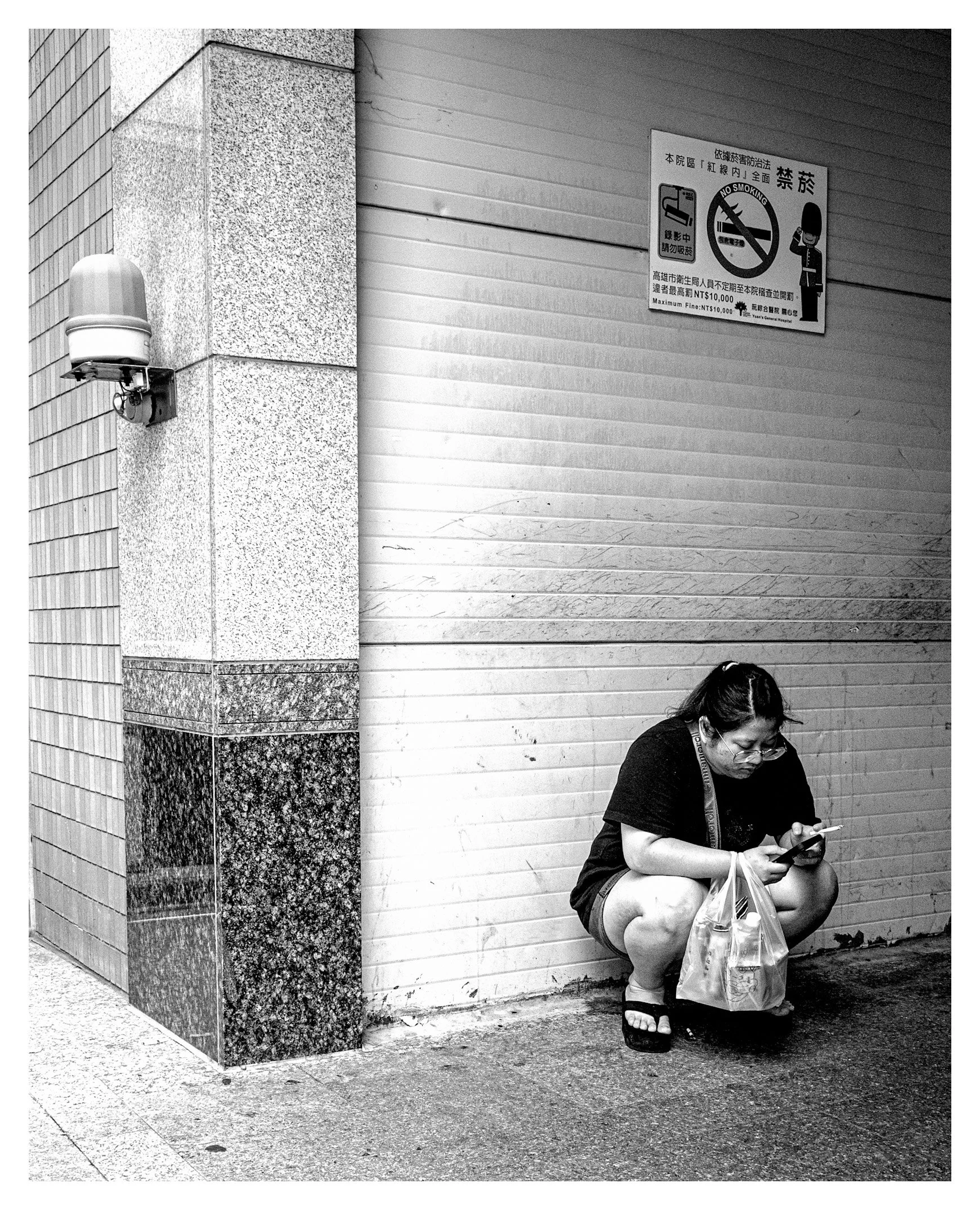
A woman crouches for a moment’s rest against a hospital wall, cigarette between her fingers, directly beneath a No Smoking sign warning of a NT$10,000 fine. A black-and-white study in geometry, irony, and the small contradictions of an ordinary afternoon.
Camera Model: Ricoh GR III
Shutter Speed: 1/320 sec
Aperture: f/8
ISO: 640
The Critique
This photograph belongs to a tradition of quiet visual irony that runs directly through Tony Ray-Jones and, following him, Martin Parr — both linked by a talent for social observation, with photographs rich in narrative and full of humour, built on the organized chaos of everyday contradiction rather than staged setup. Here the contradiction is simple and immediate: a bilingual No Smoking sign, complete with a fine amount printed directly beneath it, hangs on the wall above a woman crouched at street level, cigarette in hand, entirely absorbed in her phone. Nobody arranged this. The photograph simply waited for the world to contradict itself, which it reliably does if you’re patient enough to notice.
Ray-Jones described his own work as an attempt to show the sadness and humour in a gentle madness that prevails in people, built on situations that are sometimes ambiguous, with the juxtaposition of elements seemingly unrelated — yet the people are always real. That’s precisely the register this image operates in. There’s no cruelty in the observation, no setup, just an honest visual coincidence caught with a straight, patient eye. The composition reinforces that patience: the geometric architecture on the left — a granite-clad column with distinct textured bands — divides the frame cleanly from the corrugated metal shutter on the right, creating a strong vertical seam that organizes what could otherwise be a visually flat scene into two clearly readable zones.
The placement of the sign is doing real compositional work too — high and to the right, cartoon guard illustration included, it anchors the upper portion of the frame while the woman occupies the lower right, creating a diagonal visual relationship between warning and action that the eye naturally connects. The security camera mounted on the column adds a further layer of quiet commentary — another watching eye, recording everything, seemingly unconcerned with enforcing the rule directly above.
Technically, the black-and-white treatment and the strong midday contrast give the corrugated wall real textural interest — the scuff marks and scratches across its surface read almost like a canvas of accumulated wear. Where the image could be pushed further is in the balance of empty space; the large expanse of blank shutter between the sign and the woman is compositionally intentional (it lets the eye travel and connect the two elements) but risks feeling slightly underutilized on a first glance — a viewer needs a beat to understand why that gap matters.
How This Image Could Be Improved
• Consider whether a tighter crop, including the sign and the woman more closely together, changes the joke’s timing. The current spacing rewards patience; a tighter version would deliver the irony faster but with less quiet buildup — worth trying both.
• Watch for a moment when her face is more visible. She’s absorbed in her phone here, which suits the observational mood, but a frame with her glancing up, aware of the sign above her, could add a second layer of narrative.
• Explore returning to well-observed locations like this one. A spot with this kind of built-in irony — sign plus contradicting behavior — is often good for more than one frame across different visits.
Becoming a Better Photographer Over Time
• Practice recognizing “built-in irony” locations. Signs, rules, and warnings posted in public space are a reliable source of the kind of gentle visual contradiction this image captures — train yourself to notice them and wait.
• Study patience as a specific skill distinct from reaction speed. This is a “waiting” photograph rather than a “reacting” one — log which of your strongest images come from patient observation of a static scene versus a fast reflexive response to sudden movement.
• Keep a working list of personal rules, the way Ray-Jones kept a notebook of instructions to himself that later shaped Parr’s own practice — a short, evolving list of your own compositional habits and blind spots can sharpen your eye faster than equipment ever will.
Photographers to Study
• Martin Parr — for his decades of finding irony, humor, and social commentary in ordinary contradictions.
• Tony Ray-Jones — the foundational influence on this entire mode of observational irony in street photography.
• Tod Papageorge — for his disciplined, formally rigorous treatment of urban geometry and coincidence.
• Joel Sternfeld — for his deadpan documentation of American social contradiction.
• Philip-Lorca diCorcia — for his staged-feeling but genuinely candid use of architectural light and geometry around unposed subjects.
Books Worth Reading
• Common Sense by Martin Parr
• A Day Off by Tony Ray-Jones
• Public Relations by Tod Papageorge
• American Prospects by Joel Sternfeld
• A Storybook Life by Philip-Lorca diCorcia
Videos Worth Watching
• “The Controversial Photography of Martin Parr” — a solid overview of Parr’s ironic, observational approach directly relevant to this frame.
• “I Am Martin Parr - Official UK Trailer” — a glimpse into his method of finding these moments of everyday contradiction.
• “Photographers in Focus: Martin Parr” — further context on his career-long fascination with irony and social observation.