

Day 294/365 Nine Faces at the Window: A Study in the Uncanny
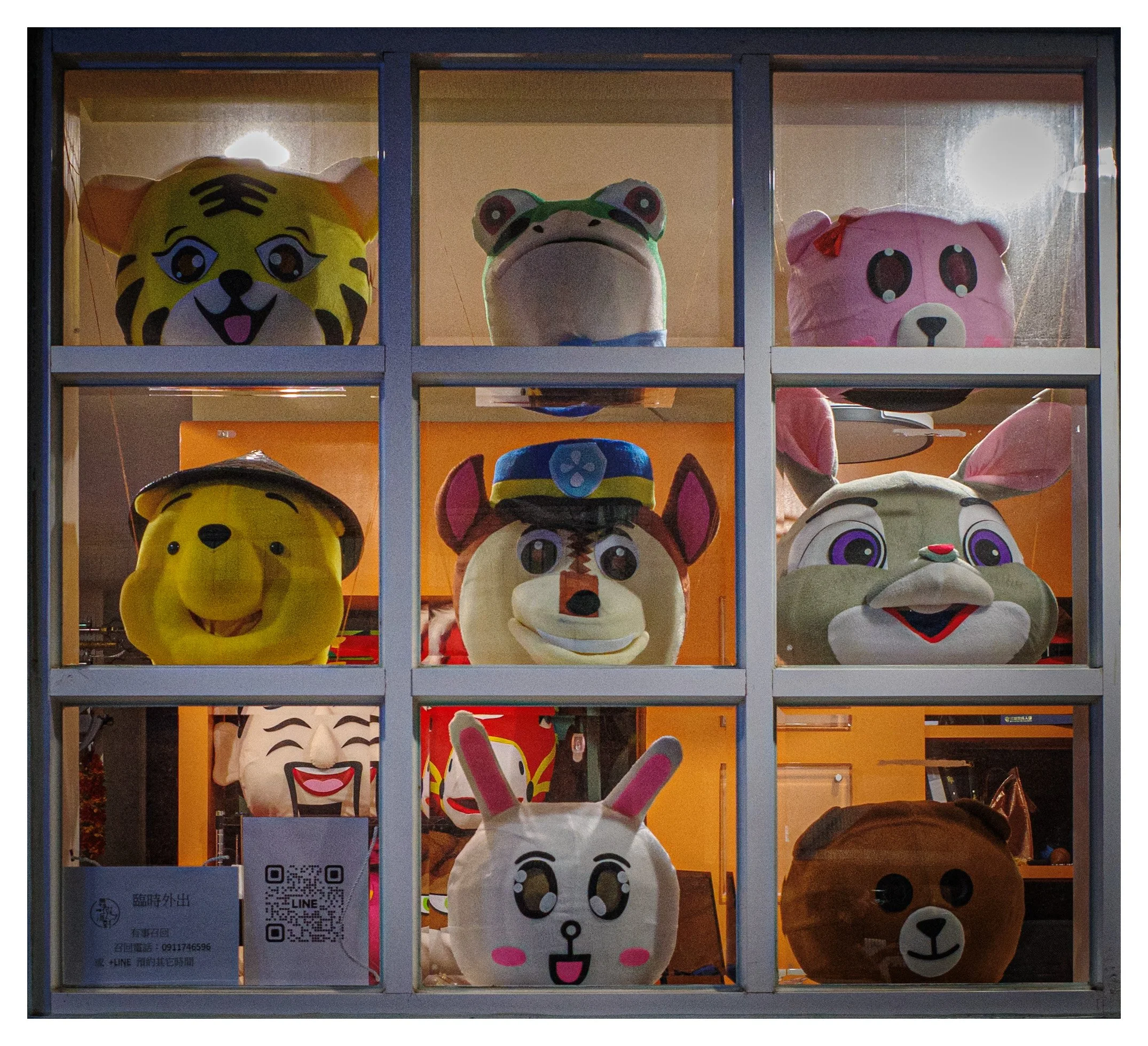
Nine oversized mascot heads stare out through a grid of windowpanes at night, their painted eyes catching the light like a strange, silent audience. A saturated, faintly unsettling study in repetition, color, and the uncanny territory between cute and creepy.
Camera Model: Ricoh GR III
Shutter Speed: 1/125 sec
Aperture: f/2.8
ISO: 2500
The Critique
This photograph works because it sits precisely on the line between charming and unsettling, and it refuses to resolve that tension in either direction. Nine oversized costume mascot heads — a tiger, a frog, a bear, and several other cartoon animal characters — are arranged in a tidy three-by-three grid, framed by the window’s own muntin bars, staring directly out at the camera with the wide, painted eyes typical of parade and event mascot costumes. Lit from within by warm interior light against the cool blue of the window frame, they read simultaneously as cheerful children’s entertainment props and as something closer to a row of disembodied heads mounted for display.
That doubled reading is exactly the territory Diane Arbus made her career exploring — the way an ordinary or even cheerful subject can tip, with the right framing and directness, into something genuinely strange. Arbus’s work is often described as bizarre, fantastical, and psychologically complex all at once, evoking a sense of “othering” through the intensity of the gaze her photographs offer, turning even mundane subjects into visual spectacles. These mascot heads were never meant to be looked at this closely or this directly — normally glimpsed for a moment at a children’s event, worn and moving — and isolated here, staring fixedly through glass at night, they take on exactly that Arbus-like quality of ordinary things rendered strange through unflinching, direct observation.
The compositional grid is doing serious work too. Nine faces, each occupying its own pane, creates a formal, almost portrait-gallery structure that recalls the constructed, theatrical tableaux of Sandy Skoglund, whose work centers on surreal, color-saturated environments filled with handcrafted props and repetitive visual motifs, exploring consumerism, domesticity, and the uncanny through elements like repeated or doubled figures in absurd, disorienting settings. The repetition here — face after face after face, each rendered in a slightly different cartoon style but united by that same wide-eyed, painted stare — builds a cumulative eeriness that no single mascot head alone would carry.
Color contributes enormously: the warm amber interior light against the cool window frame creates a strong temperature contrast, while the individually bright, saturated colors of each mascot (yellow tiger, green frog, pink bear, brown bear) keep the grid visually lively despite its slightly ominous undertone. Where the image could be pushed further is in the reflections visible in the upper panes — they add a bit of visual noise that occasionally competes with the mascot faces for attention; a slightly different shooting angle might have minimized that glare.
How This Image Could Be Improved
• Consider shooting from a slight angle to reduce window glare in the upper panes, which currently compete somewhat with the mascot faces in those sections.
• Watch the bottom row’s visibility. The lowest panes read slightly darker and more ambiguous than the top two rows; a touch of shadow recovery could bring those faces into clearer focus.
• Explore a tighter crop on just the eyes across the grid. A version focused purely on the row of painted eyes, without full faces, could push the uncanny quality even further as a companion image.
Becoming a Better Photographer Over Time
• Practice recognizing the uncanny in ordinary commercial objects. Mascot costumes, mannequins, and store displays are reliable sources of this kind of unsettling repetition — train your eye to notice them.
• Study grid and repetition as a deliberate compositional strategy. Log which of your images benefit from a single strong subject versus a repeated, gridded arrangement, and build intentional control over when to use each.
• Return to well-lit night windows repeatedly. Interior lighting against exterior darkness, as here, creates dramatic natural contrast — actively seek out illuminated storefronts and displays after dark as a category of subject.
Photographers to Study
• Diane Arbus — for her unmatched ability to find the strange within the ordinary through direct, unflinching observation.
• Sandy Skoglund — for her constructed, color-saturated tableaux built on repetition and the uncanny.
• David LaChapelle — for his maximalist, hyper-saturated engagement with consumer and pop imagery.
• Cindy Sherman — for her sustained investigation of masks, personas, and the unsettling space between character and self.
• Miles Aldridge — for his glossy, saturated, subtly disquieting color photography that sits between fashion and fine art.
Books Worth Reading
• Diane Arbus: An Aperture Monograph
• Sandy Skoglund: Reconstructing Reality
• LaChapelle Land by David LaChapelle
• Cindy Sherman: Retrospective
• Miles Aldridge: I Only Want You to Love Me
Videos Worth Watching
• “Diane Arbus: My Queen of Documentary Photography” — a personal, engaging look at Arbus’s fascination with the strange within the ordinary.
• “Masters of Photography - Diane Arbus” — a fuller documentary treatment of her career and visual philosophy.
• “A Box of Ten Photographs: The Odyssey of Diane Arbus” — a panel discussion offering further insight into how Arbus approached direct, confrontational subject matter.