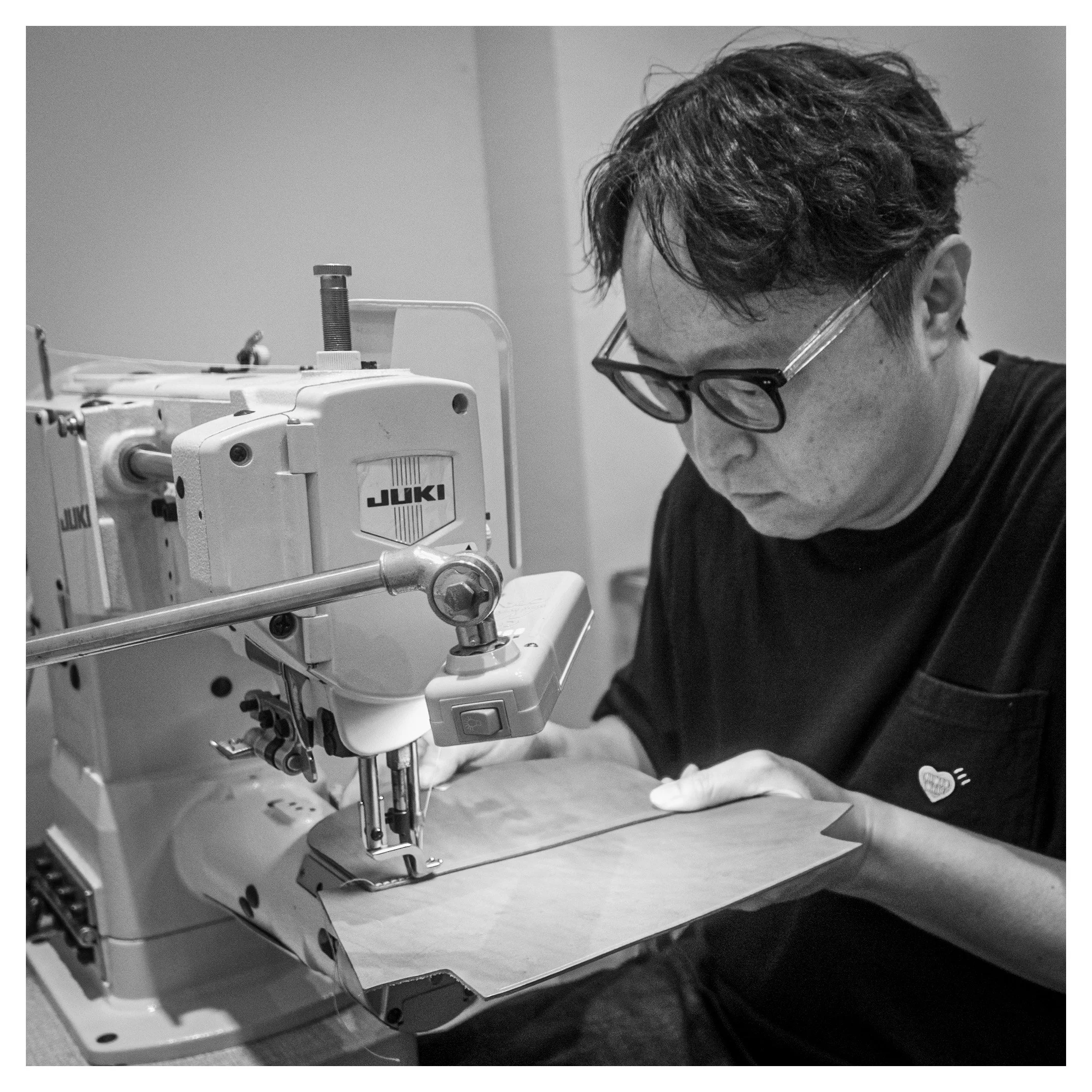
Day 295/365 Rainforest W: A Portrait of the Craftsman at Work
Head bent low, glasses catching the light, a leatherworker guides material beneath the needle of a well-worn industrial machine. A close, unposed study in concentration, craft, and the particular stillness that skilled hands bring to repetitive, exacting work.
Camera Model: Leica D-Lux 8
Shutter Speed: 1/250 sec
Aperture: f/1.7
ISO: 500
The Critique
This photograph documents the proprietor of Rainforest W, a leatherworker in Lingya District, mid-stitch at his JUKI industrial sewing machine — and it belongs to a tradition of dignifying skilled trade through photography that runs directly back to Irving Penn’s landmark Small Trades series. In 1950, Penn began photographing craftsmen and workers in Paris, London, and New York, dressed in their work clothes and holding their tools, treating tradespeople with the same formal seriousness he brought to his fashion sitters — a project itself inspired by Eugène Atget’s earlier documentation of Parisian street trades. Penn’s underlying belief, as one critic put it, was that people were interesting enough in themselves that they didn’t need a glamorous backdrop to justify being photographed with care.
This image achieves something related, though by very different means — rather than the neutral studio backdrop and full-length formal pose Penn used, this is a close, unposed, in-situ portrait, catching the leatherworker fully absorbed in the actual moment of stitching rather than presenting himself for the camera. That distinction matters. Where Penn’s subjects held their tools as props within a constructed studio moment, this photograph catches genuine, unguarded concentration — the slight downward tilt of the head, glasses low on the nose, one gloved finger guiding the leather precisely toward the needle. This is what the craft actually looks like mid-task, not a reenactment of it.
The shallow depth of field at f/1.7 does important work, throwing the machine’s body and the background wall into soft focus while keeping his face and hands — and the needle itself — in the sharpest plane. That selective focus draws the eye directly to the point of contact between hand, tool, and material, which is precisely where the skill of the work actually resides. The black-and-white treatment strips away any distraction of color, letting the tonal relationship between his dark shirt, pale skin, and the bright chrome and white housing of the JUKI machine carry the full visual weight of the frame.
Where the image could be pushed further is in the background, which, while appropriately soft, is fairly featureless — a small amount of environmental detail (tools, materials, shop signage) visible even slightly out of focus could add a touch more context about the space itself without competing with the primary subject.
How This Image Could Be Improved
• Consider a companion wider shot of the workshop. This close, intimate frame is strong on its own, but a second image showing more of the shop environment would round out the story of the space and its tools.
• Watch for a frame with slightly more visible environmental detail in the background, even softly out of focus, to add context without sacrificing the subject’s dominance in the frame.
• Explore a moment with his eyes visible. The downward gaze here suits the concentration of the work, but a frame catching a brief glance upward could add a second layer of connection to complement this more absorbed, task-focused image.
Becoming a Better Photographer Over Time
• Build a personal “trades and craft” project, following Penn’s example of taking skilled work seriously as photographic subject matter. Local leatherworkers, tailors, cobblers, and other artisans are increasingly rare, and documenting them now has real long-term value.
• Practice catching genuine absorption rather than posed presentation. The difference between a subject performing for the camera and a subject genuinely lost in their work is often the difference between a competent portrait and a memorable one — train yourself to wait for the latter.
• Study selective focus as a storytelling tool, not just an aesthetic choice. Log which of your portraits use shallow depth of field to direct attention toward the specific point where skill or labor is happening, and build that instinct deliberately.
Photographers to Study
• Irving Penn — for his landmark Small Trades series and its belief in the inherent dignity of skilled work, well worth studying as a direct point of comparison and contrast to this frame’s unposed approach.
• W. Eugene Smith — for his deeply immersive, close documentary portraits of workers and communities.
• David Goldblatt — for his patient, unglamorous documentation of workers and their environments.
• Paul Strand — for his formally rigorous, dignified portraiture of laborers and craftspeople.
• Bert Hardy — for his warm, direct British documentary photography of working people.
Books Worth Reading
• Irving Penn: Small Trades
• W. Eugene Smith: Photographs 1934–1975
• David Goldblatt: South Africa: The Structure of Things Then
• Paul Strand: Sixty Years of Photographs
• Bert Hardy: Photojournalist
Videos Worth Watching
• “The Art of Capturing Humanity: Irving Penn’s ‘Small Trades’” — a direct look at the project most relevant to this frame’s subject matter and underlying philosophy.
• Ted Forbes, The Art of Photography channel — for further historical grounding in documentary and trade portraiture traditions from Atget through Penn.
• Sean Tucker’s channel — his videos on patience and presence apply well to catching a subject genuinely absorbed in skilled work rather than posing.