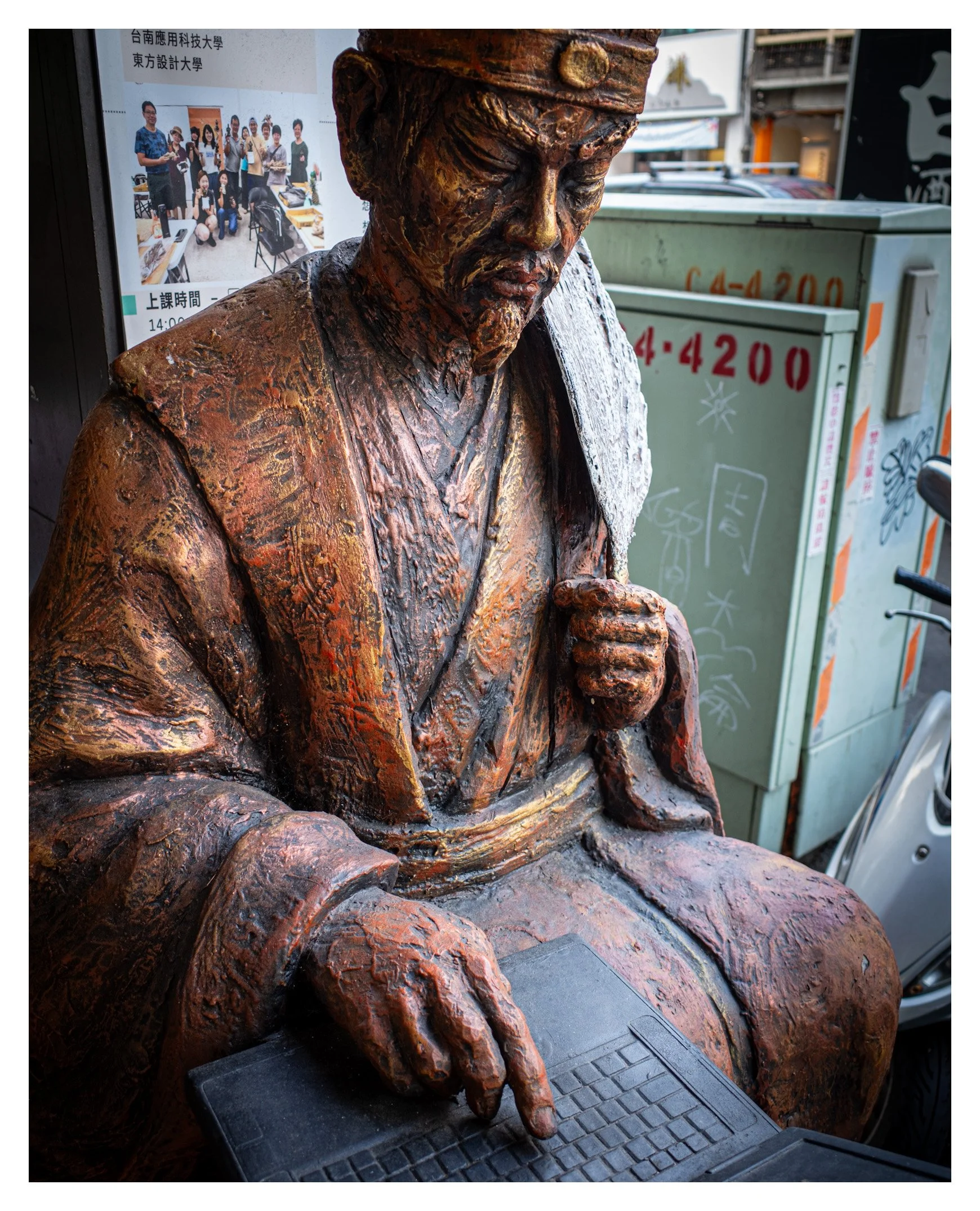
Day 296/365 The Sage and the Keyboard: A Study in Anachronism
A weathered statue of a robed scholar rests one carved hand on a modern computer keyboard, ancient wisdom meeting the tools of the digital age. A close, warmly lit study in incongruity, texture, and the sly humor a city can build into its own public art.
Camera Model: Ricoh GR III
Shutter Speed: 1/50 sec
Aperture: f/2.8
ISO: 250
The Critique
This photograph finds one of those rare, ready-made visual jokes that a photographer only has to notice and frame well — a statue of a traditionally robed scholar, rendered with real sculptural detail in its beard, headwear, and flowing garments, positioned with one weathered hand resting directly on a black computer keyboard. The anachronism does all the conceptual work here: centuries of implied history and tradition literally touching the tool of contemporary digital life, likely installed outside what the visible signage suggests is a design or technology institute.
This is territory Duane Michals mapped out across a long career of conceptual photography — his work consistently explores how, when an object is held or placed in relation to a figure, it’s not just about the object itself, but about the hybridity it evokes, how the juxtaposition creates layers of meaning beyond what’s immediately visible. Whether or not this statue was placed with full deliberate irony by whoever installed it, the photograph recognizes and isolates exactly that hybrid meaning: tradition and technology, physically touching, neither one able to fully explain the other.
The framing decision to crop in tightly on the statue’s upper body, rather than showing it in a wider establishing shot, is the composition’s smartest move. It forces the viewer to read the statue almost as a portrait — the individualized carved face, with its lined brow and downcast, contemplative expression, reads with real emotional weight, as though the sculptor genuinely wanted this figure to seem to be thinking rather than merely decorative. The warm bronze and gold patina of the statue’s surface catches directional light beautifully, creating rich tonal variation across the robe’s folds and the texture of the carved hair and beard.
The background clutter — a utility box, a parked scooter, a poster with photographs of university students — does useful documentary work, firmly grounding this whimsical piece of public art within the unglamorous reality of an actual Kaohsiung street corner rather than presenting it as an isolated art object. Where the image could be pushed further is in the color balance between the statue’s warm bronze tones and the cooler green utility box behind it; they compete slightly rather than complementing each other, and a marginally different angle might have found a background with less competing color intensity.
How This Image Could Be Improved
• Consider a background with less competing color saturation. The green utility box pulls attention in a way that slightly rivals the statue’s warm tones; a different angle might isolate the figure against calmer surroundings.
• Watch the keyboard’s position at the very bottom edge. It’s the punchline of the whole image, but currently sits close to being cropped; a touch more room below would let it read with full clarity as the object completing the joke.
• Explore a companion wide shot. This tight crop works well as a character study, but a wider frame showing the statue’s full seated pose and complete surroundings could make a strong second image in a pairing.
Becoming a Better Photographer Over Time
• Actively hunt for anachronism and incongruity in public space. Statues, murals, and public art frequently contain exactly this kind of unintentional or knowing juxtaposition — train yourself to notice and frame these moments specifically.
• Study how tight cropping can turn an object into a portrait. This image works partly because it treats a statue with the same compositional respect you’d give a human subject — practice applying portrait principles to non-human subjects deliberately.
• Build a personal file of “objects with meaning beyond their function.” Michals’s career-long interest in how held or juxtaposed objects generate meaning is a genuinely useful lens to apply to street photography broadly, not just staged conceptual work.
Photographers to Study
• Duane Michals — the essential conceptual reference for this frame’s interest in juxtaposition and the meaning generated when unlike things are placed together.
• Chema Madoz — for his witty, surreal treatment of ordinary objects reframed into new meaning.
• Ai Weiwei — for his recurring interest in the collision between ancient tradition and contemporary life within a single image.
• Sophie Calle — for her conceptual, narrative-driven approach to found objects and public space.
• Erwin Olaf — for his richly staged, conceptually loaded color photography.
Books Worth Reading
• Duane Michals: Storyteller
• Chema Madoz (Fundación MAPFRE monograph)
• Ai Weiwei: Beijing Photographs
• Sophie Calle: True Stories
• Erwin Olaf: Volume
Videos Worth Watching
• “Duane Michals - An extended vision of what photography could be” — a concise, moving overview of his conceptual approach following his passing.
• “Illusions of the Photographer: Duane Michals at the Morgan” — deeper insight into his method of building meaning through juxtaposition.
• “Duane Michals: Beyond the Annotated Portrait” — Michals discussing his own work and process directly.