

Day 297/365 The 85 Sky Tower, Wrapped in Cloud
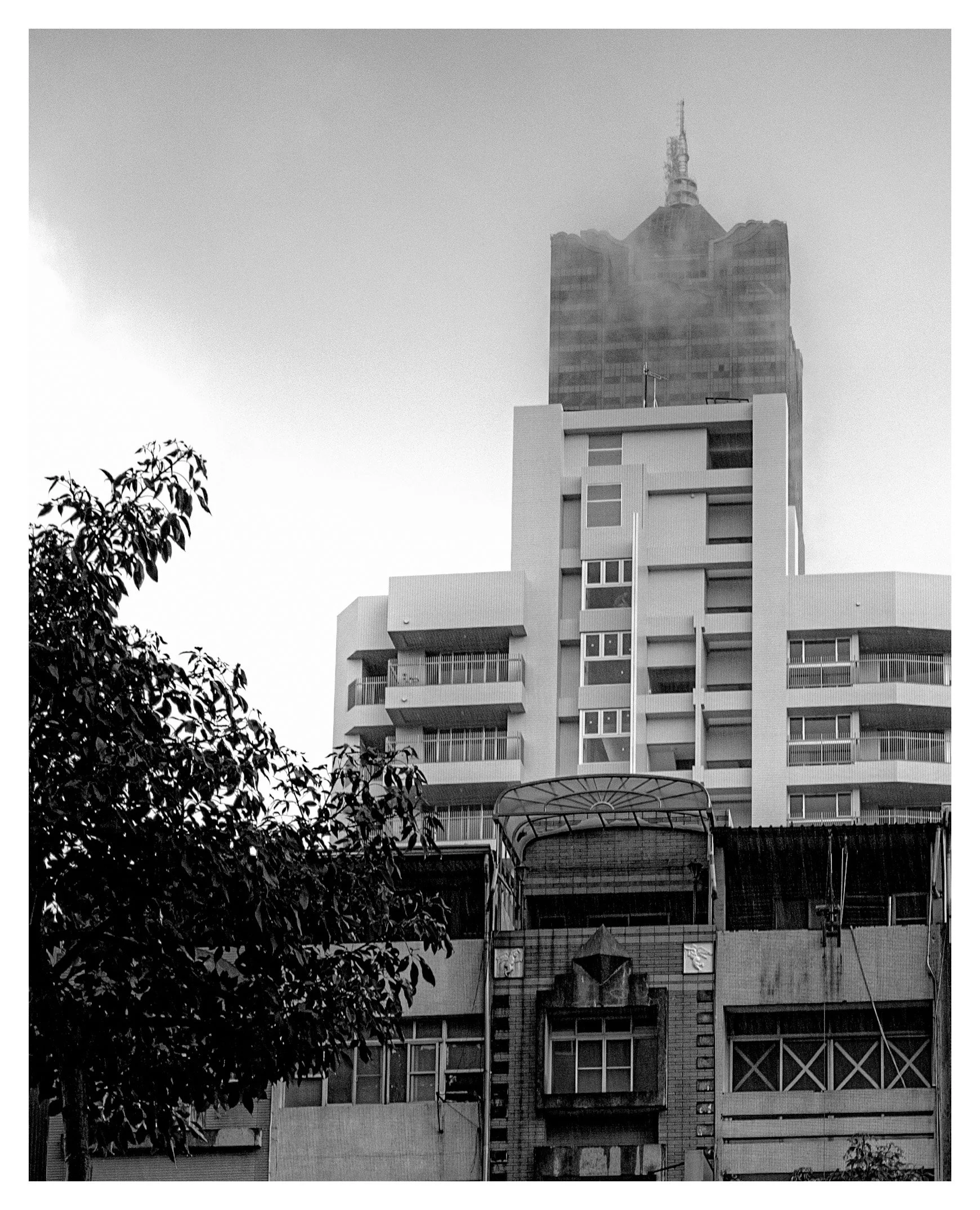
Kaohsiung’s tallest building disappears into low mist, its distinctive crown just visible above a foreground of ordinary apartment blocks and a dark, leafy tree. A black-and-white study in scale, layered urban history, and the atmosphere a passing cloud can lend to a skyline.
Camera Model: Ricoh GR III
Shutter Speed: 1/40 sec
Aperture: f/6.3
ISO: 200
The Critique
This photograph captures the 85 Sky Tower — officially the tallest building in Kaohsiung, rising 347.5 meters over 85 stories, with an antenna pushing the total height to 378 meters — at a genuinely fortunate atmospheric moment, its distinctive twin-pronged crown wreathed in low cloud that softens the upper floors into a hazy, almost dissolving presence. Completed in 1997 by the now-defunct Tuntex Group, the tower’s unusual silhouette, splitting into two separate sections before merging into a single central spire, was deliberately designed to resemble the Chinese character for “tall” — a piece of architectural symbolism that’s genuinely hard to read from ground level but becomes legible in exactly this kind of clear vertical composition.
The photograph’s real strength, though, is structural rather than purely atmospheric: it stacks three distinct eras and scales of Kaohsiung architecture vertically within a single frame. A weathered, older low-rise building with visible tile work and an ornate rooftop structure occupies the immediate foreground; a mid-century modern apartment block, with its distinctive stepped balconies, fills the middle ground; and the 85 Sky Tower, unmistakably contemporary and vastly taller than everything beneath it, rises through the clouds at the top. This layering of old, mid-period, and landmark-contemporary architecture within one vertical composition tells a genuine story of the city’s growth without needing a single word of explanation.
The dark, leafy tree occupying the left third of the frame does important compositional work, functioning almost exactly the way trees did in Alfred Stieglitz’s and Edward Steichen’s celebrated early-20th-century photographs of the Flatiron Building — both photographers, working within two years of each other, used foreground trees to partially obscure and frame their skyscraper subjects, creating a visual conversation between the organic and the engineered that made the new architecture feel embedded in, rather than opposed to, its surroundings. This photograph does something remarkably similar: the silhouetted branches on the left balance and humanize the hard geometric mass of concrete and glass rising on the right.
The black-and-white treatment and the low-contrast, overcast light give the whole scene a soft, almost pearlescent tonal range — nothing blows out, nothing goes fully black, and the mist wrapping the tower’s crown reads with genuine atmospheric subtlety rather than as simple underexposure. Where the composition could be pushed further is in the middle-ground apartment block, which currently occupies a large, fairly flat expanse of the frame without much textural interest; a different vantage point might have found more visual incident in that middle layer to match the richness of the foreground and background.
How This Image Could Be Improved
• Consider a vantage point with more textural interest in the middle ground. The apartment block’s flat facade is the least visually engaging element in an otherwise rich vertical composition.
• Watch for repeat visits during different weather. This kind of low cloud wrapping a landmark tower is genuinely fortuitous; a series of images at this same vantage point across different atmospheric conditions could become a compelling ongoing study of the building.
• Explore the crop margins. There’s a slight tension in how tightly the tower’s spire is cropped at the very top; a touch more headroom might let its full silhouette, antenna included, breathe more within the frame.
Becoming a Better Photographer Over Time
• Study how foreground natural elements can frame and soften architectural subjects. The Stieglitz-Steichen Flatiron tradition of using trees to partially obscure a skyscraper is a genuinely useful, repeatable compositional device worth practicing deliberately.
• Learn the history of your city’s landmark buildings. Knowing that the 85 Sky Tower’s split-and-merge silhouette deliberately evokes a Chinese character changes how you might frame future images of it — research adds intentionality to instinct.
• Chase atmospheric conditions actively rather than waiting passively. Fog, low cloud, and mist dramatically transform tall buildings; track weather forecasts specifically with landmark architecture in mind.
Photographers to Study
• Alfred Stieglitz — for his pioneering photographs of New York’s early skyscrapers, particularly his repeated engagement with the Flatiron Building using foreground trees as framing devices.
• Edward Steichen — for his own atmospheric treatment of the same Flatiron Building, taken independently within years of Stieglitz’s version, and his lifelong interest in mood and tonal subtlety.
• Berenice Abbott — for her disciplined documentation of a rapidly changing New York skyline.
• László Moholy-Nagy — for his dynamic, unconventional angles on modern architecture.
• Andreas Feininger — for his structural, often elevated treatment of skyscrapers and urban form.
Books Worth Reading
• Alfred Stieglitz: The Key Set
• Steichen: A Life in Photography
• Changing New York by Berenice Abbott
• The New Vision by László Moholy-Nagy
• The Face of New York by Andreas Feininger
Videos Worth Watching
• “Alfred Stieglitz: The Eloquent Eye” — the definitive PBS American Masters documentary on Stieglitz, including his skyscraper work, directly relevant to this frame’s approach.
• “Chapter 19 - Alfred Stieglitz: The Eloquent Eye” — a focused chapter excerpt from the same documentary.
• Ted Forbes, The Art of Photography channel — for further historical grounding in early modernist architectural photography.