

Day 298/365 The Spotmatic and Its Ghosts: A Still Life in Analog
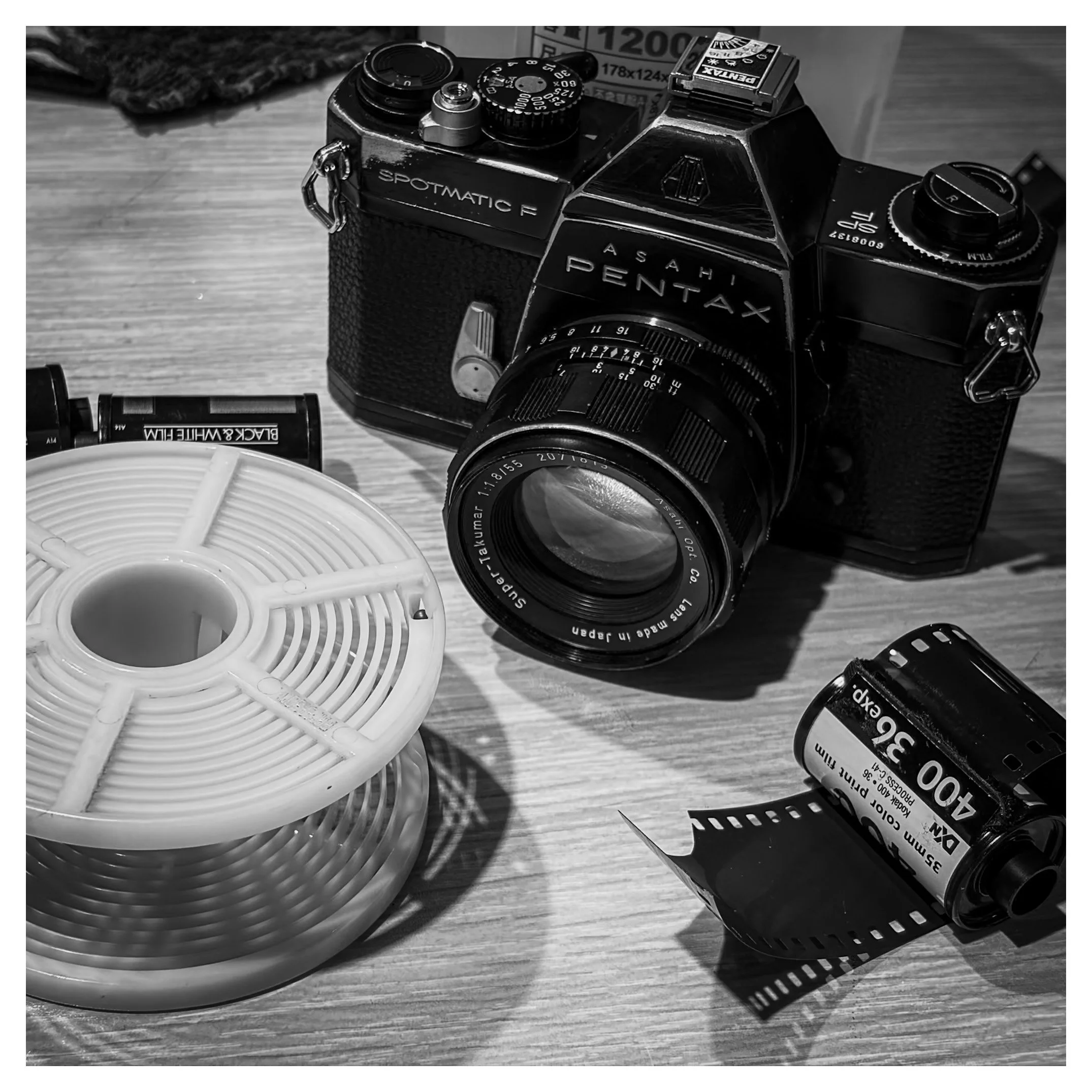
A vintage Asahi Pentax rests among coiled film reels and unopened rolls, side light raking across decades-old metal and leather. A quiet, textural study in the tools that shaped photography before anyone carried a lens in their pocket.
Camera Model: Apple iPhone 17
Shutter Speed: 1/120 sec
Aperture: f/1.6
ISO: 25
The Critique
This photograph documents a genuinely lovely piece of photographic history — an Asahi Pentax Spotmatic F, a landmark 35mm SLR from the late 1960s and early 1970s, paired with its original Super-Takumar 55mm f/1.8 lens, surrounded by the physical ephemera of film photography: a plastic developing reel, canisters of black-and-white and color film stock, and a partially unspooled roll of Kodak 400. As a still life, it works because every object present has a specific, legible function, and together they tell a complete story about a now largely obsolete process — loading film, shooting, developing, all represented by physical objects rather than the invisible sensors and menus of digital photography.
The lighting deserves real credit. A hard, raking side light rakes across the scene, catching the camera’s brassed edges, the fine machined ridges of the lens’s aperture ring, and the reflective curve of the lens glass itself, while throwing deep, well-defined shadows across the wood grain surface beneath. This is the classic still life lighting principle in action — side light reveals shape and texture far more effectively than flat frontal light would, and it’s precisely why the Spotmatic’s textured leatherette body and knurled dials read with such tactile clarity here.
The composition’s diagonal arrangement — camera occupying the upper right, film reel curving through the lower left, film canisters bridging the middle distance — creates a satisfying visual rhythm that pulls the eye through the frame rather than settling on any single element. The black-and-white treatment suits the subject perfectly; color would have been almost redundant here, since these objects are already essentially monochrome in their real-world materials of black plastic, chrome, and gray metal. Stripped to tone, the image emphasizes form and texture instead — the grille pattern of the film reel, the machined numerals on the aperture ring, the peeling label on the black-and-white film canister.
Where the image could be pushed further is in the depth of field. At this close working distance, only a narrow band across the middle of the frame holds full sharpness, and both the camera’s top plate and the nearer film canister soften noticeably. That’s a reasonable stylistic choice for a moody still life, but a slightly narrower aperture might have held a touch more of the Spotmatic’s body in focus, since its engraved details are genuinely worth preserving sharply.
How This Image Could Be Improved
• Consider stopping down slightly to extend the sharp zone across more of the camera body, particularly the top plate details, without losing the overall shallow-depth mood.
• Watch the film canister positioning at the lower right. It’s compositionally useful but sits close to the frame edge; a small adjustment could give it a touch more breathing room.
• Try a version with the film strip more fully unspooled. The small torn section peeking from the canister is a nice detail; a longer visible strip could add even more narrative and textural interest.
Becoming a Better Photographer Over Time
• Practice side lighting deliberately for object photography. This is one of the most reliable lighting setups for revealing texture and form — dedicate practice sessions specifically to side-lit still life until it becomes second nature.
• Build a personal archive of meaningful objects. Photographing your own tools and gear, as here, often produces more emotionally resonant still life work than arbitrary props, since you understand and care about what each object represents.
• Study depth of field as a narrative choice for object clusters. Log which of your multi-object still life images benefit from broad sharpness versus selective focus, and build intentional control over that trade-off.
Photographers to Study
• Wright Morris — for his tender documentation of everyday American objects imbued with personal and cultural history.
• Minor White — for his contemplative, symbolically charged black-and-white still life and object work.
• Frederick Sommer — for his textured, surreal approach to still life composition.
• Paul Caponigro — for his meditative, tonally rich black-and-white treatment of objects and natural forms.
• František Drtikol — for his early modernist mastery of dramatic side and directional light on still life subjects.
Books Worth Reading
• Wright Morris: God’s Country and My People
• Minor White: Rites of Passage
• The Art of Frederick Sommer
• Paul Caponigro: A Retrospective
• František Drtikol: Photographer, Painter, Mystic
Videos Worth Watching
• “Flat Lay Photography Tutorial: Tips, Setup & Ideas” — a practical guide that specifically uses a vintage camera collection as its working example, directly relevant here.
• “Still Life Photography Lighting - A Simple Tutorial for Dramatic Shots” — solid grounding in the side and rim lighting principles at play in this frame.
• “Mastering 17th-Century Lighting and Composition in Still Life Photography” — Karl Taylor’s deeper dive into classical still life lighting and composition, useful for pushing this kind of work further.