

Day 299/365 Lucky’s Flame: A Study in Action and Craft
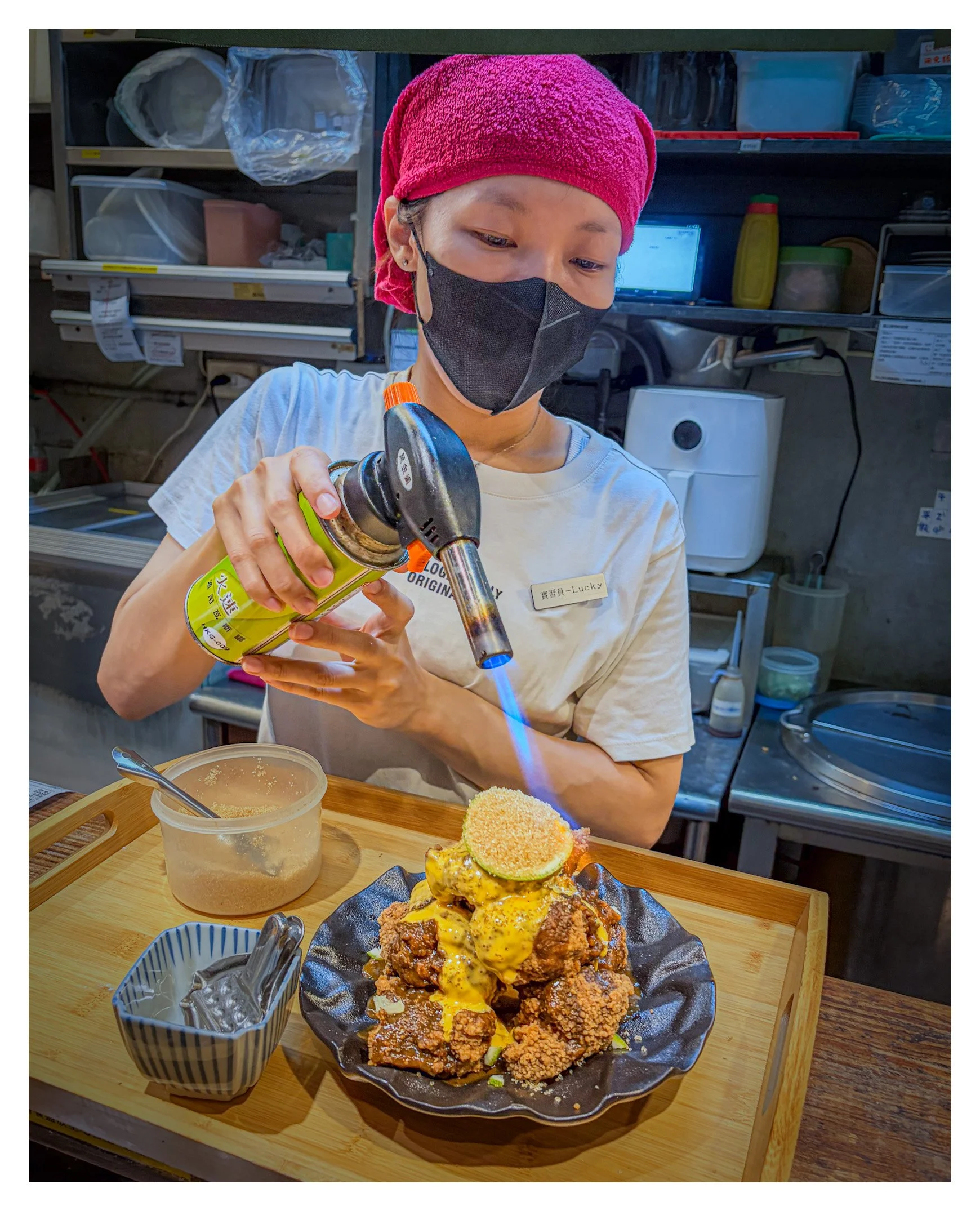
A trainee cook wields a butane torch over a towering plate of fried chicken, blue flame caught mid-motion against a saucy, cheese-crowned mountain of food. A dynamic, color-rich study in kitchen action and the exact instant a dish becomes finished.
Camera Model: Apple iPhone 17
Shutter Speed: 1/40 sec
Aperture: f/1.6
ISO: 400
The Critique
This photograph captures kitchen action photography at its most demanding: a real moment of technique, not staged for the camera, with genuine fire and genuine motion involved. Food action shots make any food photography dynamic and more realistic, and involving actual movement — torching, pouring, sprinkling — is what separates lively food imagery from static plated shots. Here, the trainee cook (her name tag reads “Lucky”) leans in with a butane torch, blue flame licking across the top of a towering plate of sauced fried chicken, the exact instant of technique caught rather than reenacted.
The composition does real work pulling together two very different visual registers: portrait and food photography, combined in a single frame. Her masked, focused expression occupies the upper half, kitchen shelving and equipment cluttered behind her in a way that firmly grounds this as an actual working kitchen rather than a styled set. The lower half belongs entirely to the food itself — the towering, glossy chicken with its cheese-sauce drape and toasted garnish disc, a genuinely appetizing subject in its own right. The torch’s blue flame, arcing between her hands and the dish, is the visual and narrative bridge connecting the two halves, and it’s rendered with enough sharpness at 1/40s to read clearly despite the demanding low-light, high-contrast conditions kitchen photography always presents.
Color is doing significant work throughout — the hot pink of her headscarf, the warm golden-brown of the fried chicken, and that small, saturated blue flame create a lively, high-energy palette that suits the kinetic subject matter. The framing, tight enough to include both her concentrated expression and the full dish below, required real spatial judgment in a cramped working kitchen — getting close enough to a hot flame and hot oil to make this image involved genuine physical positioning, not just camera settings.
Where the image could be pushed further is in the background clutter, which is authentic and valuable for documentary purposes but does compete somewhat for visual attention — a slightly wider aperture, had lighting allowed it, might have thrown that shelving further out of focus to let her and the dish dominate more completely. The torch flame itself, while sharp, sits fairly small within the frame relative to its narrative importance; a marginally tighter crop might have given it more visual weight.
How This Image Could Be Improved
• Consider a tighter crop that gives the flame slightly more visual weight, since it’s functioning as the narrative and compositional bridge between subject and dish.
• Watch background clutter competing for attention. A shallower depth of field, if light allows, could soften the shelving behind her and let the action dominate more clearly.
• Try a burst of frames around this exact moment. Kitchen action shots benefit enormously from multiple attempts, since flame position and hand gesture change rapidly — select the sharpest, best-composed frame from several tries.
Becoming a Better Photographer Over Time
• Practice photographing implied and actual motion together. This frame succeeds because it captures a real technique in progress rather than a static pose — seek out more moments where a subject is genuinely mid-task rather than paused for the camera.
• Get comfortable working close in cramped, hot environments. Kitchen photography demands physical proximity to real hazards; building trust with staff and understanding kitchen workflow makes this kind of close access possible.
• Study color harmony in food and portrait combinations. Log which of your kitchen and food images successfully balance a human subject’s palette against the food’s own colors, and build deliberate control over that relationship.
Photographers to Study
• David Griffen — for his belief that food photography’s real drama comes from movement and action, not just static plating.
• Gabriele Galimberti — for his warm, culturally rich documentary approach to food and the people who make it.
• Gentl and Hyers — for their painterly, texturally rich food and kitchen photography.
• Ditte Isager — for her dynamic, light-driven approach to food in motion.
• Todd Selby — for his intimate, documentary-style portraits of chefs and cooks within their working environments.
Books Worth Reading
• Gabriele Galimberti: Delicatessen with Love
• Gentl and Hyers: Nature Morte
• Ditte Isager: Food Photography Portfolio
• Edible Selby by Todd Selby
• The Photography of Modernist Cuisine by Nathan Myhrvold and Ryan Matthew Smith
Videos Worth Watching
• “8 Cooking Photography Tips for Food Action Shots” — a practical guide on capturing exactly this kind of movement in a kitchen setting.
• “The Drama of Food Photography with David Griffen” — insight from an award-winning food action photographer on finding drama in real kitchen moments.
• “Professional Cinematic Cooking: Lighting, Angles & Editing Explained with Dylan Batista” — further technique for working in real, unstyled kitchen environments.