

Day 300/365 The Roof of Formosa Boulevard: A Study in Faceted Light
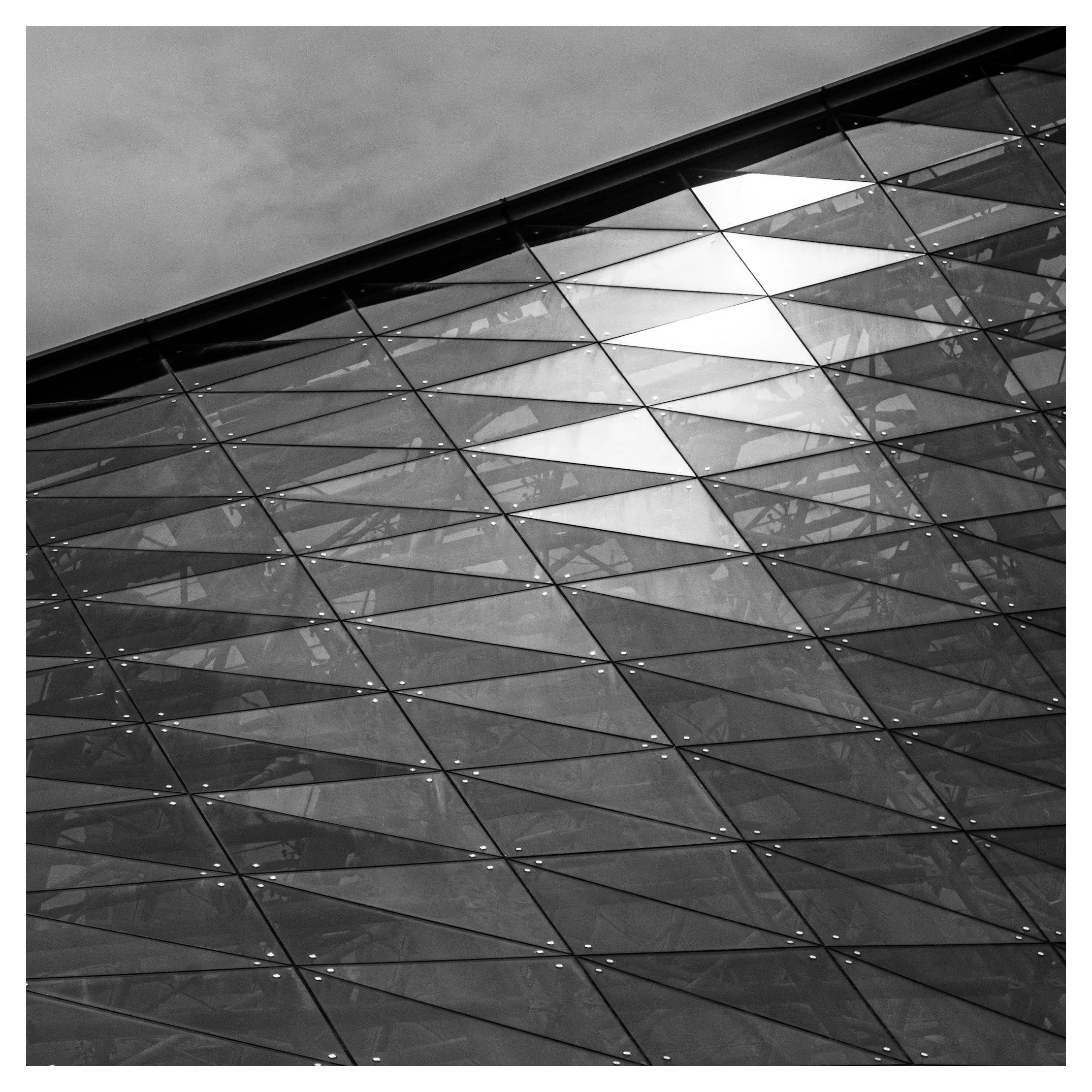
Triangular glass panels tile the canopy of Kaohsiung’s most beloved MRT station, sunlight catching a bright shard among a field of gray. A tight, black-and-white study in grid, geometry, and the abstraction hiding in a building most people only see from below.
Camera Model: Leica D-Lux 8
Shutter Speed: 1/1600 sec
Aperture: f/8
ISO: 200
The Critique
This photograph belongs to a lineage of architectural abstraction that treats a building’s surface not as something to document in its entirety, but as a field of pure form worth isolating and studying on its own terms. Cropped tight enough that the roof’s actual shape and context disappear entirely, the frame reduces Formosa Boulevard Station’s dramatic canopy — the shell-like glass structure whose curved form is said to evoke two hands clasped in prayer, a quiet nod to the Formosa Incident this station and boulevard commemorate — into a repeating grid of triangular glass panels, each one riveted at its corners, catching and reflecting light differently depending on its angle to the sun.
This kind of close, grid-focused abstraction is territory Thomas Ruff has explored across decades of architectural work, studying under Bernd Becher and internalizing his teacher’s core lesson: when working with a medium, you should reflect the medium in the work itself. Ruff’s own architectural photographs strip buildings down to geometric abstraction, becoming nothing more than façade — surface without depth, in service of studying the underlying pattern rather than the building’s function or context. This frame does something similar: it isn’t really “about” the MRT station as a place people move through; it’s about the diamond lattice of triangles the roof’s structural glazing creates, and how differently each panel behaves under the same light.
That variation is the photograph’s real subject. Most of the frame reads as a consistent, mid-gray field of glass reflecting the steel understructure beneath, but a cluster of panels near the top catches direct sun and blows into near-pure white triangles, creating a bright, jagged shape that reads almost like a lightning bolt cutting diagonally across the grid. That contrast between the uniform, repetitive triangulation and the singular bright disruption gives the composition real visual tension — order versus a moment of exception within it.
The tight diagonal framing, with the roof’s dark structural edge cutting cleanly across the upper left corner against open sky, adds a further layer of geometric rigor. Where the image could be pushed further is in the transition zone between the brightest panels and the surrounding mid-tones — it’s slightly abrupt, and a touch more graduated exposure control might have preserved a bit more detail in the panels immediately adjacent to the brightest cluster.
How This Image Could Be Improved
• Consider a touch of highlight recovery in the panels bordering the brightest cluster, to smooth the transition between blown highlights and the surrounding mid-tone grid.
• Explore the same canopy from multiple angles at different times of day. The bright triangular highlight here is a product of a specific sun angle; returning at other hours would likely produce entirely different patterns of light and shadow across the same grid.
• Try an even tighter crop on just the bright cluster and its immediate surroundings, to see whether isolating that specific disruption further intensifies the graphic tension.
Becoming a Better Photographer Over Time
• Study your local landmark buildings for abstraction opportunities, not just full establishing shots. A building most people photograph in its entirety, like Formosa Boulevard’s famous Dome of Light inside, may have equally compelling abstract details on its exterior that go unnoticed.
• Practice isolating pattern from context deliberately. Log which of your architectural images work better as full documentation versus tight, decontextualized abstraction, and build intentional control over that choice.
• Learn the story behind buildings you return to. Knowing the canopy’s symbolic “praying hands” reference and its connection to the Formosa Incident adds meaning that could inform future compositions of the same structure.
Photographers to Study
• Thomas Ruff — for his rigorous, Becher-trained approach to reducing architecture to grid and surface abstraction.
• Bernd and Hilla Becher — for the foundational typological discipline underlying this entire tradition of architectural pattern study.
• Hélène Binet — for her poetic use of light and shadow to reveal architectural structure.
• Filip Dujardin — for his surreal, formally inventive treatment of architectural form.
• Roland Halbe — for his precise, internationally recognized documentation of contemporary architectural surfaces.
Books Worth Reading
• Thomas Ruff: l.m.v.d.r.
• Bernd and Hilla Becher: Typologies of Industrial Buildings
• Hélène Binet: Composing Space
• Filip Dujardin: Fictions
• Roland Halbe: Architectural Photography Portfolio
Videos Worth Watching
• “Interview with Thomas Ruff” — Ruff discussing his career-long dissection of photography’s genres, including architecture, directly relevant to this frame’s approach.
• “Meet the photographer | Thomas Ruff” — further insight into his process of manipulating and abstracting architectural imagery.
• Ted Forbes, The Art of Photography channel — for broader historical grounding in the Düsseldorf School and architectural abstraction tradition Ruff emerged from.