

Day 301/365 Empty Stools: A Study in Solitary Symmetry
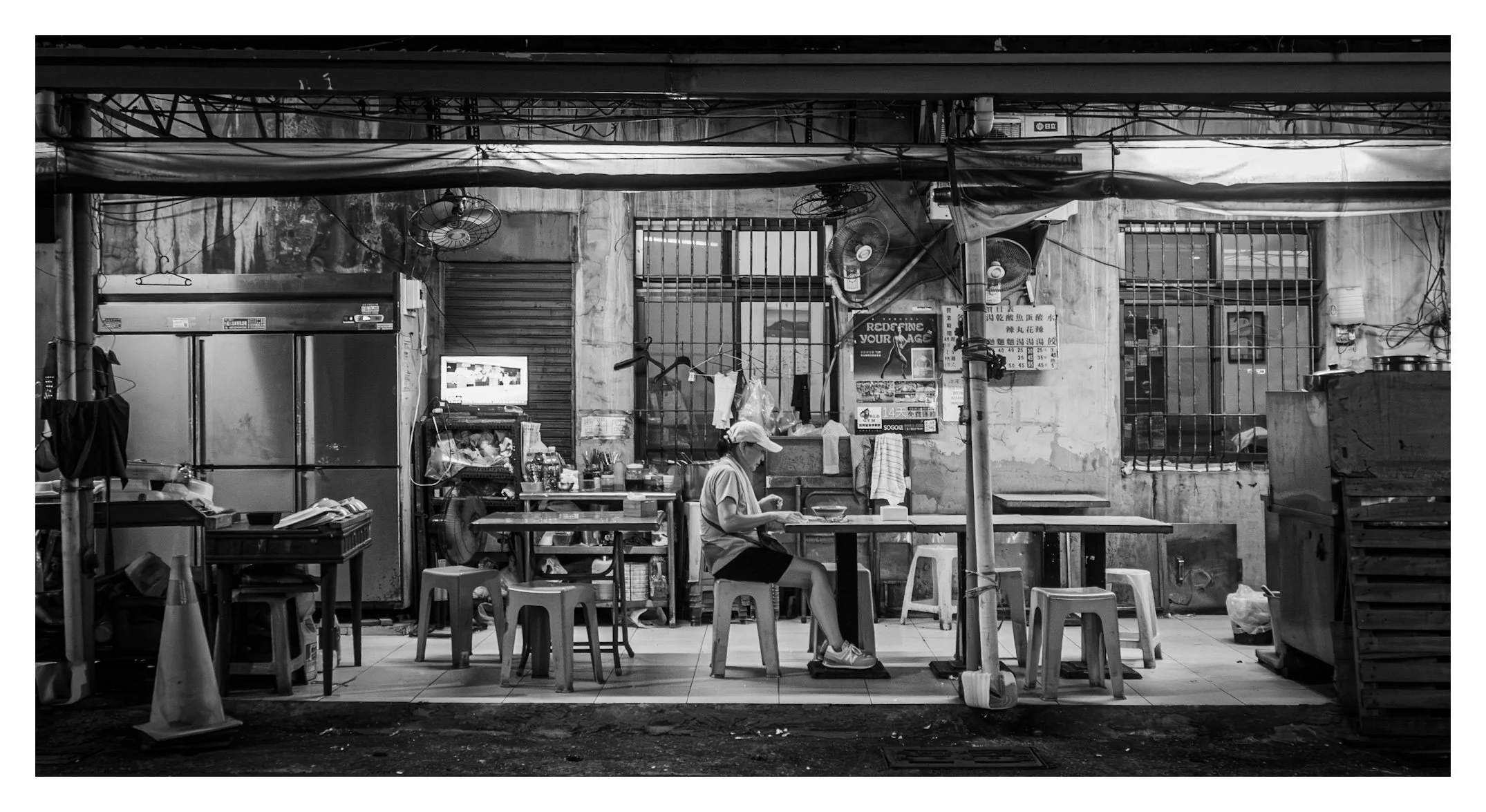
A single figure sits eating alone amid a symmetrical field of empty plastic stools, the cluttered machinery of a street kitchen framing her on every side. A quiet, cinematic study in solitude, stillness, and the strange emptiness that settles over a public space between rushes.
Camera Model: Leica D-Lux 8
Shutter Speed: 1/125 sec
Aperture: f/2.1
ISO: 3200
The Critique
This photograph captures a genuinely striking piece of urban solitude, and it does so through a compositional strategy that Gregory Crewdson has spent decades refining: the isolated figure surrounded by carefully arranged, mundane domestic and commercial detail, everything precisely placed even when the scene itself is unstaged. Crewdson’s photographs of suburban America are often filled with a sense of isolation, and are frequently discussed in conversation with Edward Hopper’s paintings of solitary figures in American diners and interiors — this frame belongs firmly in that same visual and emotional territory, even though it’s an unposed street photograph rather than an elaborately constructed set.
The symmetry is doing enormous work. A single woman sits at roughly the center of the frame, eating alone at a plastic table, surrounded by row upon row of empty stools stretching in both directions — perhaps a dozen or more visible seats, all unoccupied. That emptiness isn’t incidental; it’s the entire emotional register of the image. A crowded version of this same eatery would read as lively and communal; this nearly-vacant version, caught at whatever hour left her alone here, reads as contemplative, even melancholic, in exactly the way Crewdson describes his own work exploring moments of disconnect and figures isolated and inaccessible, both to each other and to the viewer.
The environmental detail surrounding her — the looming stainless steel refrigerator, tangled overhead wiring, barred windows, a small television glowing in the middle distance, hanging clothes, a gym advertisement poster — builds a genuinely rich sense of place without ever competing for the emotional center of the frame, which remains firmly on the solitary seated figure. The black-and-white treatment and the high ISO grain lend the whole scene a slightly rough, immediate texture that suits its documentary honesty; this wasn’t lit or arranged, but the result still achieves something of that cinematic, suspended-moment quality Crewdson builds through elaborate staging.
Technically, the wide, almost panoramic aspect ratio does real work reinforcing the emptiness — there’s simply more visible unoccupied space on either side of the man than a standard frame would allow, which intensifies the sense of solitude. Where the image could be pushed further is in the left third of the frame, which carries a fair amount of visual clutter (traffic cone, stacked equipment) that, while authentic, pulls slightly against the more contemplative right two-thirds where the seated figure and empty stools dominate.
How This Image Could Be Improved
• Consider whether a slightly tighter crop on the left could sharpen the emotional focus. The cluttered equipment there is documentary-honest but competes somewhat with the more powerful emptiness on the right.
• Watch noise levels at ISO 3200 in the darkest shadow zones. A touch of targeted noise reduction in the deepest blacks could clean up the image without sacrificing the grain that suits the overall mood.
• Return to the same location at a different hour. A version of this frame during a busy dinner rush, with every stool occupied, would make a compelling companion piece, showing the same space transformed entirely by human presence.
Becoming a Better Photographer Over Time
• Study how emptiness itself can be a compositional subject. Log which of your strongest images use negative space or absence (empty seats, empty rooms, empty streets) to create emotional weight, and practice seeking out these moments deliberately.
• Learn from staged photographers even when working purely documentary. Crewdson’s obsessive attention to environmental detail, even though his scenes are elaborately constructed, offers real lessons in how surrounding clutter can support rather than distract from a central figure.
• Practice wide aspect ratio framing for isolation subjects. A wider frame, as used here, can amplify a sense of solitude in ways a standard crop cannot — build this into your compositional toolkit deliberately.
Photographers to Study
• Gregory Crewdson — for his sustained, decades-long exploration of solitude and isolation within ordinary environments, and his acknowledged conversation with Edward Hopper’s visual language.
• Todd Hido — for his atmospheric, often solitary treatment of interior and exterior night scenes.
• Luigi Ghirri — for his quiet, deadpan documentation of empty and near-empty everyday spaces.
• Bill Owens — for his observational documentation of ordinary domestic and communal American life.
• Ed Ruscha — for his flat, catalog-like documentation of vernacular commercial architecture and space.
Books Worth Reading
• Twilight by Gregory Crewdson
• Cathedral of the Pines by Gregory Crewdson
• Todd Hido: House Hunting
• Luigi Ghirri: Kodachrome
• Bill Owens: Suburbia
Videos Worth Watching
• “Gregory Crewdson - photographs from his inner world” — a direct look at Crewdson’s search for mystery and stillness within ordinary, everyday settings.
• “There But Not There: Gregory Crewdson Documentary” — behind-the-scenes insight into how he constructs his isolated, contemplative scenes.
• Ted Forbes, The Art of Photography channel — for further context on the Hopper-Crewdson lineage of American solitude in visual art.