

Day 302/365 The Tire Stack: A Study in Circles Within Circles
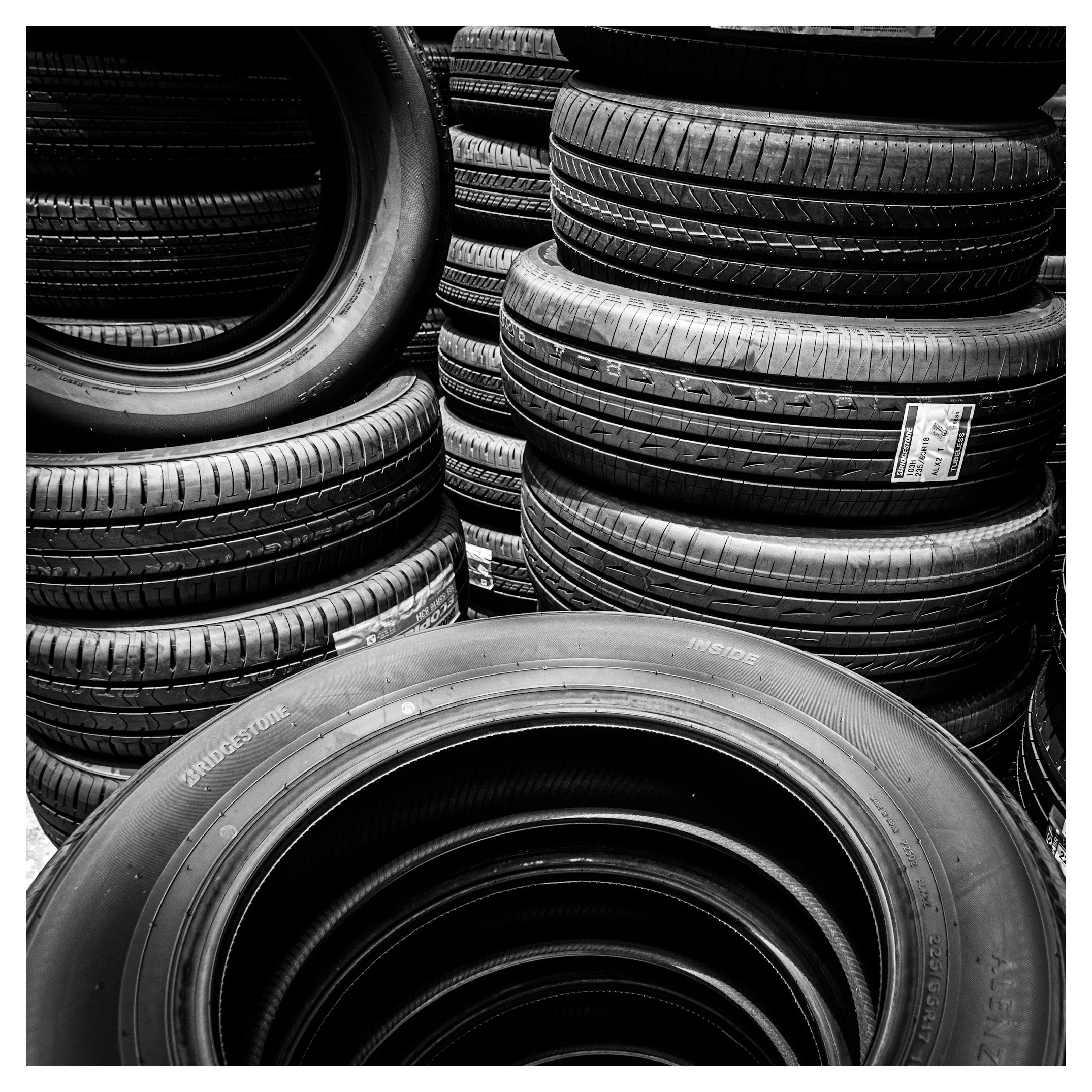
Dozens of tires, stacked and leaning against each other, form a dense field of overlapping black rings. A tight, high-contrast study in repetition, curvature, and the strange sculptural beauty found in an ordinary tire yard.
Camera Model: Leica D-Lux 8
Shutter Speed: 1/250 sec
Aperture: f/3.2
ISO: 200
The Critique
This photograph belongs to a tradition of finding pure abstraction within completely mundane, functional subject matter — the same instinct that drove Aaron Siskind to spend decades photographing close-up, abstract compositions of everyday objects and urban scenes, transforming the ordinary into the extraordinary. Siskind began his career as a social documentary photographer with the Photo League before turning entirely toward texture, line, and the arrangement of objects within the picture plane, eventually finding an unlikely kinship with Abstract Expressionist painters like Franz Kline, who recognized in his photographs the same concerns with flatness and form that occupied their own canvases. This image of stacked tires works in exactly that register — it isn’t really “about” tires as functional objects; it’s about the dense, overlapping rhythm of circles their stacking creates.
The composition’s real achievement is compositional density without visual confusion. Dozens of individual tire treads, sidewalls, and shadowed interiors overlap and interlock across the frame, yet the eye can still trace individual forms — the large Bridgestone tire dominating the foreground, its “INSIDE” marking legible, versus the tighter, more compressed stacks receding into the middle and background. That balance between chaos and legibility is genuinely hard to achieve and is the mark of a well-composed abstract frame rather than an accidental jumble.
Black and white does essential work here, stripping away what would otherwise be a fairly monochromatic subject already (most tires are black regardless of brand) and instead emphasizing the rich tonal range within that apparent sameness — the deep, nearly pure black of shadowed tire interiors against the lighter gray of tread patterns catching directional light. That tonal variation, rather than color, becomes the actual visual interest of the frame, exactly the kind of formal concern Siskind pursued when he described his subject matter as “a series of echoing forms, lines, and textures.”
Where the image could be pushed further is in the upper right corner, where a fragment of a tire and some background clutter feel slightly less resolved than the rest of the tightly composed frame — a small crop adjustment might tidy that corner without sacrificing the density that makes the rest of the composition work.
How This Image Could Be Improved
• Consider a small crop adjustment in the upper right, where the framing feels slightly less deliberate than the rest of the composition.
• Watch for even more extreme close-ups as a companion series. This frame works at a mid-distance that balances individual tire legibility with overall pattern; a tighter crop isolating just the tread textures could push the abstraction even further.
• Try varying light conditions on repeat visits. Directional sun, as used here, creates the tonal separation between treads and shadows; overcast light would likely flatten this same subject considerably, worth testing for comparison.
Becoming a Better Photographer Over Time
• Practice finding abstraction in explicitly non-art subject matter. Siskind’s career-defining insight was that any surface or arrangement of objects, however mundane, could be treated as pure form — actively seek out industrial and commercial subjects (tire yards, scrap piles, stacked materials) with this mindset.
• Study tonal separation as the primary tool in monochromatic subjects. When color isn’t available to create contrast, as with black tires, light direction and exposure become the entire visual language — practice deliberately.
• Build comfort with density and repetition. Log which of your abstract images successfully balance visual chaos with underlying legibility, and refine your instinct for how much repetition a composition can hold before it becomes genuinely confusing.
Photographers to Study
• Aaron Siskind — the essential reference for finding abstract, texturally rich compositions within completely ordinary urban and industrial subject matter.
• Brett Weston — for his disciplined, high-contrast treatment of natural and man-made textures and patterns.
• Edward Weston — for his sculptural, formally rigorous approach to organic and manufactured circular forms.
• Wynn Bullock — for his meditative, tonally rich engagement with abstract natural and industrial subjects.
• Imogen Cunningham — for her close, pattern-focused studies of botanical and manufactured forms alike.
Books Worth Reading
• Aaron Siskind: Photographs
• Brett Weston: Voyage of the Eye
• Edward Weston: The Daybooks
• Wynn Bullock: The Enchanted Landscape
• Imogen Cunningham: A Portrait
Videos Worth Watching
• “Photographer Aaron Siskind and Painter Franz Kline” — a direct exploration of Siskind’s abstraction technique and his connection to Abstract Expressionist painting, essential context for this frame’s approach.
• Ted Forbes, The Art of Photography channel — for broader historical grounding in mid-century American abstract photography.
• Sean Tucker’s channel — his videos on finding compositional order within visual complexity apply well to dense, pattern-heavy subjects like this one.