

Day 303/365 The City Dissolving: A Study in Fog and Distance
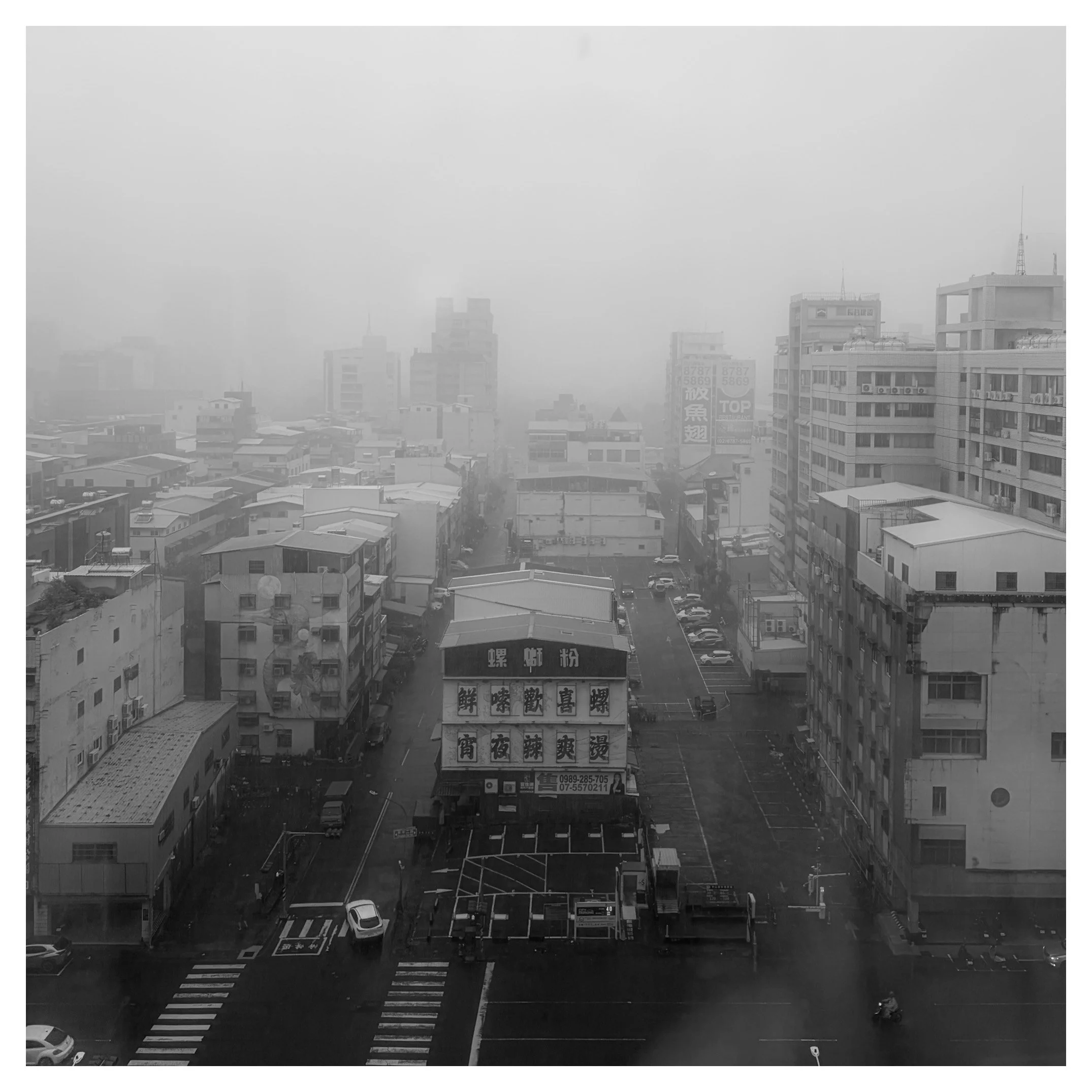
Kaohsiung disappears into layers of mist, its buildings fading from sharp foreground detail into pale, ghostly silhouette. A black-and-white study in atmospheric perspective, scale, and the strange calm a fogged-in city takes on from above.
Camera Model: Apple iPhone 17
Shutter Speed: 1/120 sec
Aperture: f/1.6
ISO: 100
The Critique
This photograph works entirely through atmospheric perspective — the optical phenomenon where distant objects lose contrast and detail as they recede through haze, a principle painters have exploited for centuries and that photography, at its best, can capture even more convincingly. From this elevated vantage, Kaohsiung’s rooftops and buildings stack back through the frame in a graduated sequence: sharply defined signage and structure in the foreground, softening steadily through the middle distance, until the farthest towers dissolve almost entirely into the pale gray of the fog itself, their outlines barely legible.
There’s a genuine and worthwhile connection here to Lang Jingshan, born in 1892 and later based in Taipei until his death in 1995, widely regarded as the most prominent figure in the history of Chinese art photography and even called the “Father of Asian Photography.” Lang developed a signature style of misty landscapes rendered in the visual language of traditional Chinese ink painting, and while his method involved elaborate composite printing techniques rather than a single documentary frame, the underlying aesthetic sensibility — distant peaks and structures dissolving into soft, atmospheric void, foreground detail anchoring an otherwise dreamlike scene — is precisely what this photograph achieves through pure environmental luck and a well-chosen high vantage point. It’s a genuinely Taiwanese photographic tradition this image quietly participates in, whether intentionally or not.
The composition’s structure rewards close looking: a building bearing large Chinese characters advertising night-market food sits at the frame’s near-center, acting as an anchor of legible, solid detail against the increasingly abstracted city beyond. The empty, rain-slicked streets and near-total absence of pedestrians reinforce the sense of a city paused, holding still under weather rather than moving through it. That stillness, combined with the soft tonal gradient of the fog, gives the whole image a contemplative, almost meditative quality — appropriate to a day spent staying in rather than out shooting in it.
Where the composition is strongest is in its sheer patience with gray — nothing in this frame reaches for pure black or pure white; the whole tonal range sits in a narrow, quiet band of mid-grays that suits the subject perfectly. If there’s a place to push further, it’s in the very brightest sky area at the top, which risks reading as slightly featureless; a touch of texture or cloud variation there, if the actual conditions allowed it, would round out the graduated tonal journey even more completely.
How This Image Could Be Improved
• Watch the sky’s tonal flatness at the very top. It’s appropriately pale given the fog, but a touch of textural variation, if present in the original scene, would extend the atmospheric gradient even further.
• Consider a version with a slightly lower horizon line, giving more weight to the layered rooftops and less to the more featureless upper sky.
• Return to this vantage point on a clear day. A companion image from the identical position under full visibility would make a striking before-and-after pairing, showing exactly how much the fog is doing to transform the scene.
Becoming a Better Photographer Over Time
• Study atmospheric perspective as a deliberate compositional tool, not just a weather condition to work around. Log which of your foggy or hazy images successfully use that graduated loss of detail to create depth, and seek out these conditions actively rather than only shooting in clear weather.
• Learn from painting traditions, not just photographic ones. Lang Jingshan’s explicit borrowing from Chinese ink painting composition is a reminder that photographic ideas about mist, void, and negative space have deep roots outside the medium itself.
• Build a personal archive of elevated vantage points in your city. A view like this depends entirely on having access to height; identifying and returning to reliable high vantage points across different weather conditions is a long-term investment worth making.
Photographers to Study
• Lang Jingshan — for his foundational, deeply Taiwan-connected tradition of misty, atmospheric composite photography rooted in Chinese painting aesthetics.
• Michael Kenna — for his meditative, high-contrast treatment of fog, mist, and minimal atmospheric landscapes.
• Sohei Nishino — for his large-scale, panoramic engagement with Asian cityscapes and urban atmosphere.
• Alfred Stieglitz — for his Equivalents series exploring cloud and atmosphere as pure abstract form.
• Elger Esser — for his large-format, muted, atmospheric treatment of landscape and cityscape.
Books Worth Reading
• Lang Jingshan: A Retrospective
• Michael Kenna: A Twenty Year Retrospective
• Sohei Nishino: Diorama Maps
• Alfred Stieglitz: The Key Set
• Elger Esser: Retrospective
Videos Worth Watching
• Smarthistory’s overview of Lang Jingshan and early Chinese photography — a solid grounding in the composite, misty landscape tradition this frame echoes.
• Ted Forbes, The Art of Photography channel — for broader historical context on atmospheric and pictorialist photography traditions.
• Sean Tucker’s channel — his videos on patience and mood-driven photography apply well to quiet, fog-bound scenes like this one.