

Day 304/365 Made in Taiwan: A Still Life on Weathered Wood
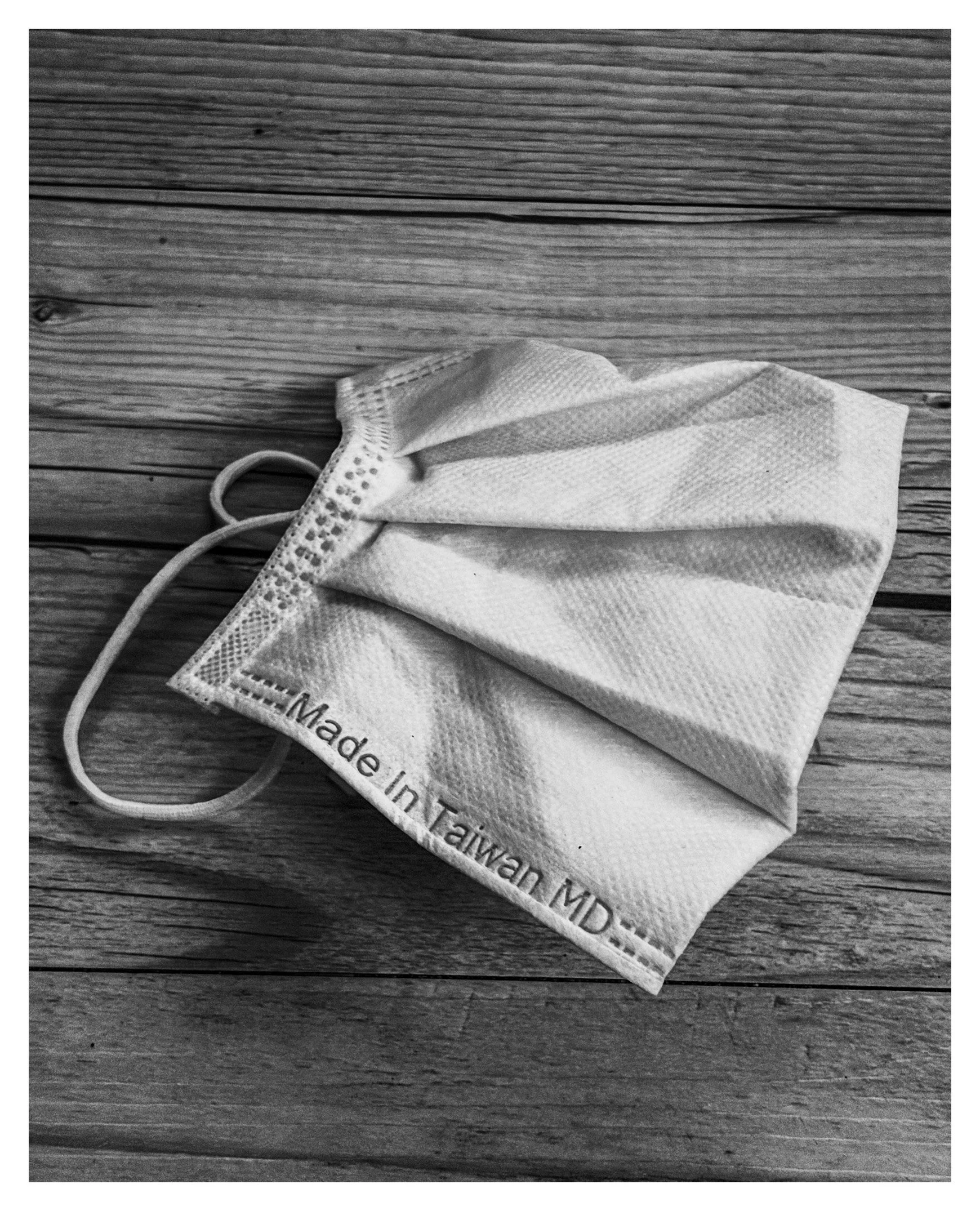
A single face mask lies folded and forgotten on a plank of rough wood, its printed origin catching the light. A quiet, textural still life turning one of the era’s most ordinary objects into something worth actually looking at.
Camera Model: Apple iPhone 17
Shutter Speed: 1/30 sec
Aperture: f/1.6
ISO: 400
The Critique
This photograph takes an object so common it’s become almost invisible — a disposable face mask — and gives it the patient formal treatment usually reserved for far more deliberately chosen still life subjects. There’s real skill in that decision. Rustic still life photography captures the beauty of everyday objects, highlighting their textures and stories, evoking a deeper connection to the ordinary things surrounding us, and this frame does exactly that: the mask’s soft, pleated fabric, printed “Made In Taiwan MD” text, and looped elastic ear straps become genuinely interesting formal elements once photographed this closely and this deliberately, rather than glanced at on a bathroom counter.
The wood-grain background is doing significant compositional work. Weathered wood, vintage tools, and everyday objects transform into art specifically through the interplay of texture, and this frame leans fully into that principle — the horizontal lines of the wood planks running perpendicular to the mask’s diagonal placement create a strong compositional tension, while the wood’s own rough, striated texture provides a rich tonal counterpoint to the mask’s smoother, pleated fabric surface.
There’s a genuine conceptual kinship here with Uta Barth’s decades-long investigation into how photography can redirect attention toward the incidental, the ordinary, and the insignificant information that surrounds us but that we pass by without noticing every day. Barth’s own work rarely treats a subject as dramatic; instead, she asks what happens when the camera lingers on something the eye would normally skip past entirely. A folded mask, photographed with real formal care under soft directional light, participates in exactly that gesture — elevating an object whose entire cultural meaning is built on disposability and unremarkableness into something the viewer is asked to actually examine.
The soft, raking light catching the mask’s pleats creates a nice rhythm of highlight and shadow across the fabric’s folds, giving real three-dimensional form to what would otherwise be a fairly flat subject. The black-and-white treatment strips away any distracting color association (the mask is likely white or pale blue in reality) and instead emphasizes pure tonal and textural relationship between fabric and wood. Where the image could be pushed further is in the depth of field — at this close working distance and wide aperture, only a narrow band of the mask holds full sharpness, and the “Made In Taiwan MD” text, while legible, sits slightly outside the sharpest plane.
How This Image Could Be Improved
• Consider stopping down slightly to bring the printed text into fuller sharpness, since it’s a genuinely interesting narrative detail worth preserving crisply.
• Watch the mask’s ear loops at the left edge. They add useful visual interest but risk feeling slightly disconnected from the main pleated form; a small compositional adjustment could integrate them more fully.
• Explore the same object against a different, less busy surface. The wood grain works well here, but a smoother or more neutral background could isolate the mask’s own texture even more completely as a companion image.
Becoming a Better Photographer Over Time
• Practice finding significance in genuinely disposable, overlooked objects. This is a harder discipline than photographing inherently beautiful things — log which everyday objects around you could sustain this kind of formal attention, and build a habit of noticing them.
• Study directional light on soft fabric surfaces specifically. The pleats here catch light in a way that reveals form; practice this lighting approach deliberately across other soft-textured subjects.
• Learn from photographers who treat “looking” itself as the subject. Uta Barth’s career-long question — what happens if the camera holds still on something ordinary — is worth returning to whenever you’re tempted to dismiss a subject as too mundane to photograph.
Photographers to Study
• Uta Barth — for her sustained investigation into perception and the incidental, redirecting attention toward things normally passed by unnoticed.
• Emmet Gowin — for his tender, textural treatment of everyday objects and domestic subjects.
• Olivia Parker — for her inventive, texturally rich still life work built from ordinary materials.
• Wolfgang Tillmans — for his democratic, documentary approach to everyday objects and intimate detail.
• Roni Horn — for her conceptual, repetition-driven engagement with ordinary objects as carriers of larger meaning.
Books Worth Reading
• Uta Barth: Peripheral Vision
• Emmet Gowin: Mysteries of the Rectangle
• Olivia Parker: Signs of Life
• Wolfgang Tillmans: If One Thing Matters, Everything Matters
• Roni Horn: Still Water
Videos Worth Watching
• “Uta Barth’s Atmospheric Photographs” — a direct look at her philosophy of finding significance in ordinary, easily overlooked subjects, directly relevant to this frame’s approach.
• Rustic still life technique guides on texture and directional light — practical grounding in exactly the wood-and-fabric approach used here.
• Ted Forbes, The Art of Photography channel — for broader historical context on still life’s long tradition of elevating humble, everyday objects.