

Day 308/365 Wind Against Nylon: The Rain Man’s Battle
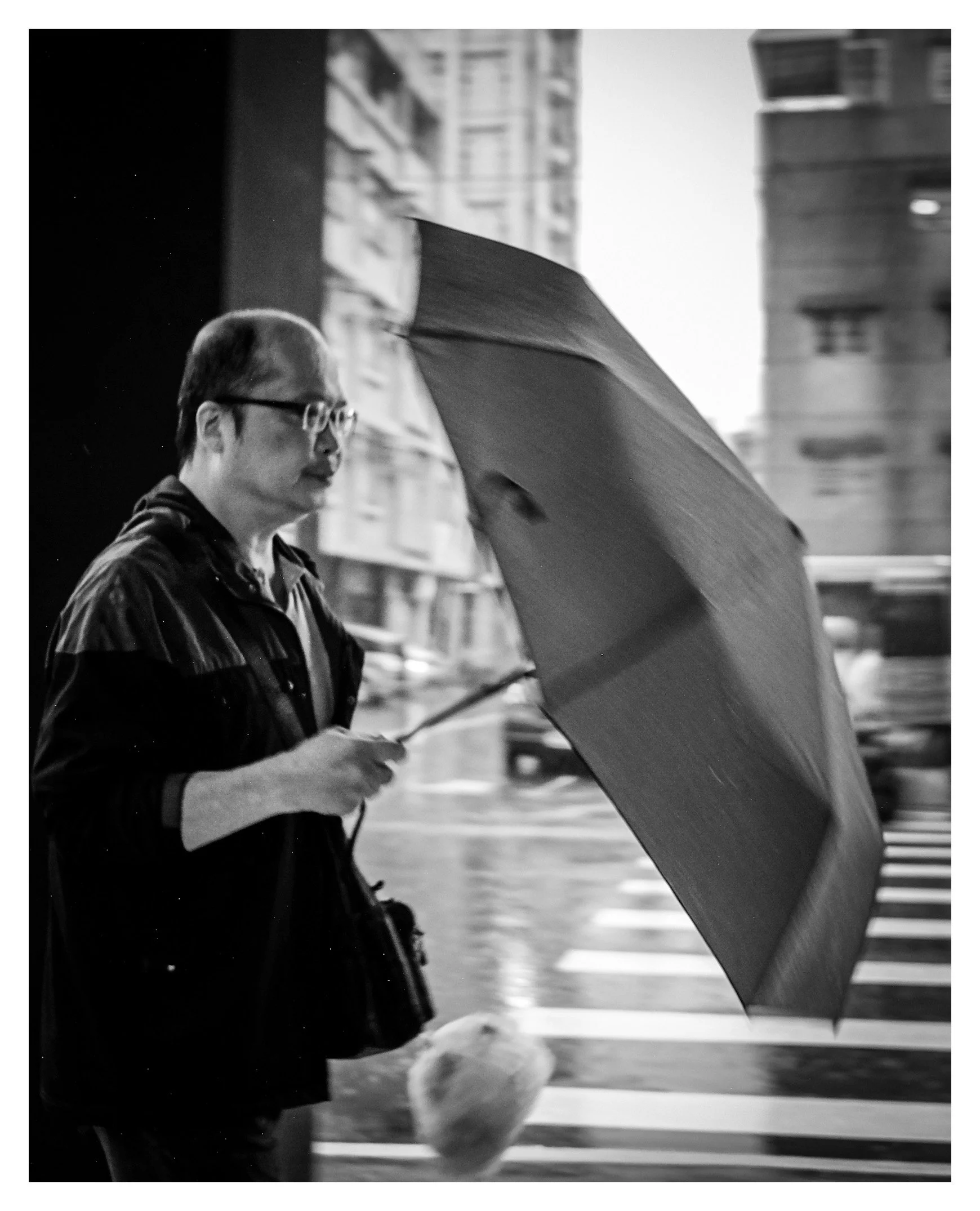
A man braces against the wind, his umbrella caught mid-flex, motion blurring the crosswalk and buildings around him into streaks. A dynamic black-and-white study in resistance, weather, and the small daily struggle of staying dry.
Camera Model: Fujifilm X-Pro2
Lens: XF23mmF2 R WR
Shutter Speed: 1/40 sec
Aperture: f/2.5
ISO: 640
The Critique
This photograph belongs to the tradition of humanist street photography that treats a stranger’s small, ordinary struggle — here, simply keeping an umbrella upright against the wind — as worthy of genuine visual drama. Sabine Weiss, one of the last surviving photographers of the postwar humanist movement, spent seven decades photographing exactly this kind of unguarded human moment on the streets of Paris and beyond, refusing even to call herself an artist while producing some of the most quietly powerful documentary images of the 20th century. This frame, catching a man mid-battle with his umbrella at a rain-slicked crosswalk, shares that same instinct: find the drama already present in ordinary weather and ordinary people, rather than manufacturing it.
The umbrella itself is the compositional centerpiece, its fabric caught with just enough motion blur to convey real force — you can see it flexing, straining against wind pressure, on the verge of inverting. That controlled blur, combined with the sharp focus held on the man’s face and hands, creates a satisfying technical balance: enough movement to feel the wind, enough stillness to read his expression clearly. His slightly furrowed brow and forward-leaning posture tell the whole story without needing any additional context — this is a person actively fighting the elements, not merely standing in rain.
The background does important supporting work too. The buildings on either side, softly blurred by the same slow shutter speed that captured the umbrella’s motion, create a sense of enveloping urban space without pulling focus from the central figure. The wet crosswalk stripes reflecting available light in the lower portion of the frame add a nice secondary texture, grounding the scene specifically in a street environment rather than an ambiguous outdoor space.
Black and white, once again, is the right call — it strips away what would otherwise be a fairly muted, gray-toned rainy scene in color and instead emphasizes the tonal drama between the man’s dark raincoat, his pale umbrella catching available light, and the softly blurred cityscape behind him. Where the image could be pushed further is in the framing at the very right edge, where the umbrella’s tip approaches the boundary somewhat tightly — a touch more room on that side would let its full extended shape breathe within the frame.
How This Image Could Be Improved
• Give the umbrella’s tip a bit more room on the right edge. It currently sits close to the frame boundary; a slightly wider capture would let its full shape read without feeling cramped.
• Consider a burst of frames around this moment. Wind-battled umbrellas move unpredictably — several consecutive frames would offer more options for exactly how much flex and motion blur best serves the composition.
• Watch focus precision on the face at this shutter speed. It’s sharp here, which is the hard part done well, but at 1/40s handheld, a few backup frames insure against any inadvertent softness.
Becoming a Better Photographer Over Time
• Seek out weather as a source of genuine human drama. Sabine Weiss and countless humanist photographers before her found some of their strongest work simply by watching how ordinary people respond to difficult conditions — wind, rain, cold, heat.
• Practice balancing selective motion blur with a sharp anchor point. This technique — background and secondary elements blurred, primary subject’s face and hands sharp — is a skill worth isolating and practicing deliberately across different subjects.
• Build a personal “weather portraits” project. A sustained series specifically documenting how people navigate difficult conditions on the street could become a genuinely compelling long-term body of work, especially given how much rain this city gets.
Photographers to Study
• Sabine Weiss — for her decades-long humanist tradition of finding genuine drama in ordinary street moments.
• Ara Güler — for his richly atmospheric documentation of Istanbul’s streets, weather, and daily life.
• Ihei Kimura — for his warm, observational documentation of postwar Japanese street life.
• Nikos Economopoulos — for his dynamic, high-contrast treatment of street scenes and human movement.
• Constantine Manos — for his bold use of color and gesture in capturing everyday human struggle and grace.
Books Worth Reading
• Sabine Weiss: Photographs
• Ara Güler’s Istanbul
• Kimura Ihei’s Tokyo
• In the Balkans by Nikos Economopoulos
• American Color by Constantine Manos
Videos Worth Watching
• “The Last Humanist Photographer | Sabine Weiss” — a strong introduction to the humanist tradition this image belongs to.
• “SABINE WEISS | ONE CENTURY OF PHOTOGRAPHY” — a fuller documentary on her career and approach to street observation.
• “The Eye of Istanbul: Ara Güler” — further context on finding drama and atmosphere in ordinary street weather and daily life.