

Day 309/365 Mirrored Harbor: The 85 Tower and the Cruise Terminal, Doubled
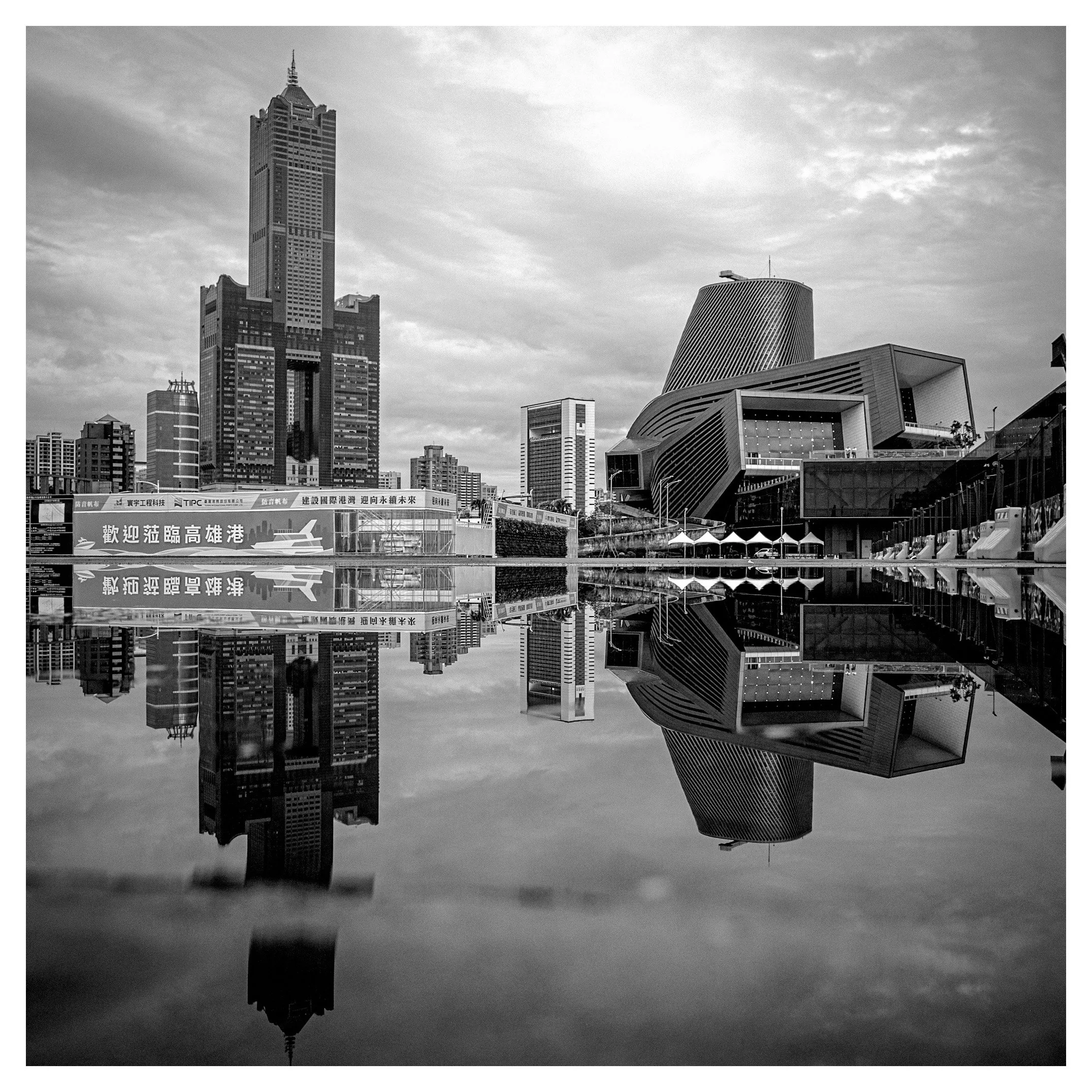
Kaohsiung’s skyline splits perfectly along a still waterline, the 85 Sky Tower and the sculptural Port Cruise Terminal reflected in flawless symmetry. A black-and-white study in architecture, stillness, and the rare gift of water this calm.
Camera Model: Ricoh GR III
Shutter Speed: 1/320 sec
Aperture: f/8
ISO: 500
The Critique
This photograph captures two of Kaohsiung’s most distinctive landmarks in a single frame — the 85 Sky Tower rising on the left, its split, character-inspired crown unmistakable, and the Kaohsiung Port Cruise Terminal on the right, its sweeping, silver-white curved form designed by RUR Architecture to evoke a ship’s hull and chimney, rising above a public plaza as part of the city’s Asia New Bay Area redevelopment. Both buildings are doubled here with near-perfect fidelity in a still reflective surface, splitting the frame into an almost seamless upper and lower half.
David Burdeny, whose architectural photography consistently treats symmetry, reflection, and stillness as vehicles for something closer to mystery than mere documentation, has spoken about seeking the sublime residing even in an ordinary space, using long exposures and careful compositional patience to transform familiar subjects into something that asks the viewer to keep looking. This image achieves a related effect through pure environmental luck and technical readiness — a genuinely flat, mirror-still body of water, rare enough that it demands recognition and immediate use when found.
The signage banner reading “歡迎蒞臨高雄港” (“Welcome to Kaohsiung Port”) running through the middle distance grounds the image firmly in its specific civic context — this isn’t an abstract architectural study, but a real, functioning gateway to the city, doubled by reflection into a kind of ceremonial threshold. The cloudy, dramatic sky above adds real atmospheric weight, its soft gradations of gray providing a quiet, painterly backdrop against which both towers’ hard architectural lines stand out clearly.
Compositionally, the choice to center the waterline almost exactly in the middle of the frame is the strongest possible decision for this subject — pure ninety-degree symmetry, upper and lower halves mirroring each other with only the banner’s construction fencing at the horizon line to mark where reality ends and reflection begins. The wide-angle lens exaggerates the tower’s height dramatically, adding a sense of monumental scale that a longer lens would have flattened. Where the image could be pushed further is in the very slight softness at the reflection’s furthest edges — the water isn’t perfectly glassy at every point, and a few ripples introduce minor distortion in the lower register that a marginally different vantage point might have avoided.
How This Image Could Be Improved
• Scout for the stillest possible water before committing to the shot. A few small ripples at the frame edges slightly soften the reflection’s perfection; even a few minutes’ wait, or a different spot along the water’s edge, can make a meaningful difference.
• Consider the banner’s role more deliberately. It’s a nice grounding detail, but its bright color-block design (even in black and white, its tonal weight) pulls some attention; a version that either emphasizes or minimizes it more intentionally could sharpen the composition’s hierarchy.
• Try this same vantage point at dawn. Early morning typically offers the stillest water, per most reflection photography guidance, and would likely produce an even more flawless mirror than this frame achieved.
Becoming a Better Photographer Over Time
• Learn to recognize and move quickly on rare still-water conditions. Perfect reflections are fleeting — wind picks up, boats pass, people disturb the surface. Building the habit of reacting fast when you spot ideal conditions is a genuinely trainable skill.
• Study your city’s landmark buildings’ design stories. Knowing that the 85 Tower’s silhouette references a Chinese character, and that the Cruise Terminal’s curved form is meant to evoke a ship’s hull, adds intentionality to how you frame future compositions of both.
• Practice centering the horizon deliberately for symmetry work, rather than defaulting to rule-of-thirds placement — reflection photography is one of the few genres where dead-center framing is often the stronger choice.
Photographers to Study
• David Burdeny — for his patient, symmetry-driven architectural photography that treats reflection and stillness as tools for finding mystery in familiar places.
• Hengki Koentjoro — for his minimalist, long-exposure black-and-white treatment of water and architecture.
• Akos Major — for his meditative, atmospheric approach to landscape and structure reflected in still water.
• Francesco Gola — for his technically precise long-exposure architectural and coastal reflection work.
• Rui Palha — for his high-contrast black-and-white urban photography, often incorporating reflective surfaces.
Books Worth Reading
• David Burdeny: Salt Water and his broader architectural photography portfolios
• Hengki Koentjoro portfolio collections
• Akos Major: Silence
• Francesco Gola photography monographs
• Rui Palha: Street Photography
Videos Worth Watching
• “Cityscape Water Reflection Tutorial” — a quick, practical technique for finding and using mirror-like reflections in urban photography.
• “Puddle Reflection Photography | Understanding The Basics” — solid grounding in the fundamentals of the technique used in this frame.
• “HOW to do REFLECTION PHOTOGRAPHY for BEGINNERS Street puddles” — further practical guidance for finding and composing reflective street and waterfront scenes.