

Day 310/365 The Divine Pig: A Study in Offering
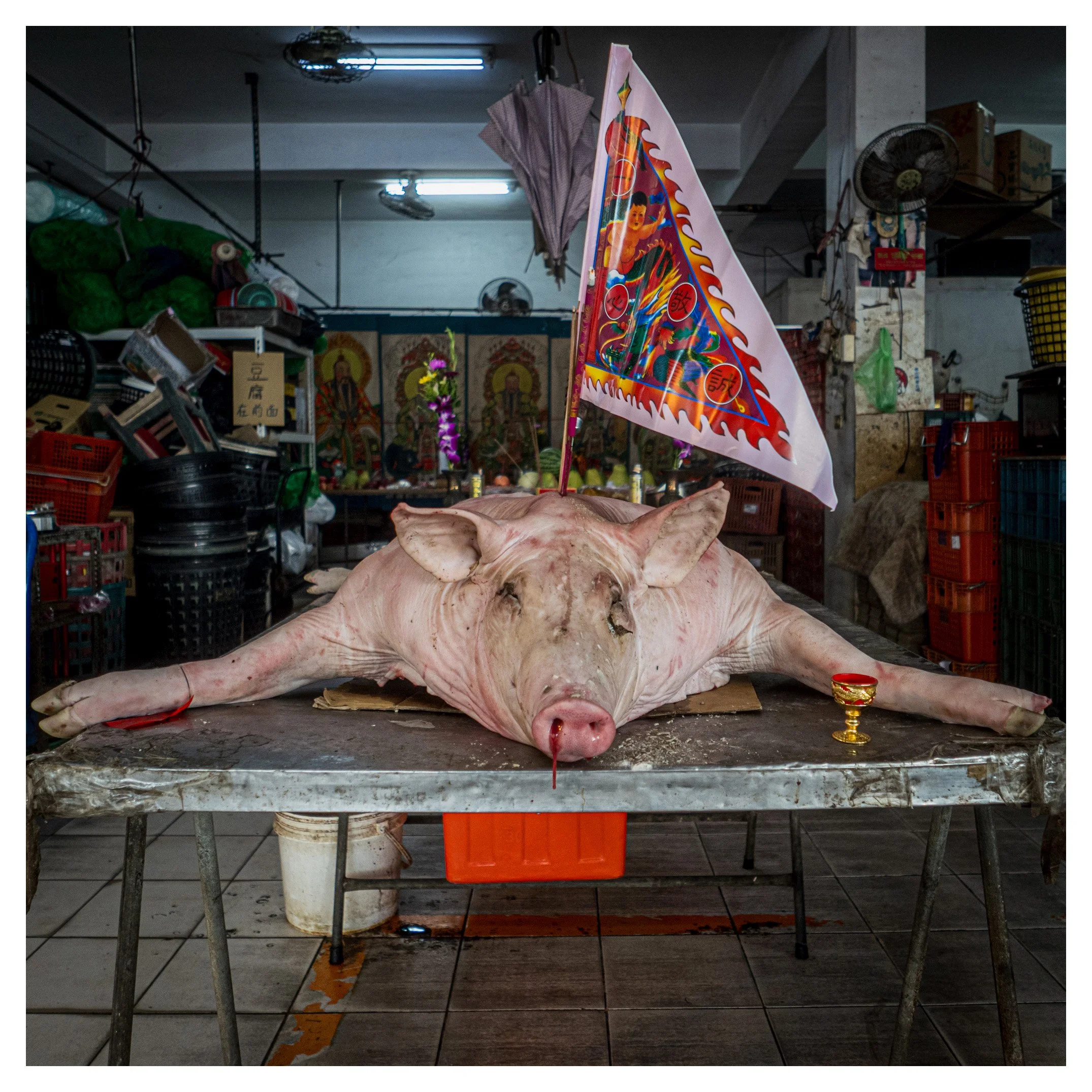
A sacrificial pig lies splayed on a metal table, a ceremonial flag planted at its head and a golden cup at its side. A direct, unflinching documentary study of Taiwan’s shénzhū offering tradition, photographed with the same seriousness the ritual itself demands.
Camera Model: Leica D-Lux 8
Shutter Speed: 1/250 sec
Aperture: f/1.7
ISO: 400
The Critique
This photograph documents Taiwan’s shénzhū (神豬), or “divine pig,” offering tradition — a sacrificial ritual rooted in the Hokkien and Hakka communities’ Yimin faith, in which a pig is presented to the gods as an expression of devotion. The most senior deities in the Taiwanese folk religious pantheon traditionally receive the “most untransformed” offerings — raw fowl, a whole raw pig — and this image captures exactly that moment: the animal laid flat on a battered steel table, legs splayed symmetrically, a triangular ceremonial flag bearing the characters 心 and 誠 (heart and sincerity) planted directly above its head like a small sail.
Documenting subject matter this direct and unglamorous — the reality of ritual, including the parts many viewers might instinctively look away from — is territory Chien-Chi Chang understands deeply. Chang, born in Taichung and now a full Magnum member, built his reputation photographing difficult, real Taiwanese subjects with what critics consistently describe as consistency, kindness, and respect rather than sensationalism; his landmark series The Chain was shot at a temple in Kaohsiung itself, this very city. This photograph works in that same tradition — it doesn’t flinch from the pig’s carcass, the visible blood at its snout, or the utilitarian, cluttered storage-room setting, but it also doesn’t sensationalize any of it. The framing is calm, centered, almost formal.
That formality is the photograph’s real strength. The pig’s body, arms splayed wide in a pose that’s almost cruciform, occupies the composition with real symmetry, while the temple altar visible in the soft-focus background — deity portraits, flowers, offerings — confirms the sacred context without needing any caption. The small golden ceremonial cup placed beside the pig’s foreleg is a lovely, easily overlooked detail that speaks to the specificity and care embedded in the ritual: this isn’t casual butchery, it’s consecrated offering, and every object in the frame reflects that intention.
The available light, likely fluorescent workroom lighting supplemented by whatever daylight reaches this space, is handled well — skin tones read accurately without an unpleasant color cast, and the shallow depth of field at f/1.7 isolates the pig and flag sharply while letting the cluttered storage environment recede into soft, atmospheric blur. Where the image could be pushed further is in the framing at the very top, where the hanging umbrella and ceiling fan crowd the upper register somewhat; a slightly lower vantage point might have let the flag’s full triangular form breathe against cleaner space.
How This Image Could Be Improved
• Consider a lower vantage point to give the ceremonial flag more clean space against the ceiling, reducing competition with the hanging umbrella and fan above.
• Watch the background altar’s legibility. It’s appropriately soft-focus here, supporting rather than competing with the main subject, but a companion frame with the altar in sharper focus could add valuable documentary context to a series.
• Document the fuller ritual sequence if possible. A single frame captures this moment powerfully; a short series showing preparation, the offering itself, and its eventual removal could build a genuinely significant documentary study of a practice with real cultural depth and ongoing controversy.
Becoming a Better Photographer Over Time
• Approach difficult or unglamorous subjects with the same formal care as any other. Chang’s career demonstrates that respectful, unflinching documentation, rather than either sanitizing or sensationalizing, is what gives difficult subject matter lasting value.
• Research the specific tradition before and after shooting. Understanding the shénzhū tradition’s history, its connection to the Yimin faith, and the contemporary animal-welfare debates surrounding it will deepen how you frame and caption future images in this vein.
• Build trust with communities before photographing sensitive rituals. Documentary work like this depends on access and permission; cultivating relationships with temple communities over time opens doors that a single visit cannot.
Photographers to Study
• Chien-Chi Chang — for his direct, respectful documentation of difficult Taiwanese subject matter, including work shot in Kaohsiung itself.
• W. Eugene Smith — for his foundational belief in humanistic, unflinching documentary photography.
• Lu Nan — for his patient, deeply embedded documentation of religious and rural life across Asia.
• James Nachtwey — for his unwavering commitment to photographing difficult realities with dignity.
• Don McCullin — for his lifelong insistence on looking directly at subjects others turn away from.
Books Worth Reading
• The Chain by Chien-Chi Chang
• W. Eugene Smith: Photographs 1934–1975
• Lu Nan: Trilogy
• Inferno by James Nachtwey
• Unreasonable Behaviour by Don McCullin
Videos Worth Watching
• “Chien-Chi Chang: The Art of Documentary Photography” — a direct look at the Taiwan-based photographer most relevant to this frame’s subject and approach.
• Magnum Photos’ feature on The Chain, shot at a temple in Kaohsiung — useful context on Chang’s method of documenting difficult Taiwanese religious and institutional subjects with respect.
• Ted Forbes, The Art of Photography channel — for broader historical grounding in humanist documentary photography’s approach to difficult subject matter.