

Day 311/365 Smoke and Steel: Burning Paper Money in the Shadow of Kaohsiung's Rising Tower
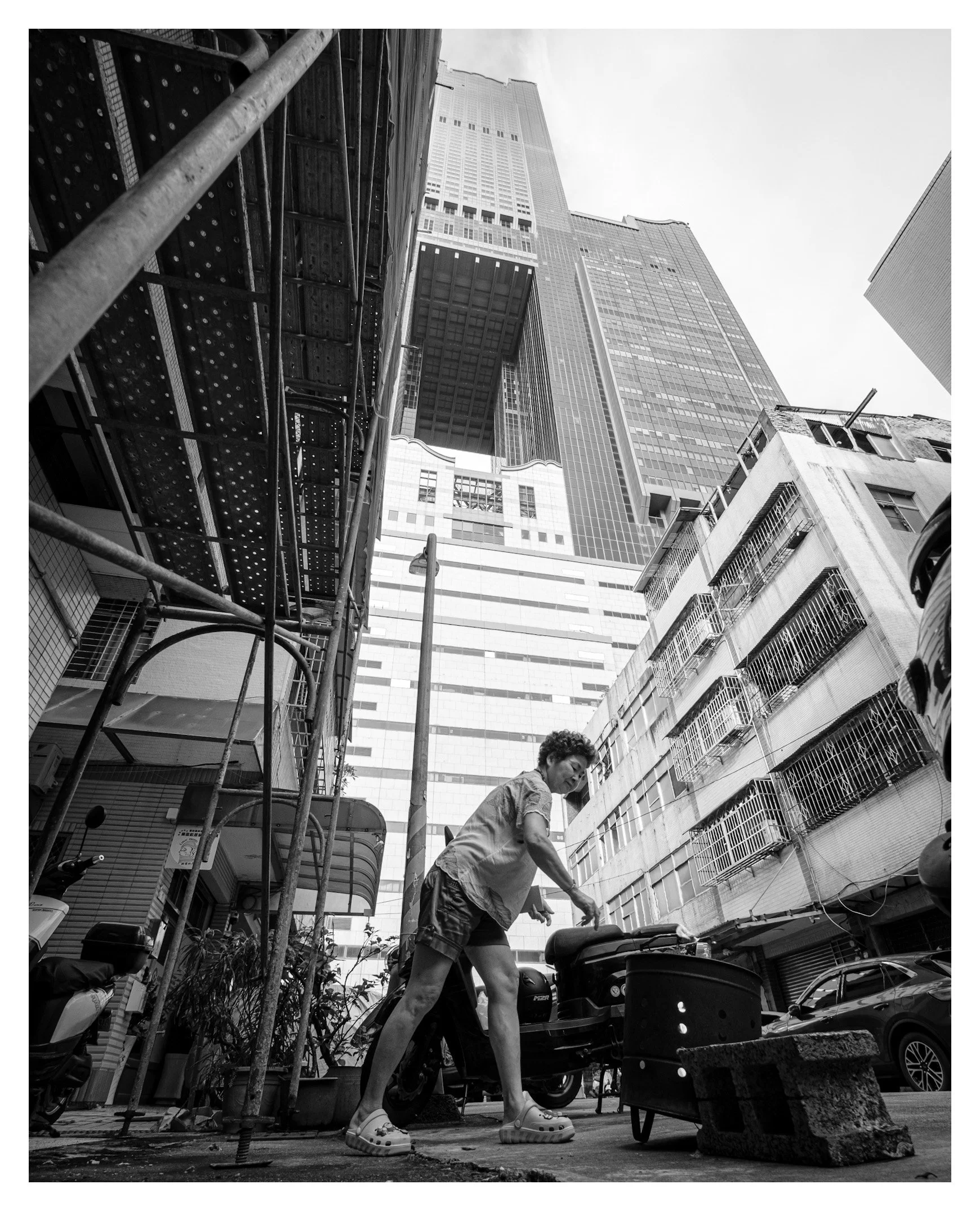
Beneath a glass skyscraper still under construction, a woman bends over a small fire, burning paper money at street level. What happens when centuries-old ritual and hyper-modern architecture share a single frame? A close look at composition, verticals, and the discipline of shooting wide.
METADATA
Camera Model: Fujifilm X-Pro2
Lens: Fujinon XF 10-24mm f/4 R OIS
Shutter Speed: 1/280 sec
Aperture: f/4.5
ISO: 200
THE CRITIQUE
There is a particular kind of vertigo that only an ultra-wide lens pointed skyward can produce, and this image trades in it fluently. The frame is built on a spine of verticals — corroded scaffolding on the left, the sheer glass face of the tower dead centre, the barred and air-conditioned tenement on the right — three separate architectural eras stacked into a single sightline. This is a composition that owes an obvious debt to the New Topographics sensibility, that deadpan, almost clinical interest in how structures accumulate and collide in the built environment. But where the New Topographics photographers of the 1970s tended to empty their frames of people, this photograph refuses that emptiness — and refuses something more specific than mere presence. At the base of all that architectural ambition, a woman bends over a small fire, burning paper money. This is one of the oldest devotional gestures in Taiwanese daily life, an offering to ancestors or spirits carried out at street level, unhurried, indifferent to the glass tower rising above her.
That juxtaposition is the real subject of this photograph, and it is a far richer one than a simple street crossing would have offered. The ritual act of burning joss paper belongs to a continuity that predates every structure in this frame by centuries; the tower behind her belongs to a skyline that is, by comparison, barely a decade old. The photograph does not comment on this tension explicitly — it doesn't need to. The composition does the work, stacking the ephemeral smoke of the fire against the permanence of steel and glass, the private and the sacred against the public and the corporate. It recalls, structurally if not stylistically, the way Michael Wolf used extreme verticality to render Hong Kong's density almost oppressive, though this frame carries a warmth his rarely did — there is a human ritual being honoured at its base, not merely a body dwarfed by scale.
The choice to shoot from a low, tilted vantage point at 10mm is the image's engine. The scaffolding in the upper left corner reads almost like a proscenium arch, an improvised frame within the frame, weathered and industrial against the pristine curtain wall of the skyscraper behind it. The black and white treatment serves the image well, flattening the visual chaos of signage, cabling, and window units on the right-hand building into texture rather than distraction, and letting the tonal contrast between the dark scaffolding and the pale tower carry the composition's weight. There's a slightly gritty, high-contrast quality to the print that echoes the confrontational street work coming out of postwar Japan — grain and shadow used not to prettify but to insist on presence.
IMPROVEMENT SUGGESTIONS
• The converging verticals on the right-hand building lean noticeably, more than the deliberate distortion on the tower itself. At 10mm this is unavoidable at the edges, but a light vertical correction in post, applied selectively rather than globally, would let the tower's dramatic lean read as intentional rather than the tenement's lean reading as accidental.
• Her bowed posture and downward gaze are appropriate to the act she's performing, but the ritual itself — the fire, the paper, the vessel she's burning it in — is small and slightly lost against the visual noise of the scooter and cargo trailer beside her. A tighter crop, or a position shot slightly closer to her level, may have given the fire itself more presence as a second focal point against the architecture above.
• The sky is close to blowing out in the upper right quadrant. At f/4.5 and 1/280, there was room to shield some of that highlight with a faster shutter or a touch of negative exposure compensation, preserving more gradation in the clouds without sacrificing the shadow detail in the scaffolding.
• The bottom third of the frame is busy — the granite block, the trailer, the tangle of cables — and competes with the ritual for attention. A slightly lower crop or a half-step left at the moment of capture may have simplified that foreground while keeping the fire and her hands legible as the quiet centre of the image.
BUILDING A BETTER EYE OVER TIME
Improvement in photography is rarely a single leap. It's compiled, image by image, the way sediment builds a shoreline. A few disciplines worth adopting:
• Keep a running log of your EXIF choices against outcomes. Note which apertures and shutter speeds you gravitate toward in different light, and which ones actually served the image versus which were reflexive habit. Patterns will surface that tell you where your instincts are strong and where they're merely comfortable.
• Review contact sheets, not just favourites. The images you almost chose are often more instructive than the ones you did — they reveal the decision points where your eye was calibrating.
• Track a "keeper rate" over months, not days. A rising ratio of publishable frames to total frames shot is one of the few honest metrics of growth in this medium.
• Study one photographer intensively per month rather than skimming many. Depth of study builds vocabulary faster than breadth.
• Seek out critique from people who will disagree with you. Comfortable feedback flatters; honest feedback sharpens.
PHOTOGRAPHERS TO STUDY
• Michael Wolf — for his obsessive documentation of high-density Asian cityscapes and his ability to make architecture itself the subject rather than the backdrop.
• Vivian Maier — for spontaneity, and for proof that rigorous, unglamorous daily shooting builds a body of work more reliably than waiting for inspiration.
• Fan Ho — for his work in Hong Kong, where dramatic light and shadow turned mundane urban geometry into something closer to abstraction, a useful counterpoint to your own architectural instincts.
• Daido Moriyama — for the grain, the confrontation, the refusal to make Japanese street photography tidy.
BOOKS TO READ
• "Architecture of Density" by Michael Wolf
• "Hong Kong Yesterday" by Fan Ho
• "Bystander: A History of Street Photography" by Colin Westerbeck and Joel Meyerowitz
• "The Photographer's Eye" by Michael Freeman
VIDEOS TO WATCH
Vivian Maier, Photographer — a short documentary tribute built from her own images and 8mm footage, useful for understanding how an entirely private practice built one of the great archives of street photography.
https://www.youtube.com/watch?v=vDewAU-rgIM
7 Simple Tips That Will Improve Your Wide Angle Lens Photography — practical, directly applicable to the 10-24mm you're shooting with.
https://www.youtube.com/watch?v=r-TW4uC28ZM
You're Using Wide Angle Lenses Wrong — a sharper, more critical look at common mistakes with ultra-wide glass, worth watching against your own low-angle habits.