

Day 313/365 The Weight of a Plastic Bag: A Portrait of Patience on a Tainan Porch
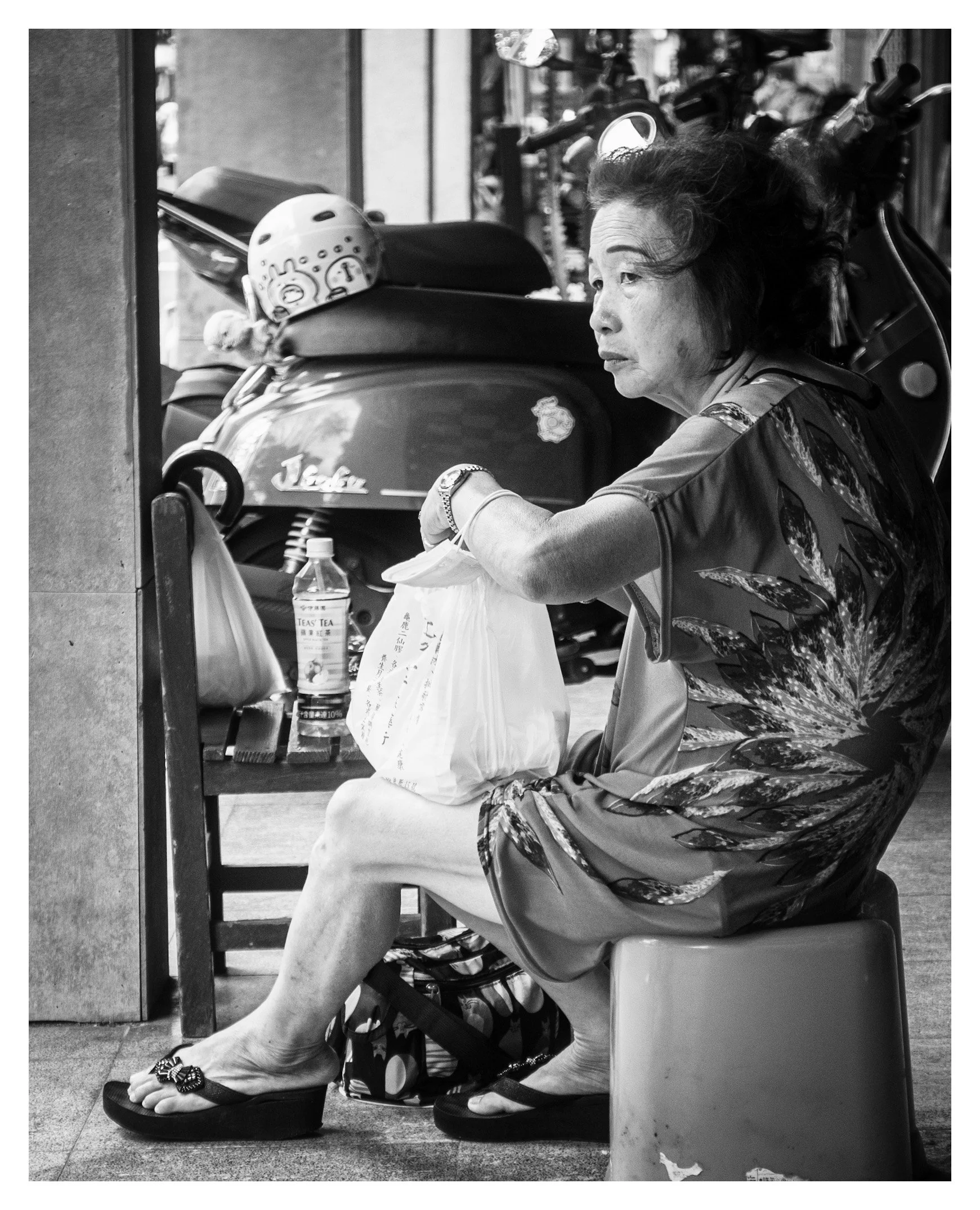
A woman rests against a parked scooter, a bag of takeout balanced on her knee, her gaze fixed somewhere past the frame. What does a single unguarded profile reveal that a posed portrait never could? A close look at stillness, environment, and the ethics of the candid image.
METADATA
Camera Model: Leica D-Lux 8
Lens: Leica DC Vario-Summilux 10.9-34mm f/1.7-2.8 ASPH. (shot at 31mm equivalent)
Shutter Speed: 1/250 sec
Aperture: f/2.8
ISO: 320
THE CRITIQUE
There's a long tradition in documentary photography of the profile as a device of respect rather than distance, and this image belongs squarely inside it. The woman is not looking at the camera, and she is not performing for it either — she has simply been caught mid-thought, one hand steadying a plastic takeout bag against her knee, the other resting with a watch and a stack of thin bracelets catching what light there is. That refusal of eye contact does something specific here: it lets the viewer study her face, the deep lines around her eyes and mouth, the slightly parted lips, without the transaction of a returned gaze. This is observation, not confrontation, and the distinction matters enormously in a photograph like this one.
The environment is doing as much narrative work as the face. Behind her, a scooter with a child's helmet perched on the seat, its cartoon eyes an odd, tender counterpoint to her weathered profile. To her left, a wooden chair pressed into service as a table, holding a bottle of iced tea and a second bag of shopping. Nothing here has been arranged. This is the accumulated evidence of an ordinary errand, and the photograph trusts that evidence to tell the story rather than reaching for a more overt gesture. It recalls the instinct at the heart of Dorothea Lange's Depression-era portraiture — the conviction that dignity survives hardship most visibly in small, unremarkable details, not in staged suffering.
There is also a specifically Taiwanese register to this image that's worth naming directly, and it puts the photograph in conversation with Chien-Chi Chang's decades of unposed portraiture of Taiwanese subjects going about the business of daily life — women waiting, resting, carrying, watching the street. Chang's work insists that these unguarded moments are not lesser than the decisive, dramatic frame; they are, in fact, where most of a life actually happens. This photograph shares that conviction. The woman here is not doing anything remarkable. She is simply pausing, and the camera has chosen to take that pause seriously.
Technically, the profile framing keeps the composition simple where the background could easily have become chaotic. The scooter's dark bodywork and the shop's cluttered interior recede into a mid-value grey that never competes with her face, which sits at the brightest point of local contrast in the frame — a small but important piece of tonal management that keeps the eye where it belongs.
IMPROVEMENT SUGGESTIONS
• The wooden chair on the left edge, with its bags and bottle, is compositionally useful but slightly cramped against the frame border. A half-step back or a few millimetres wider would have given that secondary element room to breathe without sacrificing the tightness of her profile on the right.
• At f/2.8 on this sensor, the background retains more legible detail than a full-frame equivalent aperture would allow, which is generally a strength here since it preserves narrative context — but it's worth knowing that ceiling exists, so that a future portrait requiring true separation isn't attempted at this aperture expecting full-frame-like falloff.
• Her hand and the bag she's adjusting are slightly soft relative to her face, likely from the natural motion of the gesture at 1/250. Since the rest of the frame is static, a touch faster shutter would have held that secondary point of interest just as crisply as her expression.
• The negative space in the upper left, the dark doorway behind the chair, is doing useful compositional work but reads a little empty on its own. A slightly lower shooting position may have let a sliver of the shop's interior detail bleed into that space, giving it more to offer on a second look.
BUILDING A BETTER EYE OVER TIME
Improvement in photography is rarely a single leap. It's compiled, image by image, the way sediment builds a shoreline. A few disciplines worth adopting:
• Keep a running log of your EXIF choices against outcomes. Note which apertures and shutter speeds you gravitate toward in different light, and which ones actually served the image versus which were reflexive habit. Patterns will surface that tell you where your instincts are strong and where they're merely comfortable.
• Review contact sheets, not just favourites. The images you almost chose are often more instructive than the ones you did — they reveal the decision points where your eye was calibrating.
• Track a "keeper rate" over months, not days. A rising ratio of publishable frames to total frames shot is one of the few honest metrics of growth in this medium.
• Study one photographer intensively per month rather than skimming many. Depth of study builds vocabulary faster than breadth.
• Seek out critique from people who will disagree with you. Comfortable feedback flatters; honest feedback sharpens.
PHOTOGRAPHERS TO STUDY
• Dorothea Lange — for her insistence that dignity, not drama, is the true subject of documentary portraiture.
• August Sander — for his typological eye, and for a useful lesson in how context and environment define a portrait as much as the face does.
• Elliott Erwitt — for finding warmth and quiet humour in small, incidental details rather than grand gestures.
• Chien-Chi Chang — for decades of unposed, deeply respectful portraiture of Taiwanese subjects in the ordinary rhythms of daily life.
BOOKS TO READ
• "American Exodus" by Dorothea Lange
• "People of the 20th Century" by August Sander
• "Personal Best" by Elliott Erwitt
• "The Chain" by Chien-Chi Chang
VIDEOS TO WATCH
Dorothea Lange: Grab a Hunk of Lightning — a full American Masters documentary on Lange's life and her lifelong commitment to photographing dignity under hardship.
https://www.youtube.com/watch?v=sfwHZ5WijV0
Chien-Chi Chang: The Art of Documentary Photography — an introduction to the only Taiwanese member of Magnum Photos and his decades spent photographing his own country.
https://www.youtube.com/watch?v=kZvV5TC05iw
The Art of Capturing Candid Street Moments — a practical look at reading a scene and anticipating an unguarded moment before it passes.