

Day 314/365 Dirt, Grit, and a Peace Sign: The Real Work Behind the Laughter in Tainan
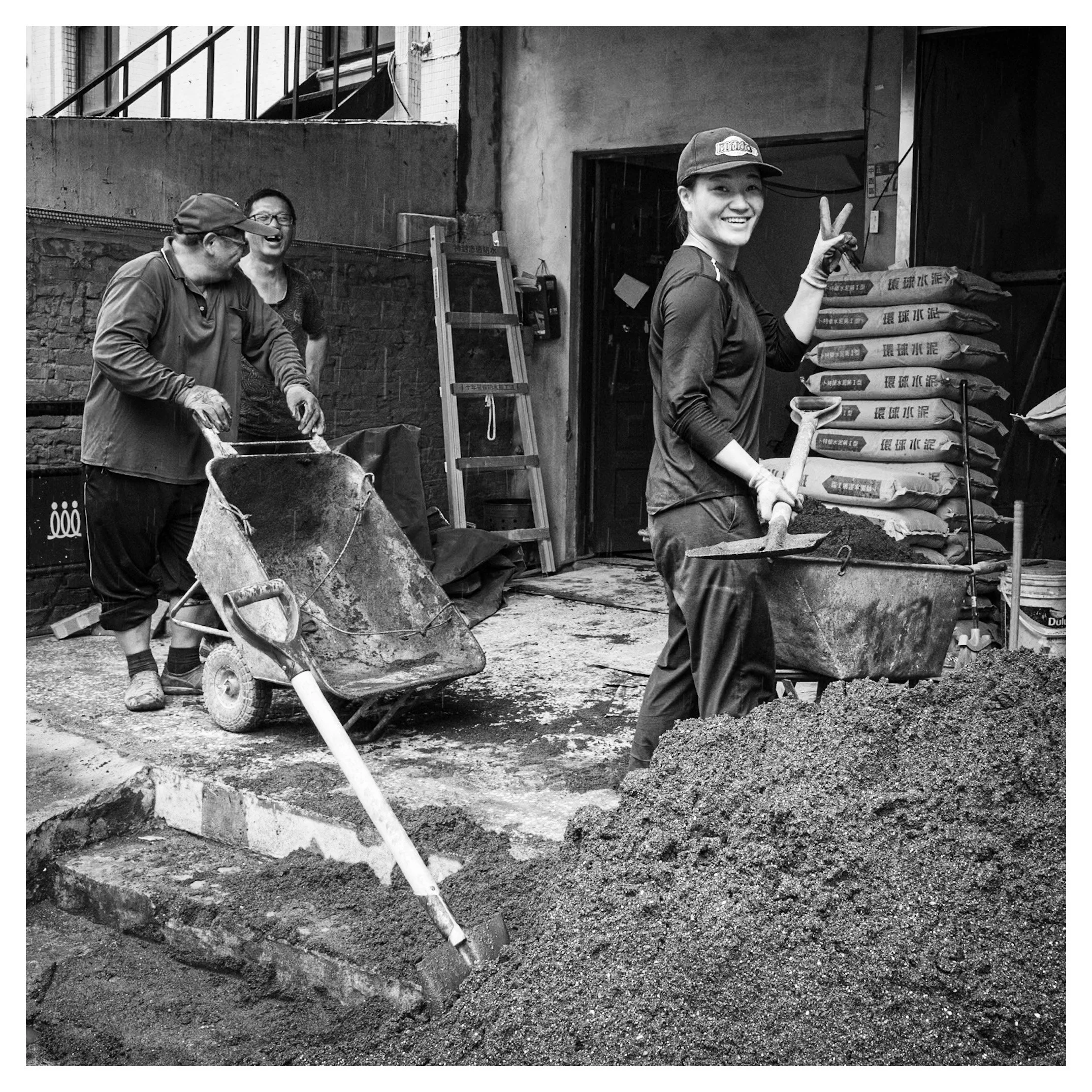
Two men laugh near a wheelbarrow while a young woman shovels cement mix, pauses, and flashes a peace sign at the camera. Who is actually doing the work in this frame? A look at labor, gesture, and the quiet subversion hiding in plain sight.
METADATA
Camera Model: Ricoh GR III
Lens: GR Lens 18.3mm f/2.8 (28mm equivalent)
Shutter Speed: 1/200 sec
Aperture: f/8
ISO: 3200
THE CRITIQUE
The first read of this frame is misdirection, and that's precisely what makes it interesting. In the background, two older men stand beside a wheelbarrow, one laughing openly, the other mid-sentence, their posture relaxed, almost sociable. In the foreground, a young woman in a ballcap has a shovel loaded with dirt, mid-motion, and she has turned to give the camera a wide, genuine smile and a peace sign without breaking her working rhythm. The photograph does not need a caption to tell you who is carrying the weight of this job site. The composition tells you on its own: she is active, tool in hand, load in motion; they are static, tool idle, energy spent on conversation rather than labor. It is a small, almost throwaway observation, and it is exactly the kind of detail that separates documentary photography from mere reportage — the willingness to notice who is actually working.
What elevates this beyond a simple gotcha of labor imbalance is her direct engagement with the lens. She is not caught unaware; she has clocked the photographer and chosen, in the middle of physical effort, to offer warmth rather than annoyance or self-consciousness. That gesture turns the image from observation into something closer to collaboration, a spirit that runs through the best contemporary labor photography — the subject as an active participant in how they are seen, not merely a specimen being studied. It is a very different register from the classical tradition of labor photography, which often posed its subjects frontally against the machinery of their work to make an argument about hardship. Here the argument, if there is one, is made almost incidentally, folded into a moment of genuine good humor.
The staging of the frame itself has real depth to it. A mound of raw material dominates the foreground, cement bags are stacked in a wall behind her, and the two men occupy a middle distance that reads as a kind of chorus — present, reactive, but not central. That layering, near to far, load to labor to conversation, gives the eye a clear path through the frame without needing directional lines to do the work. The high ISO and stopped-down aperture were the right technical call for a scene with three figures at different distances under uneven light; the resulting grain adds a texture that suits raw concrete and wet ground rather than fighting against it.
IMPROVEMENT SUGGESTIONS
• The two men in the background carry much of the image's implicit commentary, but their expressions sit slightly lost in shadow relative to her brightly lit face. A touch more attention to balancing that exposure, even a modest dodge in post on their side of the frame, would let their laughter register with the same clarity as her smile and sharpen the contrast the whole image is built on.
• The shovel's handle cuts a strong diagonal directly across her torso. It's a dynamic line, but it also visually bisects her body at an unflattering point. A slightly lower or higher vantage at the moment of capture may have let that diagonal cross through empty space rather than through her.
• As with the square crop used elsewhere in this series, it's worth reviewing the original frame before committing to 1:1 — a job site this layered may have benefited from the extra width to give the two background figures more room rather than pressing them toward the left edge.
• ISO 3200 at f/8 was a sound trade-off for depth across the scene, but if a support or brace point had been available, dropping to f/5.6 and roughly half the ISO would have preserved the same depth of field on a scene this static in its background figures, trading a stop of noise for a cleaner file.
BUILDING A BETTER EYE OVER TIME
Improvement in photography is rarely a single leap. It's compiled, image by image, the way sediment builds a shoreline. A few disciplines worth adopting:
• Keep a running log of your EXIF choices against outcomes. Note which apertures and shutter speeds you gravitate toward in different light, and which ones actually served the image versus which were reflexive habit. Patterns will surface that tell you where your instincts are strong and where they're merely comfortable.
• Review contact sheets, not just favourites. The images you almost chose are often more instructive than the ones you did — they reveal the decision points where your eye was calibrating.
• Track a "keeper rate" over months, not days. A rising ratio of publishable frames to total frames shot is one of the few honest metrics of growth in this medium.
• Study one photographer intensively per month rather than skimming many. Depth of study builds vocabulary faster than breadth.
• Seek out critique from people who will disagree with you. Comfortable feedback flatters; honest feedback sharpens.
PHOTOGRAPHERS TO STUDY
• Sebastião Salgado — for treating the human body at labor as a subject worthy of monumental, almost heroic visual treatment.
• Lewis Hine — for the foundational belief that a photograph of work could function as evidence and argument at once.
• LaToya Ruby Frazier — for her insistence on treating her subjects as collaborators rather than specimens, and for her sustained attention to labor, gender, and who gets remembered.
• Ken Domon — for his unflinching, humanist documentation of Japanese mining and industrial communities in the postwar decades.
BOOKS TO READ
• "Workers: An Archaeology of the Industrial Age" by Sebastião Salgado
• "Men at Work" by Lewis Hine
• "The Notion of Family" by LaToya Ruby Frazier
• "Children of Chikuho" by Ken Domon
VIDEOS TO WATCH
The Salt of the Earth — Official Trailer — Wim Wenders' documentary on Salgado's lifelong project of photographing labor, migration, and human endurance across the globe.
https://www.youtube.com/watch?v=OivMlWXtWpY
LaToya Ruby Frazier: A Visual History of Inequality in Industrial America — a TED talk on photographing labor, family, and the communities left behind by industry.
https://www.youtube.com/watch?v=yBFC-RtfTfg
Cotton Mill Girl: Behind Lewis Hine's Photograph and Child Labor Series — a short, focused look at how Hine used a single working portrait to argue for reform.