

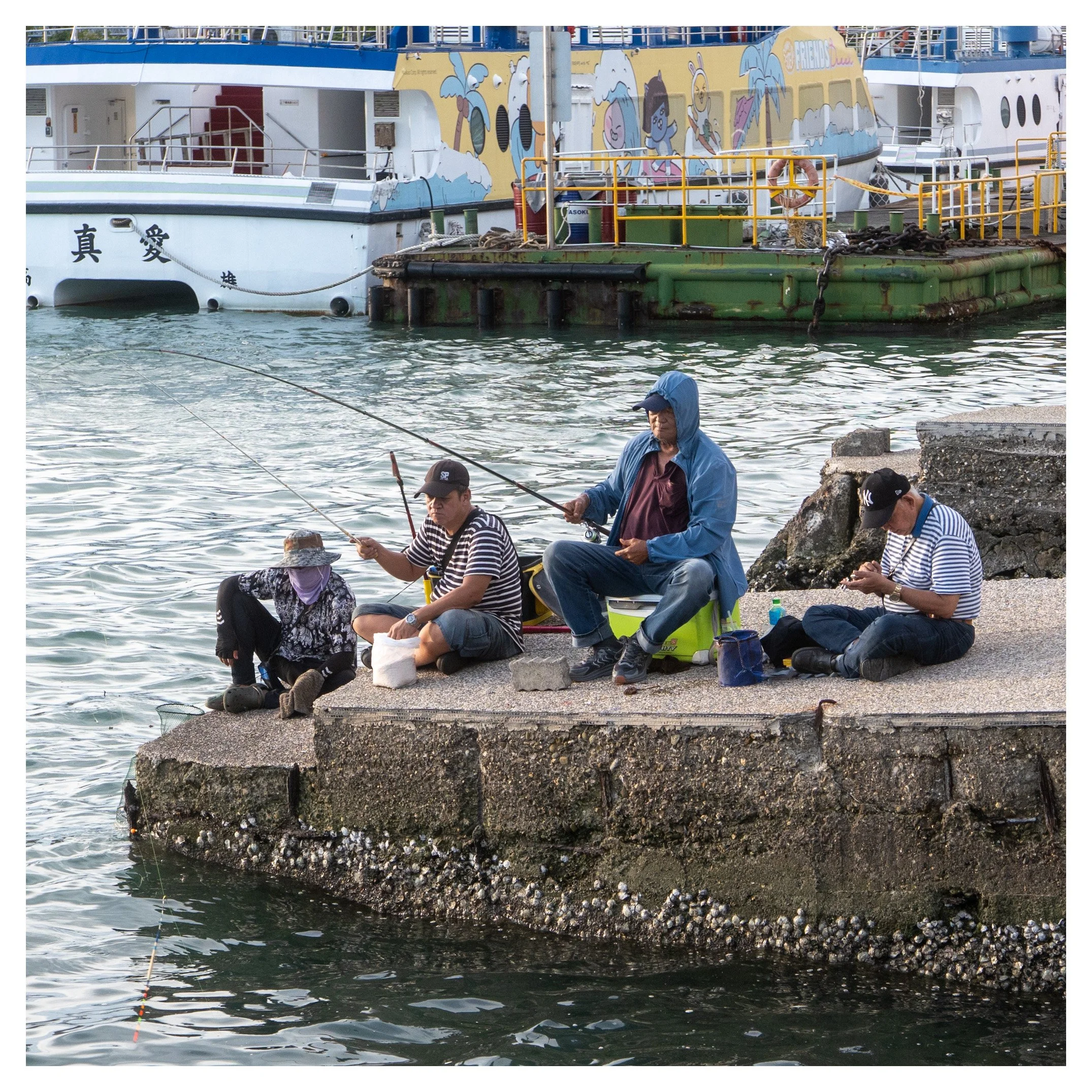
Four men share four different postures of waiting on a Kaohsiung breakwater, barnacles underfoot and a cartoon-painted tour boat named True Love moored behind them. A study in what a harbour actually is once the ferries stop being the subject, and what a square crop does to a picture built entirely out of horizontal lines.
METADATA
• Camera Model: Leica D-Lux 8
• Shutter Speed: 1/160 sec
• Aperture: f/5.6
• ISO: 200
THE CRITIQUE
Read this photograph as three horizontal bands stacked one on top of the other, because that is how it was built, whether or not the decision was conscious at the time.
The top band belongs to the tourist trade: two ferries in dock, one painted white and navy in a functional maritime register, the other given over entirely to a mural of grinning cartoon animals and palm trees, the word FRIENDS lettered across its hull in the loud sans serif of a theme park. A yellow railing, a coiled orange life ring, an oil drum, chain link rust-streaked at the edges of a green steel pontoon. This is infrastructure built to be looked at, engineered for delight.
The middle band is water, doing what water does in a harbour: holding light in broken planes, giving nothing away about depth or temperature, functioning as a kind of visual rest between the two things the photograph actually cares about.
The bottom band, the one the whole frame has been quietly organising itself around, is a row of four men seated on a barnacle-crusted concrete breakwater, each occupying his own private version of the same activity. A figure in a bucket hat and pale scarf sits lowest and furthest into the frame, a line disappearing into the water at the bottom left corner. Beside him, a man in a striped shirt and ball cap holds his rod at a steep working angle, clearly attending to something happening on the line. Centre frame, a figure wrapped in a blue hooded rain jacket sits on an upturned cooler, rod held loosely, looking out rather than down, present but not exactly occupied. At the far right, separated from the others by a shoulder of raw rock, a fourth man in a Yankees cap and matching stripes looks down at something in his hands, entirely withdrawn from the water in front of him.
Four men, four rods, four completely different relationships to the act of fishing, arranged along a single ledge like a frieze. That is the photograph's real subject, and it is a considerably better one than "men fishing," which is what a lazier version of this frame would have settled for.
What holds the whole thing together compositionally is the diagonal thrust of the two extended rods against the insistent horizontals of pier, waterline and breakwater edge. Without those rods the picture would be inert, four stacked bands and nothing to move the eye between them. With them, the frame gets a current running through it, literally crossing the water at the angle the men are actually working it. The left-hand rod, nearly horizontal and running almost the full width of the frame, is doing the most work here. It is the single most active line in the composition, and it is not an accident that it belongs to the figure positioned lowest and most engaged with the water.
There is a detail worth lingering on, because Theo Marr cannot resist it and would be a lesser critic for pretending otherwise. The white ferry's hull carries two characters: 真愛. True love. It sits directly above the row of fishermen, close enough to read as a caption the photograph never asked for and got anyway. I will not pretend this means something the photographer intended. I will say that photography has always been partly a matter of standing in the right place while the world supplies its own punctuation, and a picture of four men patiently waiting for something, moored under a boat called True Love, is the kind of gift a harbour hands out perhaps once a week to whoever happens to be looking.
The square crop is the more interesting formal decision, and the one worth scrutinising hardest. A 3:2 frame would have given the eye somewhere to travel and somewhere to rest; the square compresses everything toward the centre and forces a much more deliberate reading of the horizontal bands against each other. It mostly succeeds. Where it strains is at the edges: the left-hand rod's line exits the frame at the very corner rather than being allowed to simply fade into the water, and the right-hand figure sits close enough to the frame edge that the barnacled rock behind him reads as slightly cramped rather than as the textural counterweight it wants to be. A square crop asks for generosity at its margins precisely because it has already sacrificed the breathing room a rectangle would have given for free. This one is fractionally too tight to fully deliver it.
None of that undoes what the photograph gets right, which is a genuinely difficult thing to get right: four strangers who happen to be doing the same thing, photographed so that their differences are legible rather than flattened into a generic "local colour" tableau. That is character work, not scenery work, and it is the harder of the two disciplines by a wide margin.
HOW THIS IMAGE COULD BE IMPROVED
• Reconsider the square crop's left and right margins specifically. A touch more space at both edges, even a modest amount, would let the extended fishing line and the rightmost figure breathe rather than press against the frame boundary.
• Watch the top band's competition for attention. The mural boat is visually loud enough to pull the eye away from the men before it settles; a slightly lower vantage or a few steps left could reduce how much of that painted hull intrudes into frame.
• Consider a second, tighter frame isolating just the four men and the breakwater, without the boats at all. The wide version tells a story about context; a tighter version would tell a story about character, and both are worth having from the same afternoon.
• If revisiting the location, watch for a moment when two of the men's postures rhyme rather than merely differ. Four distinct postures reads as documentary variety; three distinct plus one echo often reads as a stronger single composition.
• Check the histogram on the brightest painted panels of the mural boat before committing to an exposure. At f/5.6 and ISO 200 there is headroom to protect those highlights further if a reshoot is possible.
ON BECOMING A BETTER PHOTOGRAPHER: LET THE DATA SPEAK
• When a frame contains more than one person doing the same activity, log how many distinct postures or engagement levels you captured. Photographs of groups improve sharply once you start hunting for variation rather than settling for the first coherent arrangement.
• Track your ratio of square crops to rectangular ones across a few months. A pattern either way is fine, but knowing whether square is a genuine compositional choice for you or a habit worth questioning changes how deliberately you reach for it next time.
• Keep a running note of "gift details" — the incidental text, signage or coincidence that a scene hands you unasked, like a boat's name landing exactly where it matters. Reviewing these later often reveals which kinds of coincidence you are best at noticing in the moment versus only in the edit.
• Photograph the same public space at different times of day over a season. A harbour, a market, a temple courtyard. The variety of postures and activities you find there is a direct measure of how well you are learning to see beyond the obvious version of a place.
• Note how often your strongest people-frames come from waiting rather than approaching. Photographers who let a scene assemble itself in front of a fixed position often out-perform their own instinct to chase a better angle.
PHOTOGRAPHERS TO RESEARCH
• Bruce Davidson — decades spent finding individual character inside a single block, a single subway car, a single community, without ever flattening the group into a type.
• Constantine Manos — a lifelong interest in working harbours, seaside towns and the quiet choreography of people occupying public space together.
• Willy Ronis — French humanist photography at its clearest: dignity found in ordinary labour and ordinary leisure, rendered without sentimentality.
• Gordon Parks — a documentary eye trained on showing individuals as individuals first, subjects of circumstance second.
• Juan I-Jong — the defining chronicler of everyday working life across rural and coastal Taiwan, essential viewing for anyone photographing this island's people.
BOOKS TO READ
• "East 100th Street" — Bruce Davidson. Two years spent on a single block, and the clearest demonstration available of what patience does to a documentary project.
• "A Greek Portfolio" — Constantine Manos. Harbour towns, fishermen and coastal working life photographed with real formal rigour.
• "Belleville-Ménilmontant" — Willy Ronis. A working-class Paris neighbourhood in transition, humanist photography's founding document.
• "Gordon Parks: Collected Works" — Gordon Parks. A career-spanning survey and the best single entry point into his documentary practice.
• "Man and Land" — Juan I-Jong. Rural and working Taiwan across more than a decade, and required reading for any photographer working this island.
VIDEOS TO WATCH
• How Self-Taught Photographer Gordon Parks Became A Master Storyteller
https://www.youtube.com/watch?v=gQLUbdp7fqA
• Constantine Manos On Photography
https://www.youtube.com/watch?v=uPOXI1oEdec
• Bruce Davidson: A Lifetime With Leica
https://www.youtube.com/watch?v=NXjJs6n3m2U
• Willy Ronis — Street Photographer