

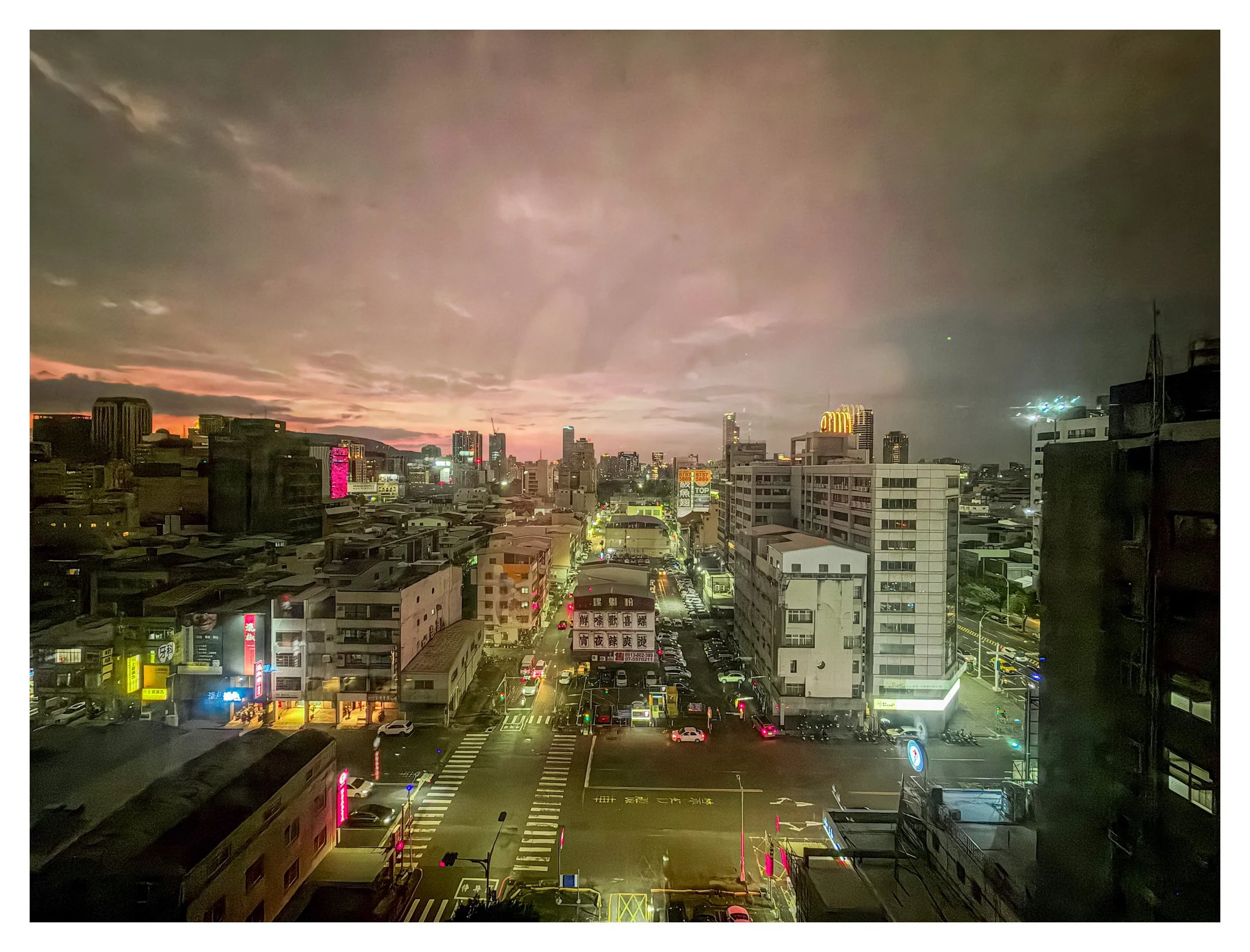
A storm clears over Kaohsiung just as the streetlights come up, and a single slow shutter tries to hold both a dying pink sky and a neon grid beneath it. On the tension between a dramatic sky and a genuinely busy street, and what a fifteenth of a second can and cannot be trusted to record.
METADATA
• Camera Model: Apple iPhone 17
• Shutter Speed: 1/15 sec
• Aperture: f/2.2
• ISO: 1600
THE CRITIQUE
There are two photographs stacked on top of each other here, and the honest question to ask of this frame is whether it successfully holds both, or whether one is quietly winning.
The upper half is sky doing something genuinely rare: heavy grey storm cloud breaking apart at the horizon to let a band of pink and orange sunset through underneath it, the remaining cloud mass catching that light from below and turning the colour of a healing bruise. This is not a sky you can plan for. It exists for a narrow window of minutes, and the photographer was in position when it happened, which is worth more credit than any compositional decision made after the fact.
The lower half is an elevated view straight down a Kaohsiung street toward an intersection, buildings crowding both edges of the frame, signage in red and yellow and cold white fluorescent stacked on top of each other in the way Taiwanese streetscapes do better than almost anywhere else in the world. A building carrying a stack of Chinese characters advertising oysters and late-night spicy food sits nearly dead centre, lit hard enough to anchor the eye. Cars wait at the crossing. A gold, ring-shaped ornamental structure crowns a building to the right, its neon glowing warm against the cooler dusk. This is a lot of visual information, and it is competing, quite directly, with the sky above it for the viewer's attention.
The photograph's real subject is the seam between the two. Roughly three-fifths of the frame is given to the sky, which tells you where the photographer's eye went first and what mattered most in the moment of pressing the shutter. That is a defensible choice. It is also not a free one. Giving the sky that much room means the street below has to do a lot of work in a compressed space, and it mostly manages it: the road's white lane markings converge toward the lit intersection at the frame's rough centre, giving the eye a route down into the city before it climbs back up into the clouds. That convergence is the strongest structural device in the photograph, and it is doing more to hold the composition together than the sky is, even though the sky is what makes you stop scrolling.
Colour temperature is the more interesting formal story here, because the frame is actually working across three distinct registers rather than one. The sky sits in warm coral and pink, softened by cloud into something closer to pastel than saturated colour. The street level runs cooler and harder, sodium orange and cold white fighting for space, with pink neon punctuating the lower left like a rhyme with the sky above it. Between the two, the mid-distance skyline sits in flat blue-grey twilight, doing almost no colour work at all, which is exactly the right amount of visual rest between two busy zones. Photographers rarely get three honest colour registers in a single frame without engineering them. This one arrived mostly by circumstance, and it is the single best thing happening in the picture.
Now the technical account, because it matters more here than it usually would. A fifteenth of a second, handheld, is a genuinely difficult exposure to hold still, and at this resolution any residual shake reads first in exactly the two places that most need to stay crisp: the fine edges of neon lettering, and the texture within the storm cloud itself. The phone's computational processing is almost certainly doing real work here, stacking multiple short exposures to arrive at something that looks like a fifteenth of a second without the shake a true fifteenth of a second would produce handheld. That is worth knowing, because it changes what you should expect from the file at full resolution: a soft, slightly waxy quality in cloud texture and in small text is the signature of this kind of computational assist, not necessarily of camera movement, and it is worth checking for before assuming the frame is simply unsharp.
Where the photograph strains hardest is dynamic range. A scene with a bright, graduated sky and a comparatively dark, artificially lit street below is close to the hardest lighting condition there is to hold in one exposure, and there are moments here where it shows: the darkest side streets running off the main avenue lose detail into near-black, while the brightest signage edges toward losing texture at the top of their tonal range. None of this breaks the photograph. It does mean there was more information available in that scene than a single exposure, however cleverly computed, was able to fully retain.
HOW THIS IMAGE COULD BE IMPROVED
• Brace the phone against something solid — a railing, a window frame, a tripod if one is to hand — for a genuinely still fifteenth of a second rather than a computationally assisted one. The gain in fine detail, particularly in the cloud texture, would be immediate.
• Bracket the exposure and blend, or use the phone's own HDR capture, specifically for this kind of graduated-sky-over-lit-street scene. The dynamic range here exceeds what one exposure can hold cleanly.
• Experiment with the horizon position. Try a version with less sky and more street, letting the signage and architecture carry more of the frame, and a version with even more sky, letting the storm dominate as near-pure atmosphere. The current split is a reasonable compromise but has not been tested against its alternatives.
• Wait two or three minutes longer next time a sky like this appears. Blue hour deepens fast in the tropics, and a slightly darker sky against the same streetlights would sharpen the contrast between the two registers rather than letting them compete on near-equal terms.
• Check the frame's edges for any barrier between camera and subject — glass, screen, railing — since anything in that path at this shutter speed can introduce a softness that is easy to mistake for motion blur after the fact.
ON BECOMING A BETTER PHOTOGRAPHER: LET THE DATA SPEAK
• Keep a log of elevated vantage points you have access to in your own city, and revisit each of them across different weather. A single rooftop or high floor, checked repeatedly, will eventually hand you a sky like this one; the skill is in already being in position when it happens, not in chasing it after the fact.
• Track your handheld shutter speed ceiling honestly. Modern phones can fake stillness through computation further than you might assume, which is useful, but knowing where that assistance starts to show softness in fine detail changes when you reach for a brace instead of trusting the sensor.
• Note which of your strongest frames feature more than one distinct colour temperature zone in the same image. This tends to be a marker of genuinely dynamic light, and hunting for it deliberately, rather than waiting to stumble into it, speeds up how often you find it.
• Photograph the same elevated view at three or four different points in the transition from day to full night, cataloguing shutter speed and ISO at each. Reviewing that sequence later is the fastest way to learn exactly how much time you actually have in a changing sky, which is usually far less than it feels like in the moment.
• When a frame has both a bright sky and a dark, artificially lit foreground, get in the habit of shooting a bracketed set even when you do not think you will need it. The habit costs nothing in the moment and saves a photograph later far more often than expected.
PHOTOGRAPHERS TO RESEARCH
• Andreas Gursky — large-scale, hyper-detailed views of built environments and infrastructure that treat scale itself as the subject.
• Peter Bialobrzeski — a career built on photographing Asian megacities at dusk and at night, where neon and dying daylight share the same frame.
• Sze Tsung Nicolas Leong — elevated, wide-format views of Chinese cities in the midst of transformation, shot with a large-format patience this photograph does not have but could learn from.
• Nadav Kander — muted, atmospheric colour work along China's Yangtze River, especially strong on cities seen through haze and changing light.
• Michael Kenna — the definitive reference for what long exposure does to a scene the eye cannot fully resolve on its own, even though his own work is almost entirely monochrome.
BOOKS TO READ
• "Andreas Gursky" — the Museum of Modern Art monograph. The clearest single introduction to photographing scale and structure together.
• "Neon Tigers: Photographs of Asian Megacities" — Peter Bialobrzeski. Seven Asian cities merged into one luminous, slightly unreal composite metropolis.
• "History Images" — Sze Tsung Nicolas Leong. Elevated views of Chinese cities documenting transformation with extraordinary patience and formal control.
• "Yangtze, The Long River" — Nadav Kander. A masterclass in holding atmosphere, haze and colour together across a genuinely difficult light.
• "Night Work" — Michael Kenna. Decades of long-exposure night photography and the best possible education in what happens to a scene over time that a single fast frame cannot show.
VIDEOS TO WATCH
• Andreas Gursky: Redefining Photography
https://www.youtube.com/watch?v=CdOxpTARGx4
• Sze Tsung Leong — Full Lecture
https://www.youtube.com/watch?v=ylJ157Antgw
• Nadav Kander — The Long River, Yangtze
https://www.youtube.com/watch?v=8-e9OsZDl60
• Michael Kenna — My Life In Photography, Photo London Talks