

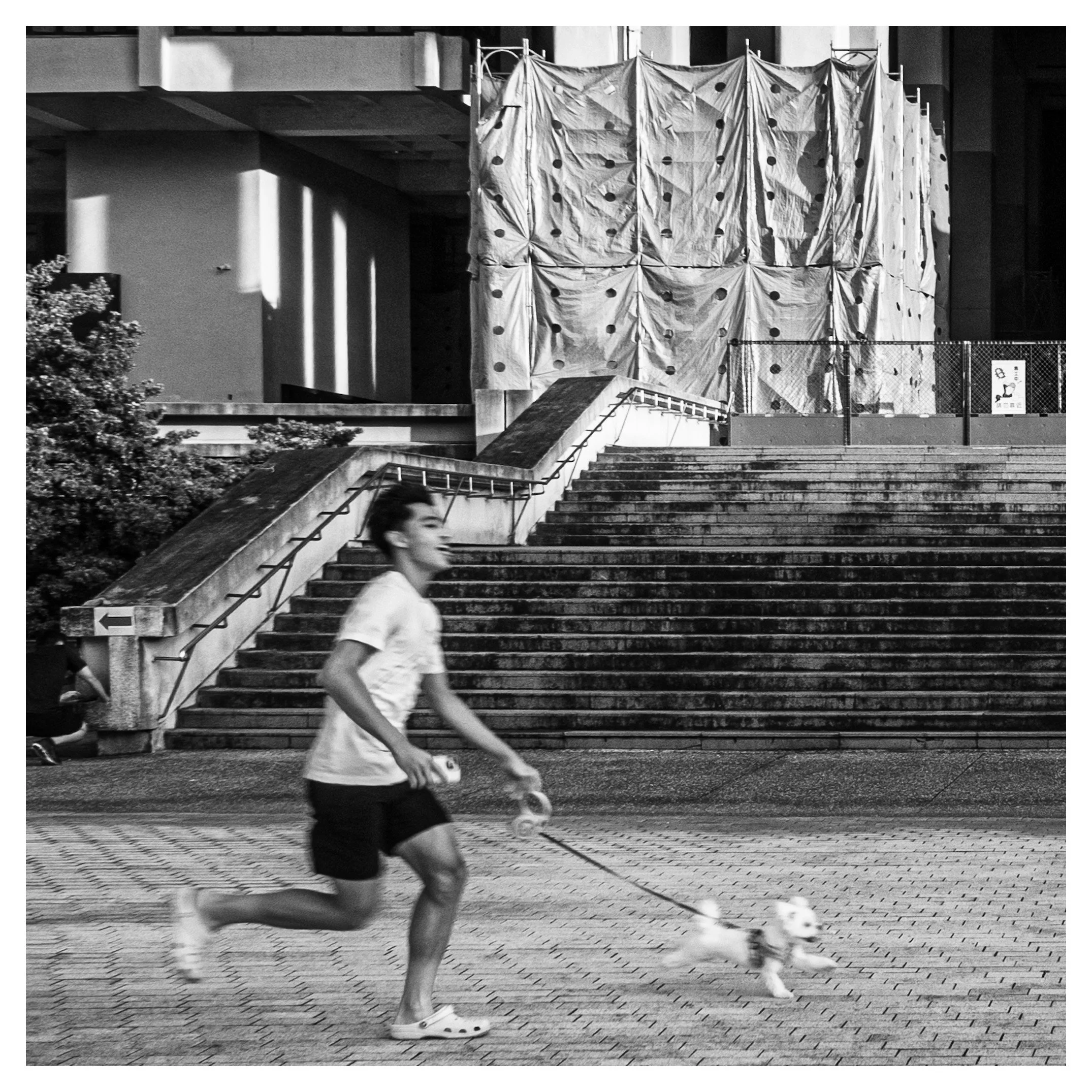
A runner and one small, indignant dog cross the plaza of Kaohsiung's Cultural Centre at speed, their legs dissolving into blur against a flight of stairs that refuses to move at all. A study in what happens when a fast subject meets a patient, monumental backdrop, and the small directional joke the frame hands you almost by accident.
METADATA
• Camera Model: Leica D-Lux 8
• Shutter Speed: 1/125 sec
• Aperture: f/6.3
• ISO: 200
THE CRITIQUE
Two subjects occupy this frame, and they are living at entirely different speeds. One is a monumental concrete staircase, sun-bleached and water-stained by decades of Kaohsiung humidity, utterly motionless, rendered in the kind of crisp, deep-focus detail that only comes from a small aperture and a subject that has nowhere to be. The other is a man in a white t-shirt and shorts, running hard across the plaza with a small white dog straining ahead of him on a leash, and he is dissolving at the edges precisely because he refuses to hold still for the camera's convenience.
That contrast is the entire photograph, and it is a better subject than either element would have been alone.
Look at where the blur actually sits. His head and torso are reasonably legible — you can read his expression, the line of his shoulders, the can he is carrying in one hand. His legs, moving at the highest angular speed relative to the lens, smear into soft multiple exposures of themselves, the classic signature of a body outrunning the shutter meant to describe it. The dog fares worse still: four legs moving faster than a human stride and closer to the ground where the eye expects sharpness, blurring into something closer to a suggestion of a dog than a photograph of one. This is not a failure of technique. It is a fairly precise visual record of relative velocity, and it is more informative about the scene than a perfectly frozen frame would have been. A crisp image of a running man tells you he was running. A frame where the fastest-moving parts of him blur into motion tells you how fast, and there is a real difference between those two claims.
The architecture is doing more compositional work than it first appears to. The staircase rises in a strict, repeating rhythm of horizontal bands, interrupted only by a diagonal handrail ramp at the left that cuts against the grain and gives the eye somewhere to enter the frame before it reaches the human subject. Behind and to the right, a wall of pale fabric sheeting, marked with a scattered pattern of dark circular holes, hangs across scaffolding in a way that reads almost like a piece of textile art dropped into a brutalist plaza by accident. It is very likely protective covering for maintenance work rather than anything intended to be looked at, and that is precisely what makes it valuable here: an entirely unplanned passage of soft, irregular texture sitting next to the hardest, most regular architectural surface in the frame. Photography is frequently at its best when it notices the coincidence rather than the subject.
There is a small joke buried in the lower left of the frame that Theo Marr is obliged to point out, because it is exactly the kind of incidental detail photography rewards patience for. A directional sign mounted on the low retaining wall points left. The runner is moving right, at speed, dog in tow, entirely indifferent to the sign's instruction. I do not believe this means anything beyond what it plainly is — a found visual pun, arriving because the photographer happened to be standing in the one spot where a static arrow and a moving man could argue with each other in the same frame. But a photograph that hands you an argument like that for free is worth keeping, even when the argument is entirely trivial.
Where the composition is less certain of itself is at the far left edge, where a seated figure is cut nearly in half by the frame boundary. It is not clear whether this figure is meant to register as a second human presence — a still counterpoint to the runner's motion, in the way the staircase already provides one — or whether it is simply an unavoidable consequence of where the frame had to end. As printed, it reads as the latter, which is a missed opportunity rather than a real fault: a slightly wider frame, or a small step to the photographer's right, would have either included that figure properly or excluded it cleanly, and either choice would have been stronger than the current partial inclusion.
The square crop suits the subject better than it might initially seem to. It compresses the staircase's height and the plaza's width into equal competition, which mirrors the picture's actual subject matter: a contest between vertical, static monumentality and horizontal, running motion. Crop the same scene to a standard rectangle and one of those two forces would almost certainly dominate. Here, for once, the square earns its keep rather than simply being a habit of the camera doing the cropping.
HOW THIS IMAGE COULD BE IMPROVED
• Decide the runner's lead room deliberately. He and the dog are already close to the right edge of the frame in their direction of travel, which leaves them little room to run into. A half-step to the left at the moment of exposure, or simply waiting for him to enter the frame slightly earlier, would give the motion somewhere to go.
• Resolve the partially cropped seated figure at the left edge. Either bring enough of the frame in to include that figure as a deliberate still counterpoint to the runner, or move enough to the right to exclude them entirely. The current halfway point reads as accidental.
• If the intent was a cleaner freeze of the whole runner, a faster shutter — a five-hundredth or above — would resolve even the dog's legs. If the intent was a deliberate, controlled blur, a genuine pan at a slower shutter speed, tracking the runner's motion with the camera, would blur the static staircase instead and isolate the runner as the one sharp element. The frame currently sits in a productive middle ground between those two choices, which is worth knowing was a choice rather than a default.
• Return to this plaza at a different time of day. The staircase's tonal range depends entirely on the angle of the sun across its worn concrete surface, and a lower, more raking light would likely deepen the shadow bands between each step considerably.
• Watch for the fabric sheeting on future visits. If it stays up for any length of time, a second frame using it as a deliberate backdrop rather than an incidental one could be worth making on its own terms.
ON BECOMING A BETTER PHOTOGRAPHER: LET THE DATA SPEAK
• Track your shutter speed choices against subject speed specifically. A personal chart of "how fast was it moving" against "what shutter speed did I choose" will reveal, often uncomfortably clearly, whether you are making a deliberate motion decision each time or defaulting to a habitual setting regardless of the subject.
• Log which direction your moving subjects travel relative to the frame edges. Photographers frequently under-serve a subject's lead room without noticing the pattern until it is pointed out in aggregate across dozens of frames.
• Note your crop ratio choices by camera body rather than by scene. If square crops keep appearing specifically with one camera, as they have here, that is worth investigating as a possible interface habit rather than a compositional decision made fresh each time.
• Revisit the same static, monumental locations across different weather and times of day. A staircase, a plaza, a courtyard. The architecture supplies the constant against which everything else in the frame can be measured, and repeat visits are the only way to learn how much that constant actually changes.
• Keep a folder specifically for "found jokes" — the incidental visual coincidences a scene occasionally hands you, like a sign pointing one way while your subject goes the other. Reviewing them later sharpens your eye for noticing them in real time rather than only in the edit.
PHOTOGRAPHERS TO RESEARCH
• Jacques Henri Lartigue — arguably the first photographer to make speed and motion themselves the actual subject of a picture, decades before it became a recognised genre.
• Garry Winogrand — a restless, unrelenting eye for gesture and chaos in American public space, rarely still, rarely composed in any conventional sense, and rarely wrong.
• Helen Levitt — decades spent photographing motion, play and gesture in New York's streets, especially children and animals caught mid-action.
• Ernst Haas — one of the first photographers to use slow shutter speeds deliberately as an expressive tool rather than a technical limitation to be avoided.
• Robert Frank — a documentary eye trained on the gap between a country's self-image and what was actually happening in its streets, often at considerable visual speed.
BOOKS TO READ
• "Diary of a Century" — Jacques Henri Lartigue. Seven decades of a life spent chasing speed, joy and motion with a camera, edited by Richard Avedon.
• "The Animals" — Garry Winogrand. A slim, funny, formally rigorous study of public space, captivity and unexpected motion at the Bronx Zoo.
• "A Way of Seeing" — Helen Levitt, with an essay by James Agee. The clearest single introduction to gesture and motion as the true subject of street photography.
• "The Americans" — Robert Frank. Still the most influential photobook of the twentieth century, and essential viewing for anyone photographing a place from slightly outside it.
• "Ernst Haas: Color Correction" — a career-spanning survey of the photographer who made motion blur a deliberate visual language rather than an accident to be avoided.
VIDEOS TO WATCH
• Garry Winogrand: All Things Are Photographable — American Masters, PBS
https://www.youtube.com/watch?v=AlcxxRtj6_A
• Helen Levitt: In The Street — Interview With Exhibition Curators
https://www.youtube.com/watch?v=IfvaZBoIuYw
• Ernst Haas — The Man Who Mastered Every Genre Of Photography
https://www.youtube.com/watch?v=_CHKP5-nsfU
• Robert Frank On Photographing The Americans — SFMOMA