

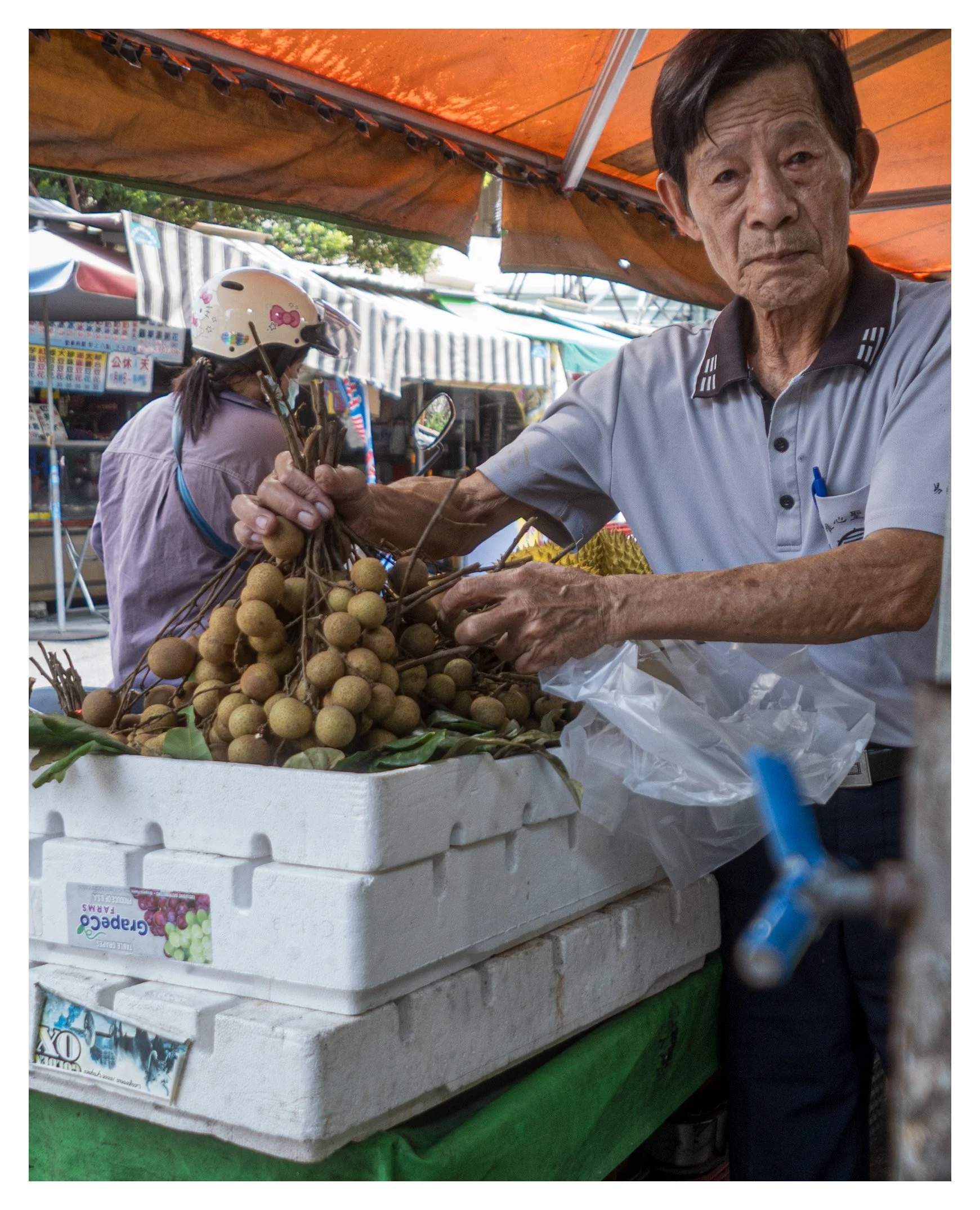
A longan vendor at Lingya Market meets the lens with a gaze that has already decided something about the person holding the camera. On the difference between a street photograph and a portrait, what a wide lens held close does to both faces and fruit, and the found joke sitting quietly at the bottom of the frame.
METADATA
• Camera Model: Leica D-Lux 8
• Shutter Speed: 1/400 sec
• Aperture: f/1.7
• ISO: 200
THE CRITIQUE
There is a meaningful difference between a photograph taken of someone and a photograph taken with someone's knowledge, and this frame sits unmistakably in the second category. The man behind the fruit is not caught. He is looking directly down the lens with an expression that is guarded, appraising, entirely aware of what is happening, and the photograph's whole character depends on that awareness rather than in spite of it. This is not street photography in the purest, invisible-observer sense. It is closer to what Hiroh Kikai spent four decades doing at a temple gate in Tokyo: a brief, acknowledged transaction between photographer and subject, conducted in public, with the subject's full knowledge that a picture is being made of him.
The lens choice makes that transaction feel physically close rather than merely conceptually close. At roughly 24mm equivalent, held near enough to fill the frame with a face and a pile of fruit at the same time, wide-angle proximity does something a longer lens never could: it keeps the near and far elements of the scene in a genuine spatial relationship rather than compressing them into a flattened plane. His nearer hand and forearm, reaching toward the pile of longan, read larger and more immediate than his more distant face — not a distortion so much as an honest record of what standing that close actually looks like. Robert Capa's old dictum about not being close enough applies here almost literally: proximity is not just a stylistic choice, it is the entire mechanism by which this photograph generates its sense of contact.
The foreground is doing serious compositional work. A steep pyramid of longan, still clustered on their stems, rises from a white styrofoam crate and very nearly dominates the lower half of the frame, its radiating branches reading as a kind of gestural drawing laid across the fruit's dense, clustered texture. This is not an incidental prop. It anchors the entire lower register of the picture and gives the eye somewhere substantial to rest before climbing to the man's face, and the shallow depth of field at f/1.7 keeps the nearest fruit sharp enough to read as genuinely tactile.
There is a small, dry joke sitting at the very bottom of the frame that deserves one sentence and no more: the crate holding the longan was printed for grapes. GRAPECO FARMS, TABLE GRAPES, in cheerful branding, now doing duty as a longan crate on a market table in Kaohsiung. It is exactly the kind of incidental textual mismatch this blog has come to enjoy noticing, and exactly the kind of detail that only exists because a market stall reuses whatever packaging is on hand rather than because anyone intended a joke.
Behind the man, the frame goes soft quickly, and this is one of the photograph's clearest technical successes. At this aperture and this subject distance, a woman in a Hello Kitty motorcycle helmet, a scooter mirror, striped market awnings and a wedge of yellow durian all recede into a legible but non-competing blur — present enough to place the scene firmly in a working Taiwanese market, soft enough that none of it fights the man's face for attention. Compare this to frames elsewhere in this series where a busy background has genuinely competed with the subject; here the optics are doing the separation work almost entirely on their own.
Colour and light are working in the man's favour without calling attention to themselves. The stall's rust-orange awning throws warm light down across his face and the polo shirt's pale grey reads clean against it, while the green cloth beneath the crates and the leaves still clinging to the longan branches supply the only cool notes in an otherwise warm frame. Nothing here has been engineered for effect. It is simply what a market stall under canvas looks like at midday, recorded accurately.
Where the frame is worth a second, harder look is at its edges. A blue-handled tool — almost certainly used for cutting fruit clusters from the branch — sits partially visible at the lower right, cropped just enough to register as present without ever being legible as an object. Given how much this photograph already owes to the tradition of showing tradespeople with the tools of their work, that half-visible hook feels like an opportunity only partly taken.
This is, in the end, a photograph that earns its directness. The man is not smiling, is not performing warmth for the camera, and the picture is considerably stronger for declining to ask that of him.
HOW THIS IMAGE COULD BE IMPROVED
• Resolve the blue-handled tool at the lower right edge. Either frame wide enough to include it as a legible object — a genuine tool-of-the-trade detail worth having in full — or crop tighter to exclude it cleanly. The current partial inclusion reads as unintentional.
• Watch the zone directly behind the subject's head. It currently sits close to a slightly busy patch of awning fabric and a hint of yellow durian; a half-step to the side at the moment of exposure would separate his profile from that background more cleanly.
• Consider a companion frame taken a beat later in the same encounter, once the initial awareness of the camera has settled. The guarded expression here is genuinely compelling, but a second, more relaxed register from the same subject would round out a proper character study rather than a single moment of it.
• Check exposure on the brightest part of the orange awning at the top of the frame. Strong midday sun under coloured canvas can clip highlights quickly; a third of a stop of negative compensation would give more room to protect that colour.
• If revisiting this stall, get lower and closer to the fruit pyramid itself for at least one frame, letting it fill more of the lower third and intensifying the immersive proximity the wide lens already does well elsewhere in this composition.
ON BECOMING A BETTER PHOTOGRAPHER: LET THE DATA SPEAK
• Track how often your portraits of strangers involve direct eye contact with the lens versus candid unawareness, and note which register you find yourself reaching for more often. Neither is superior; knowing your own default is the useful part.
• Log what sits directly behind a subject's head in every portrait-style frame for a month. Background clutter at exactly that point is one of the most common and most fixable errors in close portraiture, and it rarely gets noticed until reviewed in aggregate.
• Where a subject grants you a moment of acknowledged attention, try to make at least two frames rather than one — the guarded first reaction and whatever follows it. Reviewing pairs like this over time teaches you a great deal about how strangers relax, or don't, in front of a camera.
• Continue tracking crop ratio against camera body, a thread worth carrying forward from an earlier post in this series. This frame breaks the square-crop pattern noted previously with this same camera, which is itself a useful data point: the habit is not universal, and knowing when it does and doesn't hold is more valuable than the habit itself.
• If a market or working stall welcomes repeat visits, treat it as an ongoing subject rather than a single frame. The trust built over several visits tends to produce a materially different, more settled kind of portrait than a first encounter ever can.
PHOTOGRAPHERS TO RESEARCH
• Hiroh Kikai — four decades of acknowledged portraits made at the gate of a Tokyo temple, the clearest possible model for photography as a brief, consented encounter rather than a stolen one.
• Bruce Gilden — close-quarters, wide-lens street portraiture built entirely around proximity as method, unafraid of the tension it creates.
• Diane Arbus — a career spent photographing people who knew exactly what was happening, and letting that mutual awareness become part of the picture rather than something to disguise.
• Irving Penn — the "Small Trades" series brought tradespeople into the studio with the tools of their work, treating labour and craft as subjects worthy of formal portraiture.
• Marc Riboud — decades documenting Asia with a rare combination of geometric rigour and genuine warmth toward the people in front of his lens.
BOOKS TO READ
• "Asakusa Portraits" — Hiroh Kikai. Hundreds of brief encounters at a single temple gate, and essential reading on portraiture as transaction.
• "Facing New York" — Bruce Gilden. Close, high-intensity street portraits that argue proximity is itself a compositional decision.
• "Diane Arbus: An Aperture Monograph" — still the definitive single-volume introduction to her work and method.
• "Irving Penn: Small Trades" — tradespeople and market workers photographed with their tools, dignified and unadorned.
• "Marc Riboud: Fifty Years of Photography" — a career retrospective spanning China, Vietnam and beyond, essential for anyone photographing working life in Asia.
VIDEOS TO WATCH
• In Conversation | Bruce Gilden On Street Photography — Magnum Photos
https://www.youtube.com/watch?v=foGe7nRSo3k
• Masters Of Photography — Diane Arbus (1972 Documentary)
https://www.youtube.com/watch?v=Q_0sQI90kYI
• The Art Of Capturing Humanity — Irving Penn's Small Trades
https://www.youtube.com/watch?v=wv88rC2kQJE
• Marc Riboud — A Nomadic Quest For Stories