

Day 327/365 The Balloon Is Smiling At No One
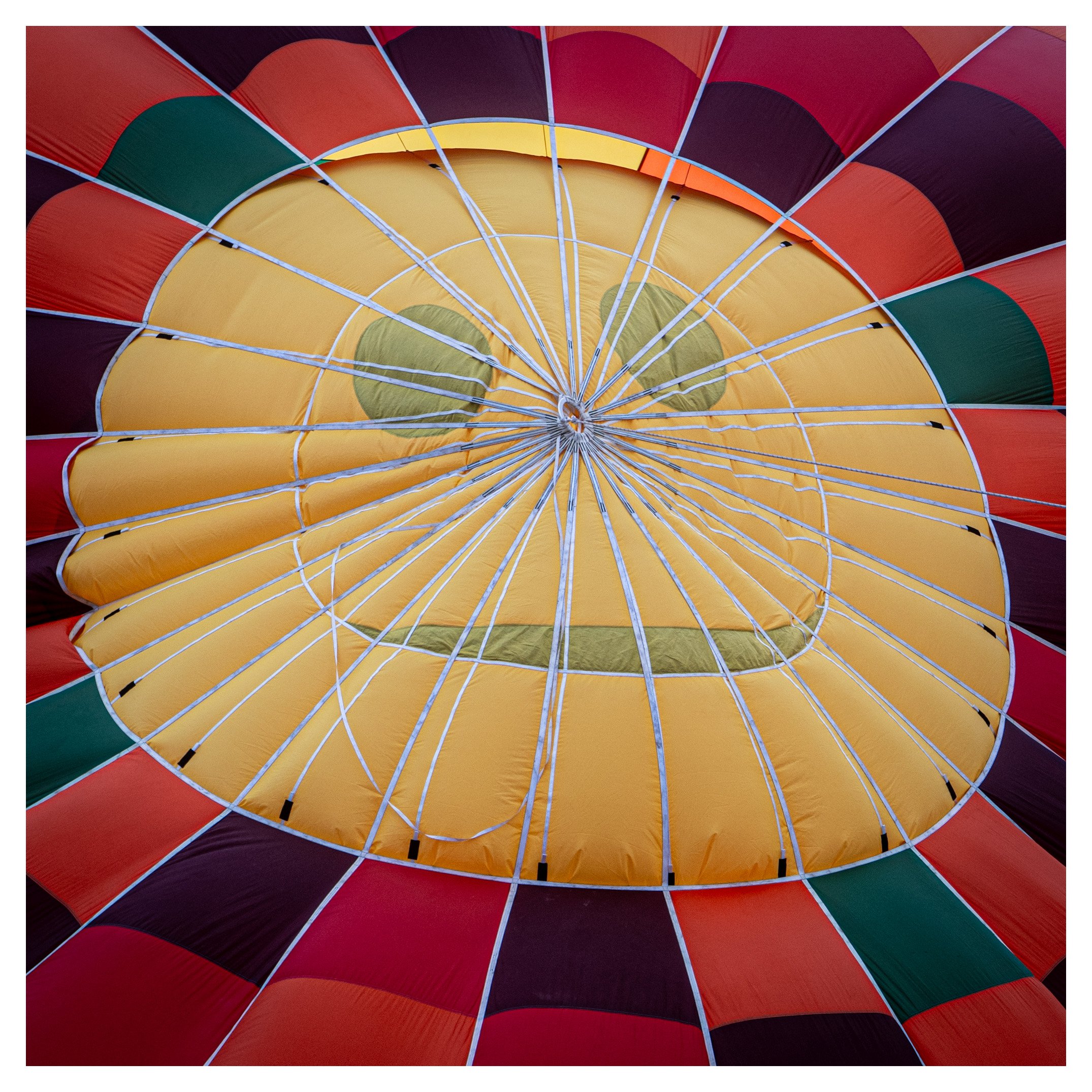
Looking straight down onto the crown of a hot air balloon, a web of white rigging tapes converges to a single point at the top, and the yellow fabric there just happens to resemble a face. A study in radial symmetry, alternating colour, and the difference between a pattern that was designed and one a camera simply found.
METADATA
• Camera Model: Leica D-Lux 8
• Lens: DC VARIO-SUMMILUX 10.9-34mm ASPH.
• Shutter Speed: 1/125 sec
• Aperture: f/5
• ISO: 200
THE CRITIQUE
Hot air balloons are built from a set of long fabric wedges called gores, sewn edge to edge with a reinforcing tape running the full length of each seam, all of those tapes gathering at the crown — the very top of the envelope — into a single rigging point that holds the whole structure's shape under load. From ground level, walking past an inflated balloon, none of that is visible; it simply reads as a large coloured shape overhead. This frame was made from above, looking directly down onto that crown, most likely during ground inflation, when the envelope lies flat and its top panel briefly becomes accessible to a camera in a way it never is once the balloon is standing upright with its crown many metres in the air. Whatever the exact circumstance, the vantage is a genuine rarity: a view of a balloon's most structurally important point that almost nobody who has watched one fly has actually seen.
The composition could not be more literal about its own geometry. Dozens of white tapes radiate outward from a tight knot of rigging at the exact centre of the frame, tracing perfectly straight lines across a curved, three-dimensional surface until they reach the perimeter, where alternating wedges of crimson, deep aubergine and forest green take over. This is radial symmetry used about as directly as photography allows: a single point, lines radiating from it in every direction, and nothing in the frame competing with that structure for attention. The eye has no real choice but to be pulled toward the centre, then sent back outward along whichever tape it happened to land on.
Colour is doing a second, separate job here, running against rather than with the radial lines. The gore panels alternate in a repeating rhythm around the perimeter — red, purple, green, red, purple, green — creating a rotational visual pulse distinct from the straight-line convergence of the rigging. Two different systems, one radiating and one rotating, occupy the same frame simultaneously, and the slight tension between them is what keeps the image from settling into pure, static symmetry. A perfectly even mandala would be inert. This one has a faint suggestion of spin to it, generated entirely by the colour sequence rather than by anything actually moving.
At the centre, where the yellow crown panel sits closest to the rigging point, two darker olive patches and a curved band happen to fall into an arrangement that reads, almost unavoidably, as a face — two eyes, a mouth, set into a wide yellow head. This is very likely pure coincidence, a reinforcing patch or a structural seam that was never designed to resemble anything, caught at the one moment and angle where it does. It is worth noting exactly once, in the spirit of every other accidental resemblance this blog has flagged in inanimate objects, and then left alone. The photograph does not need the face to succeed. It is simply a pleasant surprise sitting at the exact point the whole composition was already built to draw the eye toward.
Technically, the exposure has been judged well for a genuinely difficult surface to photograph evenly. Balloon fabric is not flat — it billows, folds and catches light unevenly even when laid out — and a wider aperture here would have thrown large sections of the radiating pattern out of focus as the surface curved away from the plane of sharpest focus. At f/5, enough depth is held across the curve that tapes near the frame's edge remain nearly as crisp as those at the centre, which matters enormously in an image whose entire structure depends on every line reading clearly from the middle of the frame to its outer edge.
There is a genuine connection worth drawing to another extreme-perspective photograph already discussed on this blog: a frame looking straight down at a pavement from a great height, where a single small figure and an enormous shadow did all the compositional work. Both images share the same refused vantage point — a direct, vertical look down at a surface rather than the eye-level view a normal photograph defaults to — and both depend on scale and geometry rather than a face or gesture to hold interest. What differs is the source of that geometry. That earlier frame found its structure in coincidence: a low sun, a passing figure, gone within minutes. This one finds its structure in engineering, in the deliberate radial construction of a manufactured object that will look exactly the same the next time someone gets above it. Both are legitimate uses of the same overhead vantage, and it is worth knowing which kind of photograph is being made each time a camera is pointed straight down: one borrowing a moment's accidental order, or one revealing order someone else built on purpose.
HOW THIS IMAGE COULD BE IMPROVED
• If a slightly wider or narrower crop is possible on a repeat shoot, experiment with how many complete colour wedges sit at the frame's edge. An even number currently produces a certain visual balance; an odd number, or a partial wedge cut by the frame boundary, would change the composition's sense of rotational rhythm meaningfully.
• Consider a version taken at a slightly different angle to the vertical, introducing a small amount of asymmetry to the radial convergence. Perfect symmetry is striking but can read as static; a few degrees off-axis might add tension without sacrificing the pattern's legibility.
• If the crown's face-like patches can be photographed again in slightly different light, note whether the resemblance holds or was specific to this exact exposure and colour balance. Coincidental readings like this one are often more fragile than they first appear.
• Where possible, pair this frame with a wider shot of the balloon fully inflated and upright from a normal vantage point. The overhead structural view is strong on its own, but a companion image showing what all this rigging actually produces once the balloon is standing and flying would round the pair out considerably.
• Watch for any slight softness where the fabric folds furthest from the lens's plane of focus. A touch more depth of field, if light allows, would ensure the outermost gore seams hold the same crispness as the centre.
ON BECOMING A BETTER PHOTOGRAPHER: LET THE DATA SPEAK
• Keep a dedicated note of manufactured objects whose internal construction reveals striking geometry once viewed from an unusual angle — balloon rigging, umbrella ribs, tent structures, awnings. This is a repeatable category of photograph, and a running list of candidates will make it far easier to recognise the next opportunity quickly.
• Track how often a strong radial or symmetrical composition in your work comes from engineered structure versus coincidence of light and shadow. Both produce similar-looking results, but they are found in completely different ways, and knowing which you are chasing changes how you look for the next one.
• Log your aperture choices specifically for curved, three-dimensional surfaces like fabric, versus flat subjects like walls or pavement. Depth of field behaves very differently across a curve, and a personal record of what worked will save considerable trial and error next time.
• When a photograph contains an accidental figurative resemblance — a face, a shape, a familiar form appearing where none was intended — note it once, plainly, and resist the temptation to build the whole caption or edit around it. The resemblance is a bonus, not the subject.
• Revisit any earlier extreme-perspective frames in your archive and sort them by source of geometry: found in the moment, or built into the object itself. This distinction, once made explicit, often reveals which type you are naturally drawn to and which you might be under-exploring.
PHOTOGRAPHERS TO RESEARCH
• Franco Fontana — flattened landscapes into pure bands of saturated colour for six decades, treating colour itself as the actual subject of a photograph. Fontana died only a few weeks before this piece was written, and his work is worth revisiting with that in mind.
• Barbara Kasten — built entire photographic careers around geometric abstraction constructed from light, glass and colour rather than found in the world.
• James Welling — has spent decades testing exactly how far a photograph can be pushed toward pure pattern and abstraction while still remaining recognisably a photograph of something.
• Marilyn Bridges — photographed ancient earthworks and sacred sites exclusively from directly overhead, letting radial and geometric patterns built by other hands centuries earlier carry the entire image.
• David LaChapelle — works in hyper-saturated, almost carnival colour, treating a photograph's palette with the same theatrical intensity this balloon's own colour scheme carries.
BOOKS TO READ
• "Skyline" — Franco Fontana. The 1978 book that established colour itself, rather than subject matter, as serious photographic territory.
• "Barbara Kasten: Stages" — a full career survey of an artist who built abstraction directly out of light and geometric construction.
• "James Welling: Monograph" — a career-spanning survey of an artist relentlessly testing the boundary between photographic abstraction and representation.
• "Markings: Aerial Views of Sacred Landscapes" — Marilyn Bridges. Ancient earthworks and monuments photographed exclusively from directly above.
• "LaChapelle Land" — David LaChapelle. Hyper-saturated, theatrical colour used as a deliberate, maximalist artistic language.
VIDEOS TO WATCH
• Franco Fontana — Creative Horizon (2012): A Gaze In Colour
https://www.youtube.com/watch?v=NQ5Akc1-bFw
• Light, Form, Experiment: Barbara Kasten's Return To Poland
https://www.youtube.com/watch?v=G0PZZ8o7r3M
• James Welling In Conversation With Simon Baker — Galerie Marian Goodman
https://www.youtube.com/watch?v=4ayewJe0j0w
• VICE Meets: David LaChapelle