

Day 328/365 The Bicycle Graveyard Has A Witness
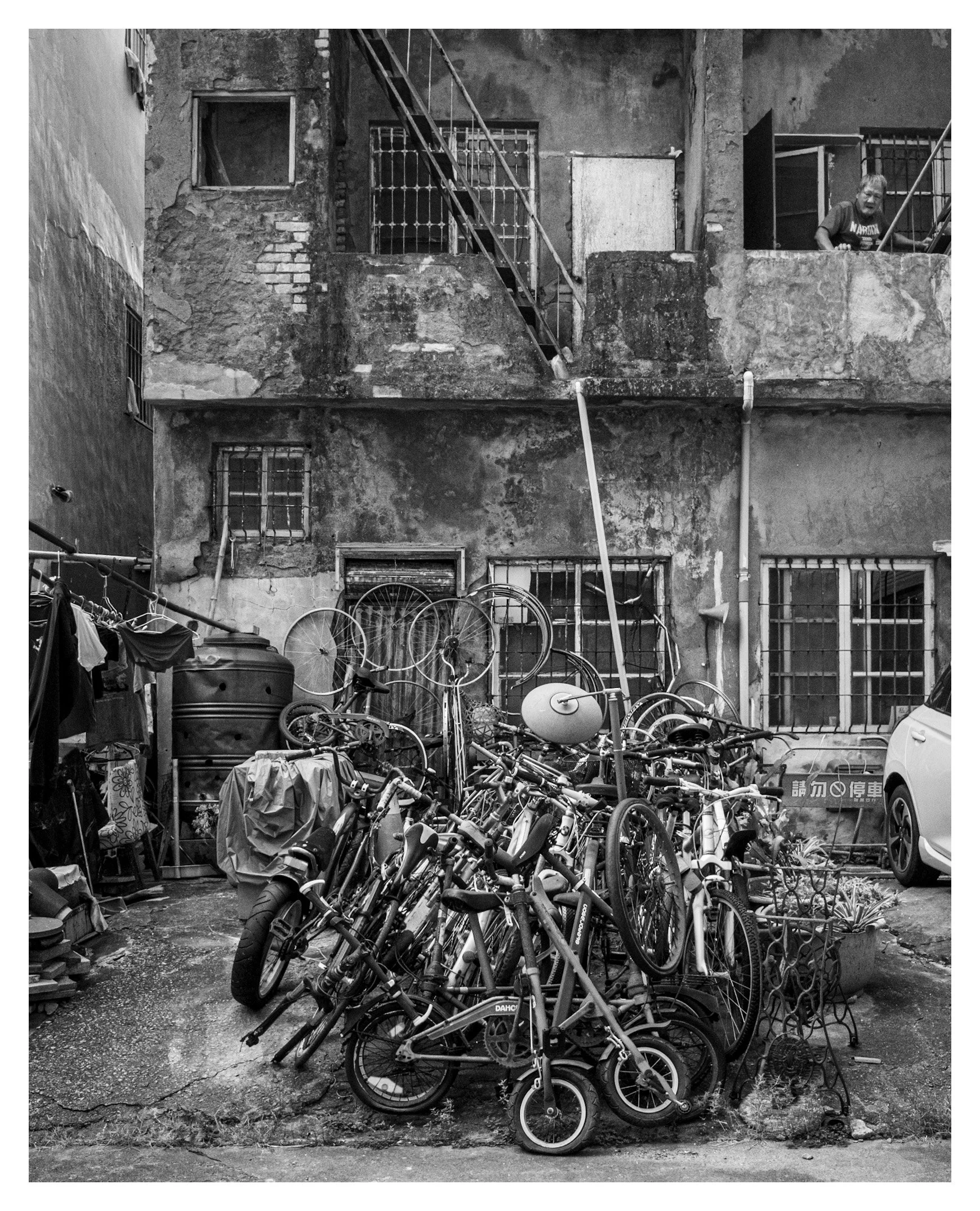
Dozens of derelict bicycles, tangled into a single dense mass against a crumbling Kaohsiung facade, and a man leaning out of an upper window watching over all of it. Most viewers will see the pile first and the witness never. This is a study in what deep focus and patient looking can do for a scene built almost entirely out of accumulation.
METADATA
• Camera Model: Ricoh GR III
• Lens: GR LENS 18.3mm F2.8
• Shutter Speed: 1/320 sec
• Aperture: f/8
• ISO: 1600
THE CRITIQUE
The first thing this photograph shows is a mountain of bicycles — frames locked into each other at every possible angle, wheels standing upright among the tangle like a small row of coins propped against a doorway, dozens of individual machines compressed into something closer to a single sculptural mass than an inventory of separate objects. It is a genuinely striking amount of visual information, and it would be easy to stop there.
The second thing this photograph shows, tucked into the upper right corner where most viewers will not look for several seconds, is a man leaning out of a window at the top of an external staircase, watching. He is not posed. He is not acknowledged by any caption or arrow pointing him out. He is simply there, present in the frame the way a real witness to a real scene actually is, and finding him is one of the genuine rewards this photograph offers to anyone willing to look at it for longer than a glance.
That structure — an overwhelming foreground demanding immediate attention, a quiet human presence rewarding patience — is the photograph's real achievement, and it is worth being precise about how the composition delivers it. The building's diagonal external staircase, zigzagging up through the frame's upper third, terminates almost exactly at the window where the man stands. Whether this was recognised at the moment of shooting or simply happened to align, the effect is the same: the eye, once it starts climbing the staircase's diagonal, arrives at a person rather than at empty architecture. The bicycles below have no comparable structure of their own. They read as accumulation, not sequence. The building above provides the only path the eye has to follow, and it leads somewhere.
Texture is doing enormous work throughout, and black and white is exactly the right decision for it. The facade carries decades of weather in its surface: plaster peeling back to expose brick beneath, water staining running in dark streaks from window ledges, a patchwork of repair and neglect that colour would have flattened into a single warm-grey wash. Stripped of colour, every one of those variations in surface — smooth render against rough exposed brick against rusted metal grille against the coiled chaos of bicycle spokes — gets to compete on tone and texture alone, which is a fairer fight and a more legible one. The bicycle pile in particular benefits enormously: in colour, dozens of overlapping frames in whatever paint they originally carried would have read as visual noise. In monochrome, they resolve into a single, coherent, almost geological mass — closer to a rock formation than a collection of vehicles.
The choice of aperture deserves specific credit. At f/8, this is the deepest depth of field used anywhere in this series, and it is the correct call for a scene whose entire point is that everything — the nearest handlebar, the furthest barred window, the man three storeys up — needs to remain legible at once. A shallower aperture would have isolated one plane of the scene and lost the rest, and this photograph is explicitly not about isolation. It is about density: how much can accumulate in one place, and how much of it a single frame can hold onto without collapsing into confusion.
There is a dry, almost deadpan joke buried in the lower right of the frame that deserves exactly one sentence. A sign reading "no parking" sits nearly swallowed by the pile of bicycles surrounding it — a prohibition on stopping vehicles, standing guard over what is, functionally, a permanent parking situation for several dozen of them. Whether anyone involved intended the irony, the photograph found it and kept it, which is often the most a photographer can ask of a scene like this one.
This kind of image — accumulated discarded objects, a decaying vernacular building, human presence at the margins rather than the centre — sits inside a well-established documentary tradition of treating overlooked, unglamorous corners of a city as genuinely worth sustained attention. That tradition has never needed its subjects to be beautiful. It has needed them to be looked at carefully, which is precisely what this frame does.
HOW THIS IMAGE COULD BE IMPROVED
• Resolve the white car at the frame's right edge. It is currently half-included, cropped just enough to register without being a legible object — the same partial-inclusion issue this series has flagged before at other frame edges. Either crop tighter to exclude it or step back to include it deliberately.
• Consider giving the "no parking" sign slightly more visual room. The irony is already present and does not need underlining, but it is currently so buried that many viewers will miss it entirely rather than discover it as a quiet aside.
• If a second visit to this location is possible, a frame isolating just the standing wheels near the doorway — the clearest passage of circular, breathing space in an otherwise dense, angular composition — would make a strong companion image built on contrast with this wider view.
• Watch whether the man in the window is open to being acknowledged on a return visit. The current respectful distance is a legitimate choice, but a second frame with his direct awareness of the camera would offer a genuinely different, complementary photograph rather than a replacement for this one.
• Check the framing against the building's full height on a repeat shoot. A small amount of additional headroom above the man's window might let the staircase's diagonal complete its visual arc with slightly more room to breathe at the top.
ON BECOMING A BETTER PHOTOGRAPHER: LET THE DATA SPEAK
• Continue the running audit of ambiguous, half-included elements at frame edges — a car here, a figure elsewhere in this series. This is now a repeated finding across multiple posts and worth a deliberate pass through your archive specifically looking for it.
• When photographing dense accumulation, test the same scene at both a shallow and a deep aperture before settling on one. This frame's f/8 is a considered choice; knowing what the shallower alternative would have lost is the only way to be sure the deep option was the right one rather than the default one.
• Build a habit of scanning every frame edge to edge after the fact, specifically hunting for secondary human presences that the main subject might have overshadowed at the moment of shooting. This photograph's real strength is a detail easy to miss on a first pass.
• Revisit sites of significant accumulated clutter — junk piles, storage yards, communal collection points — on a recurring schedule. These locations change slowly but genuinely over months, and a documented sequence would carry real value that a single visit cannot.
• Track whether black and white is becoming a default reach for texture-heavy, decayed subjects specifically, versus a decision weighed against a colour alternative each time. Knowing which it is changes how deliberately the choice is being made.
PHOTOGRAPHERS TO RESEARCH
• Camilo José Vergara — has spent over four decades documenting American urban decay and change, often returning to the exact same buildings across years to track their transformation.
• Robert Polidori — photographs interiors and facades altered by time and habitation, treating decayed architecture as a record of the lives that passed through it.
• Ed Ruscha — pioneered a deadpan, deliberately unglamorous documentary style applied to the most ordinary structures imaginable, arguing they deserved serious attention anyway.
• Andrew Moore — large-format studies of American urban decline, particularly Detroit, that find genuine formal beauty in abandonment without ever softening its causes.
• William Christenberry — spent his career photographing the same rural Alabama structures across decades, watching vernacular buildings slowly surrender to weather and time.
BOOKS TO READ
• "American Ruins" — Camilo José Vergara. Decades of American urban decline, photographed with a sociologist's patience and an artist's eye.
• "Havana" — Robert Polidori. A city's faded grandeur, documented room by room, facade by facade.
• "Twentysix Gasoline Stations" — Ed Ruscha. The deadpan documentary artist's book that changed how ordinary structures could be treated as subject matter.
• "Detroit Disassembled" — Andrew Moore. Large-format photographs of a city's monumental buildings in the process of being reclaimed by time.
• "Southern Photographs" — William Christenberry. A rural American landscape photographed with quiet devotion across a lifetime.
VIDEOS TO WATCH
• Gaze: Photographing Detroit — With Camilo José Vergara And Andrew Moore
https://www.youtube.com/watch?v=gqvkIqOpVyI
• Ed Ruscha: "Twentysix Gasoline Stations" (1969)
https://www.youtube.com/watch?v=qctDfLffMoA
• A Conversation With Robert Polidori And Steven Hoelscher