

Day 329/365 Doors Open, Waiting
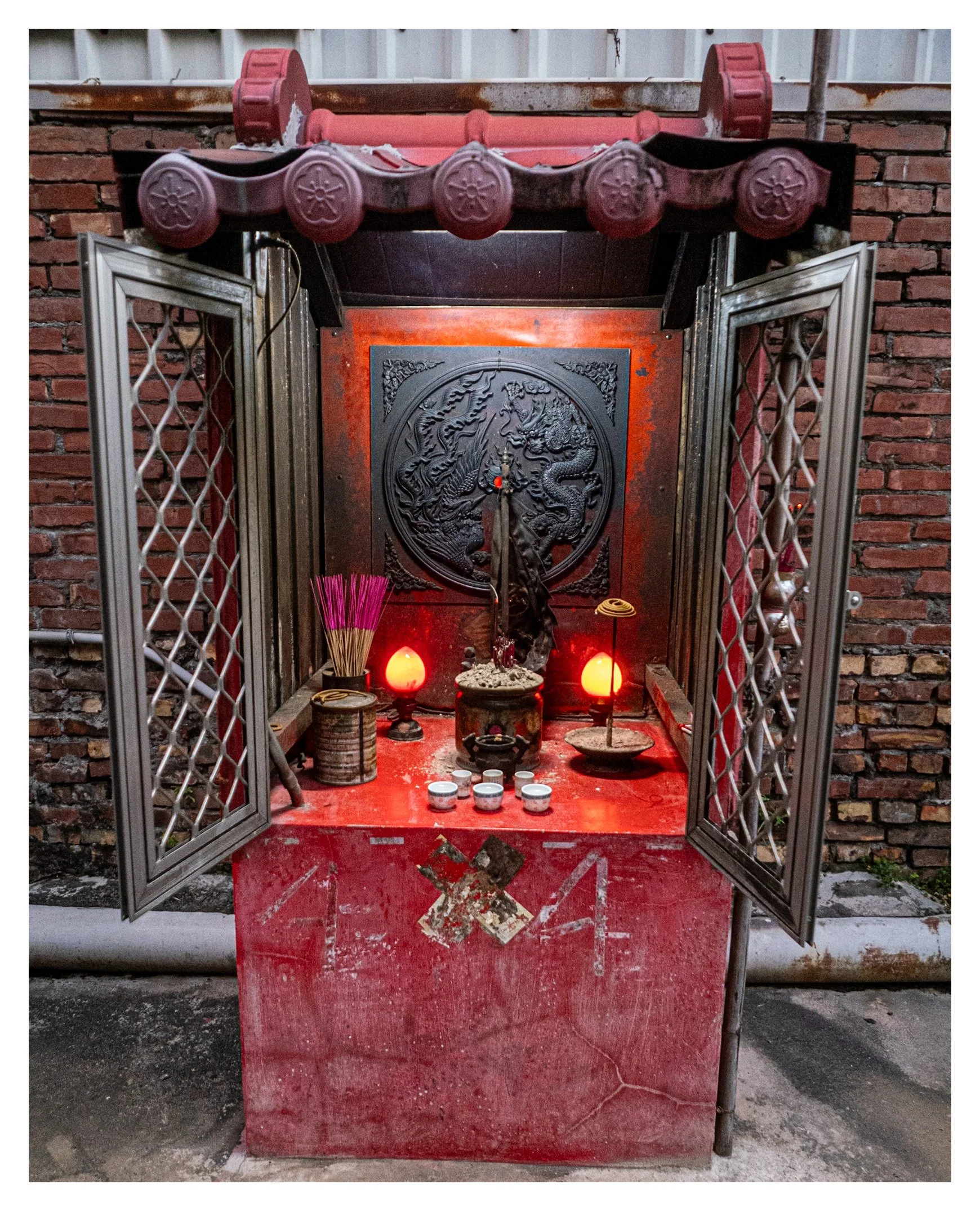
A small red street shrine, tucked against a brick wall somewhere in Kaohsiung, its cabinet doors open to reveal incense, offering cups and a carved dragon and phoenix catching the glow of two electric lamps. A study in symmetry, colour harmony rather than contrast, and what the wear on a devotional object tells you about how recently it was actually used.
METADATA
• Camera Model: Leica D-Lux 8
• Lens: DC VARIO-SUMMILUX 10.9-34mm ASPH.
• Shutter Speed: 1/125 sec
• Aperture: f/1.7
• ISO: 2500
THE CRITIQUE
This is a formal portrait of an object rather than a candid record of a scene, and the distinction matters from the first glance. The shrine sits dead centre in the frame, its two cabinet doors opened outward with near-perfect symmetry, presenting its contents directly to the lens the way a specimen case presents whatever is inside it. Nothing here was caught in passing. This is a photograph of something being shown, deliberately, straight on.
What it shows rewards the formality of the approach. A carved black relief panel, dragon and phoenix locked in a circular composition, sits at the exact centre of the shrine's interior, lit from either side by two glowing red electric lamps standing in for candles. In front of it: a cluster of vivid magenta incense sticks, a small worn burner filled with ash, a scatter of white offering cups, a coiled incense spiral on its own stand. None of this reads as staged or arranged for the camera. It reads as what it is — a small, actively used devotional object of the kind found throughout Taiwanese neighbourhoods, its contents accumulated through repeated visits rather than set out once for effect.
Colour is doing something different here than it has done elsewhere in this series, and it is worth naming the shift explicitly. Where earlier frames in this body of work have frequently built themselves around a contrast in colour temperature — warm light against cool shadow, saturated foreground against muted background — this photograph is built on harmony instead. The shrine's weathered red paint and the red brick wall behind it sit close together on the colour wheel, and the effect is a kind of visual absorption rather than separation: the object does not leap forward from its background so much as belong to it, as though the wall itself produced the shrine rather than merely hosting it. That is a legitimate and different way for a colour photograph to work, and it suits a subject about continuity and repeated ritual rather than a single dramatic moment.
The wear across the whole structure is doing real narrative work, and it is worth reading closely rather than glossing over. Paint has flaked from the roof's ornamental ridge caps down to bare rust. A paper talisman on the lower cabinet door has faded and torn, its edges curling. None of this reads as neglect. Read correctly, it reads as evidence of continued use: a shrine that sees regular incense, regular weather, regular hands opening and closing its doors, ages in exactly this way. A pristine, unweathered version of this same structure would actually tell a less interesting story — it would suggest an object recently installed rather than one that has been part of a neighbourhood's daily rhythm for years.
There is a quiet connection here worth drawing to the bicycle pile discussed elsewhere on this blog. Both photographs document weathered, vernacular objects sitting in ordinary urban space, their condition doing as much storytelling as their form. What separates them is a matter of use rather than subject: the bicycles were abandoned, their accumulation a record of things given up on. This shrine is the opposite — actively tended, its wear a record of things returned to, again and again. Photographing decay and photographing devotion can look formally similar. They are not the same act, and this frame is squarely the second one.
The strict symmetry never quite tips into sterility, and it is worth being precise about why. The incense sticks lean slightly off the vertical axis. The coiled spiral on its stand sits a little higher and further right than its mirror image would suggest. A rusted tin can occupies the left edge without any equivalent object balancing it on the right. These are small departures from a otherwise rigorous formal arrangement, and they are exactly what keeps the photograph feeling like a document of a real, used object rather than a diagram of one. Perfect symmetry photographs coldly. Symmetry with small, honest irregularities photographs like something someone actually lives with.
At f/1.7, close and wide, the shrine separates cleanly from its brick backdrop while still holding enough depth to keep the relief panel and the nearer offering cups both legible — a genuinely difficult balance at this aperture, and one the frame manages without either element losing definition.
HOW THIS IMAGE COULD BE IMPROVED
• Check the corrugated metal roofing visible at the very top edge of the frame. It reads as a slightly discordant modern intrusion against the shrine's traditional ornamentation; a tighter crop excluding it, or a repositioning to include more context instead, would resolve the current ambiguity about what it is or why it is there.
• Watch for glare on the relief panel's surface from the two flanking lamps. A small adjustment in angle or a touch less exposure on the brightest points of the lamps themselves would help protect detail in the carving where the light currently catches it hardest.
• Consider a companion frame showing the shrine's full surroundings — its position relative to the building or street it serves. This tight, formal version does its job well, but a second, wider frame would add scale and situational context this one deliberately withholds.
• If a return visit is possible, a frame made during an actual offering — someone lighting incense, placing a cup — would pair powerfully with this empty, formal version, showing the object in use rather than only in waiting.
• Note the ISO required here. At 2500, some fine grain is present in the darker brick areas; if a tripod or brace is available on a future visit, a slower shutter and lower ISO would hold slightly more detail in the wall's texture without changing the composition at all.
ON BECOMING A BETTER PHOTOGRAPHER: LET THE DATA SPEAK
• Start a dedicated catalogue of neighbourhood shrines and devotional objects encountered while walking. Their condition — fresh paint versus flaking, new offerings versus old ash — is a genuinely legible record of active use, and a body of work built around noticing that distinction would be a strong ongoing project.
• Track when a composition is built on colour harmony rather than colour contrast, and what kind of subject earns each choice. This frame is a clear example of harmony working in the subject's favour; knowing which approach a given scene calls for, rather than defaulting to contrast out of habit, sharpens the decision each time.
• Note how often small asymmetries — a leaning object, an object with no mirrored equivalent — keep an otherwise strict symmetrical composition from feeling sterile. Deliberately looking for these small departures, rather than trying to eliminate them, often strengthens formally rigorous frames.
• When photographing an actively used object rather than an abandoned one, consider documenting it both empty and mid-use across separate visits. The two versions together tell a considerably fuller story than either alone.
• Continue the running audit of frame-edge intrusions — the corrugated roofing here, a parked car elsewhere in this series. This is now a repeated, trackable pattern worth a deliberate pass through the archive rather than a one-off correction each time it appears.
PHOTOGRAPHERS TO RESEARCH
• Linda Connor — has spent decades photographing sacred sites and devotional objects worldwide with a large-format camera, approaching each with the same patient, reverent attention regardless of the tradition it belongs to.
• Lois Conner — large-scale panoramic photographs of China's cultural and religious architecture, treating history and ritual space as inseparable from the landscape around them.
• Thomas Struth — documented museums, churches and other spaces of collective devotion and attention, examining how formal, symmetrical presentation shapes what a viewer feels obligated to notice.
• Candida Höfer — built an entire career on strict frontal symmetry applied to libraries, churches and grand institutional interiors, treating architectural order itself as the subject.
• Guido Guidi — spent over four decades photographing Italy's marginal, vernacular landscape, including its roadside shrines and small devotional markers, with the same patient attention he gave to any other overlooked structure.
BOOKS TO READ
• "Odyssey: The Photographs of Linda Connor" — thirty years of sacred sites and devotional objects photographed with rare consistency of attention.
• "China: The Photographs of Lois Conner" — panoramic studies of Chinese cultural and religious architecture, shot with a banquet camera over more than a decade.
• "Museum Photographs" — Thomas Struth. Formal, symmetrical studies of how people gather in front of things they have collectively agreed matter.
• "Libraries" — Candida Höfer. Grand institutional interiors photographed with unwavering frontal symmetry and near-total stillness.
• "Per Strada" — Guido Guidi. Marginal, overlooked Italian landscapes, including the small vernacular structures most photographers drive straight past.
VIDEOS TO WATCH
• Creative Feature — Lois Conner: Photographing China
https://www.youtube.com/watch?v=437V1ShDz4o
• Candida Höfer — Public Interview (English)
https://www.youtube.com/watch?v=sQEv1RtZAuo
• Photographer Thomas Struth: "My Work Is About The Theatre Of Life" — Louisiana Channel