

Day 330/365 Someone Marked This Mirror First
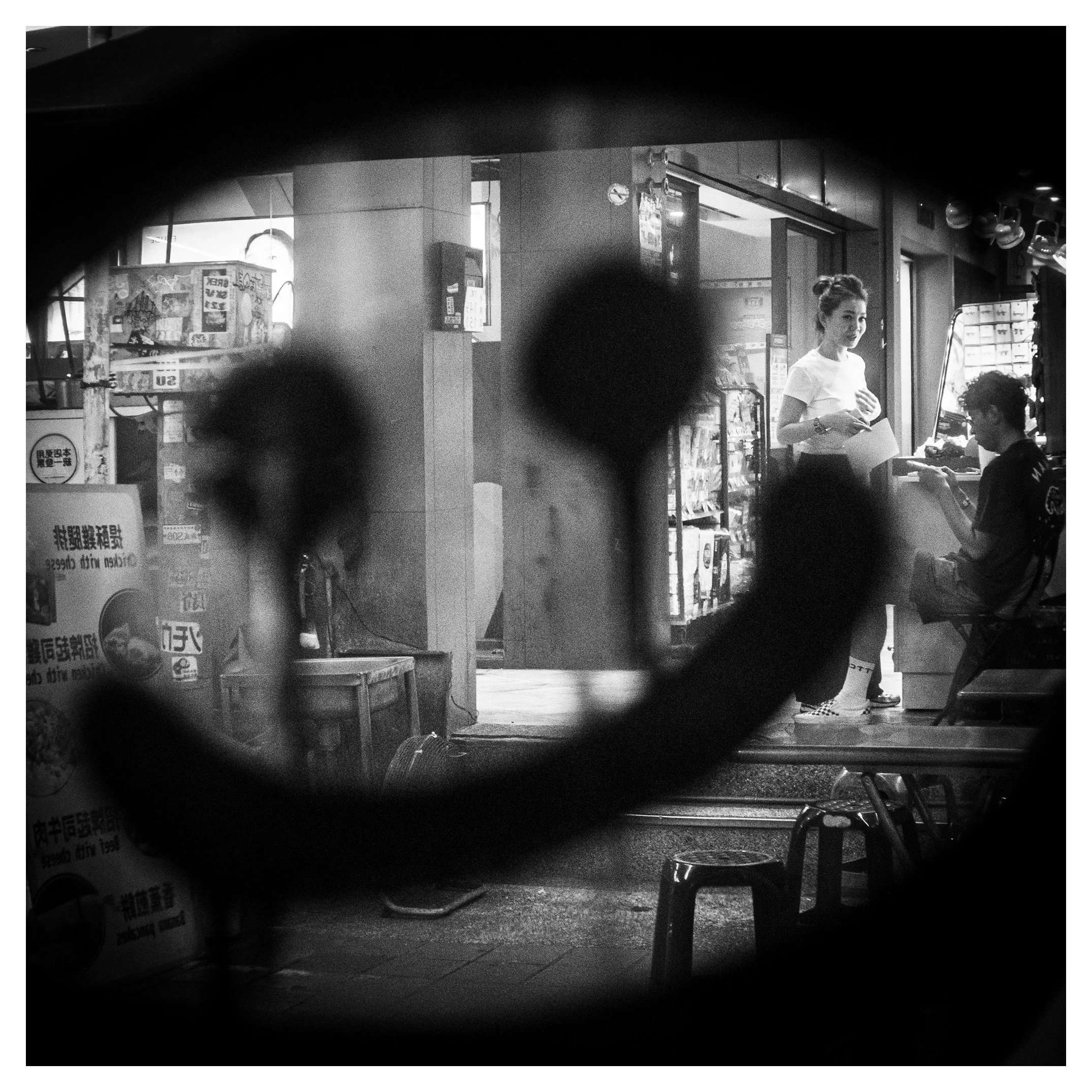
What looks at first like a photograph taken through a blurred foreground object is actually something stranger: a reflection, caught in a mirror someone else had already scrawled graffiti across. A woman and a man go about an ordinary evening at a food stall, unaware they are being viewed twice removed, through marks that were never meant to frame anyone.
METADATA
• Camera Model: Leica D-Lux 8
• Lens: DC VARIO-SUMMILUX 10.9-34mm ASPH.
• Shutter Speed: 1/125 sec
• Aperture: f/2.6
• ISO: 1600
THE CRITIQUE
It is worth being honest about what this photograph does on first viewing, because the mistake it invites is part of what makes it interesting. The dark, soft-edged shapes curling across the lower half of the frame read, at a glance, like an out-of-focus object held close to the lens — a common enough street photography device, shooting past something to reveal a scene beyond it. That is not what is happening here. Those shapes are graffiti, marked directly onto the surface of a mirror, and the crisp, well-lit scene beyond them — a woman standing near a counter, a man seated and absorbed in something in front of him, shelves of packaged food, a poster advertising chicken and cheese — is not a scene being viewed directly at all. It is a reflection.
That correction matters more than it might first seem to, because it changes what kind of photograph this actually is. Shooting through an obstruction is a technique about physical space: something sits between the camera and its subject, and the photograph is built on the gap between them. Shooting a graffiti-marked mirror is a technique about layered authorship instead. The marks on the glass were not placed there for this photograph, or by this photographer, or with any photograph in mind at all — someone else, at some earlier point, left their own gesture on the same surface this frame now depends on to produce its image. The vandalism and the photograph are not in the same physical space competing for the same depth of field. They are stacked on the same plane, doing two entirely different jobs at once: one defacing a surface, the other using that surface to bend light into a picture.
Read this way, the graffiti stops being simply an obstruction and starts being a genuinely productive collaborator, however unwilling. The dark marks dissolve into pure gesture — a curling, doubled shape with no legible content, more like handwriting reduced past the point of words than like anything approaching a real image. Because they sit soft and abstract against the sharply focused reflection behind them, the eye reads them as atmosphere rather than as information: they slow the approach to the human scene without ever threatening to explain themselves. That restraint is doing real work. A more legible tag, focused sharp enough to read as an actual name or message, would turn this into a photograph about the graffiti. Kept this soft, it stays a photograph about looking through something someone else has already touched.
The reflected scene itself carries the quieter, more conventional strengths of the frame. Two figures, two entirely different states of attention: the woman upright, alert, her posture suggesting she is aware of the mirror in front of her, though whether she is checking her own reflection or registering the presence of a camera is genuinely unknowable and shouldn't be resolved by guesswork. The man seated at the counter, head down, attention fully elsewhere, unaware of anything happening at the mirror at all. That contrast — one figure caught mid-awareness, one caught in complete absorption — gives the frame a small but real psychological charge even before accounting for the layered device delivering it.
It is worth noting, too, that because this is a mirror rather than a window, the entire reflected scene is almost certainly reversed left to right from how it would appear standing in the room itself — a small, invisible fact baked into every mirror photograph, mentioned here simply because it is true of this one, not because it needs correcting.
At f/2.6 and 21mm — coincidentally the exact wide-angle length Mark Cohen built an entire career photographing at, though his tools were flash and proximity rather than reflection — the choice to hold focus on the reflected scene rather than the mirror's marked surface itself was the right one. It lets the vandalism recede into texture while keeping the two figures, the real subject of the frame, unmistakably sharp.
The square crop continues to earn its place in this camera's vocabulary. With three distinct layers now legible in the frame — the graffiti's gesture, the mirror as an object, the reflected human scene beyond it — a centered, non-directional format handles all three without visually favouring one over the others, which a wider or taller crop would have been more likely to do.
HOW THIS IMAGE COULD BE IMPROVED
• Consider including a small hint of the mirror's physical edge, frame, or mount somewhere in the composition. As it stands, a viewer needs a beat to realise this is a reflection rather than a direct view — the same beat this critique needed. A sliver of the mirror's actual boundary would anchor that read immediately, without sacrificing any of the layered quality that makes the frame worth a second look.
• If a return visit to this mirror is possible, a companion frame focused on the graffiti itself, rather than through it, would make a genuinely interesting pair — one photograph about the vandalism as subject, one using it as atmosphere, from the same physical vantage point.
• The ambiguity around the woman's gaze — her own reflection, or the photographer — is a real strength here, but it would be worth testing whether a slightly different angle captures more of her posture and activity, deepening rather than resolving that ambiguity.
• Check whether a touch more separation between the darkest graffiti marks and the mirror's own shadowed edges would help the vandalism read a little more distinctly as marks on glass, rather than blending into the mirror's frame in the darkest areas of the print.
• Note the exposure choices at ISO 1600 in mixed lighting — reflected fluorescent light against ambient evening dark. The balance holds well here, but it is worth remembering as a benchmark setting for this specific kind of mirror-and-graffiti subject on a future shoot.
ON BECOMING A BETTER PHOTOGRAPHER: LET THE DATA SPEAK
• Start a dedicated project around mirrors, reflective surfaces, and the graffiti or scratches that accumulate on them — scooter mirrors, shop windows, convex traffic mirrors are everywhere in Taiwanese cities and represent a genuinely underexplored subject with real depth to it.
• When photographing a reflection, deliberately test both focusing on the reflective surface itself, letting scratches, dust, or graffiti become the primary subject, and focusing through it on the reflected scene, as done here. These are two different photographs from the same vantage point, and learning to choose between them on purpose sharpens both.
• Build the habit of confirming what a frame actually contains — direct view, reflection, or something else mediating it — before drawing conclusions about its compositional logic. This exact photograph is the clearest evidence yet in this series for why that check matters: the first reading and the correct one led to genuinely different critiques.
• Continue the running log of "obstruction versus revealed content" compositions in this archive, but split it going forward into its real component techniques — physical foreground objects, marked or vandalized surfaces, and reflections are related devices, not one device, and tracking them separately will produce sharper lessons than lumping them together.
• When a reflection is the subject, consider including just enough of the reflecting object's physical edge to let a viewer parse the image correctly within a second or two, unless deliberate disorientation is the explicit goal of the frame.
PHOTOGRAPHERS TO RESEARCH
• Martha Cooper — spent decades documenting graffiti and street art as it happened, treating vandalism not as damage to be ignored but as a legitimate visual culture worth recording seriously.
• Duane Michals — built a career on sequences exploring mirrors, reflection, and the instability of what a photograph claims to show, often using the mirror itself as both subject and device.
• Ralph Eugene Meatyard — used masks, blur, and recurring broken-mirror imagery to question whether a photograph ever reveals a real, singular identity at all.
• Alex Webb — a master of layered, multi-plane colour compositions where several unrelated pieces of information occupy one frame without ever fully resolving into a single clean subject.
• Mark Cohen — pioneered an aggressively close, fragmentary approach to street photography at the same wide focal length used here, letting objects and body parts intrude across the frame as a deliberate compositional strategy.
BOOKS TO READ
• "Subway Art" — Martha Cooper and Henry Chalfant. The definitive early document of graffiti as a living visual culture rather than mere vandalism.
• "Storyteller: The Photographs of Duane Michals" — a career-spanning survey of an artist obsessed with sequences, reflections, and the gap between what a camera records and what is actually true.
• "The Family Album of Lucybelle Crater" — Ralph Eugene Meatyard. Masked, doubled, mirror-haunted portraits that unsettle the very idea of a straightforward likeness.
• "The Suffering of Light" — Alex Webb. Thirty years of dense, layered colour photographs built from multiple simultaneous planes of information.
• "Grim Street" — Mark Cohen. Fragmentary, aggressively close street photographs made almost entirely at the same wide-angle length used in this frame.
VIDEOS TO WATCH
• Martha Cooper: The Unlikely Hero Of Street Art
https://www.youtube.com/watch?v=GO0zQGzi2w8
• Duane Michals: Beyond The Annotated Portrait
https://www.youtube.com/watch?v=oods77xOllA
• Alex Webb And The Suffering Of Light — Aperture Conversations
https://www.youtube.com/watch?v=DCHeVfiE1r4
• Mark Cohen — Profiles In Excellence: Street Photography