

Day 331/365 What The Monk Was Watching Over
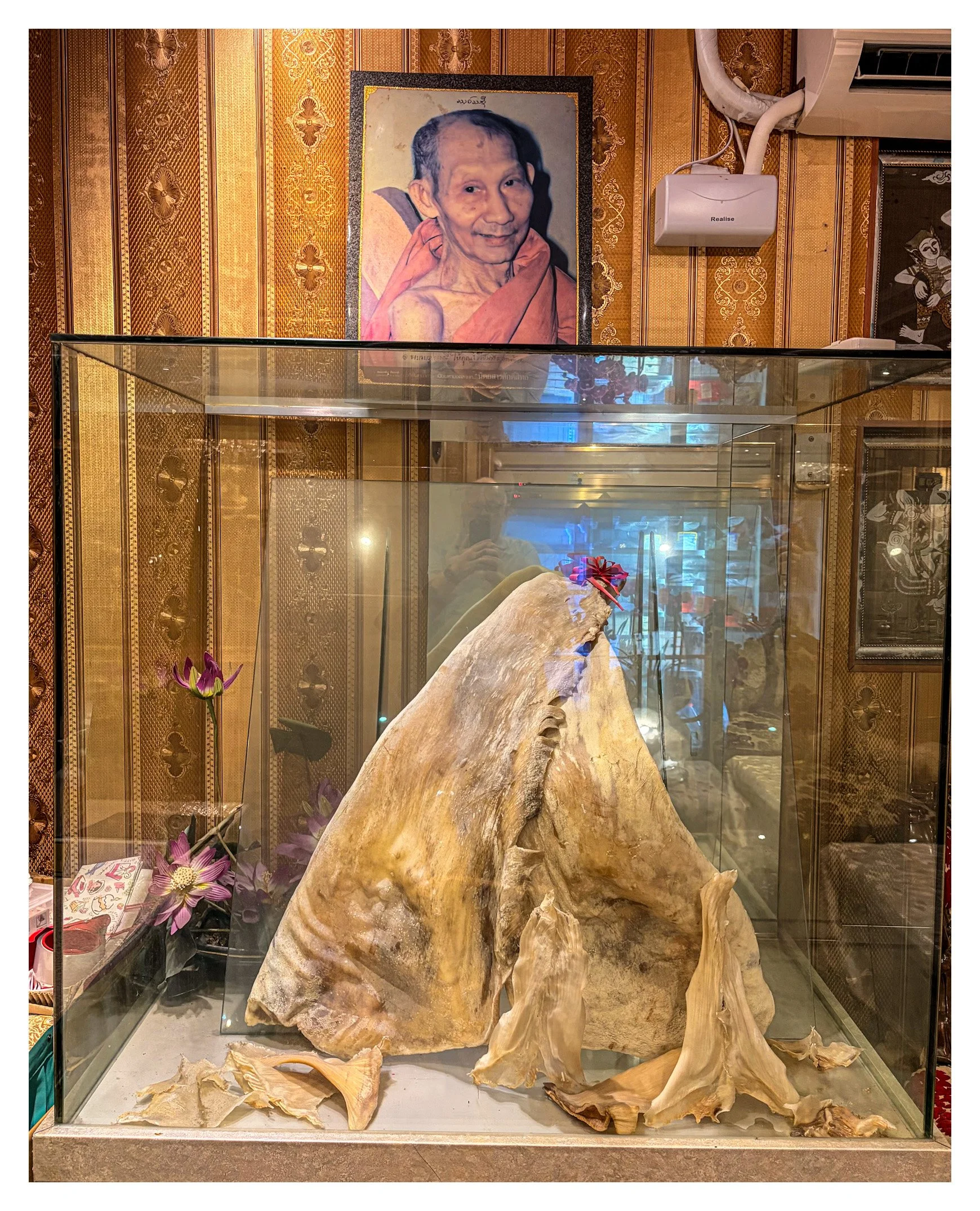
A dried shark fin the size of a small mountain, folded into a glass display case with a red ribbon tied at its peak, sits directly beneath a framed portrait of an elderly monk. Gold brocade wallpaper, a reflected stranger caught in the glass, and a question this photograph never quite answers about what, exactly, is being honoured here.
METADATA
• Camera Model: Apple iPhone 17
• Shutter Speed: 1/60 sec
• Aperture: f/1.6
• ISO: 250
THE CRITIQUE
The composition here is doing something quietly deliberate, whether or not anyone involved thought of it that way. A framed photographic portrait of an elderly monk in saffron robes sits at the top of the frame, positioned directly above a glass case containing an enormous dried shark fin. Beneath it, smaller fragments of fin are scattered at the base like offerings. A small red ribbon is tied near the fin's peak. This is, structurally, the exact grammar of a devotional altar: a valued object, enclosed and elevated, watched over from above by a figure of spiritual authority. The vocabulary has simply been transposed into a commercial dining room, and the photograph captures that transposition intact, whether the restaurant designed it consciously or arrived at it by pure force of habit.
It is worth being honest about what the object itself actually is, briefly and without turning this into something it isn't. Shark fin carries real weight beyond its texture and scale — global shark populations have been significantly reduced by demand for it, and it remains one of the more contested ingredients in contemporary food culture for exactly that reason. That context does not need dwelling on here, and this is a photography critique rather than a position paper, but it is part of why the object commands the frame the way it does: this is not simply a striking natural form on display, it is a striking natural form whose scarcity is precisely what makes it worth displaying like this in the first place.
The fin's physical presence is genuinely remarkable on its own terms. Folded and draped, its pale bone-cream surface catching the case's internal light, it reads less like a piece of a fish and more like a small geological formation — a fold of mountain, or a discarded shroud, with visible ridges and a serrated edge giving it real sculptural weight. The red bow tied at its peak is the detail that keeps the whole thing from settling into straightforward reverence. It is a genuinely strange gesture — a gift-wrapping flourish applied to what is, materially, the remains of a large dead animal — and that small collision between festivity and mortality is doing more interesting work in this photograph than almost anything else in it.
The gold brocade wallpaper behind the case supplies the second half of the picture's real subject: opulence as signal. Shark fin has occupied a specific, elevated status in Chinese banquet culture for a very long time, and the backdrop communicates that status before a viewer has even registered what is inside the glass. Warmth dominates throughout — the wallpaper's gold, the monk's saffron robe, the fin's own bone tone — broken only by a cooler blue-white tint visible in the case's reflected background, where interior lights and a glimpse of another framed artwork, apparently a dancer or shadow-puppet figure, sit at a different colour temperature entirely.
That reflection is worth discussing honestly rather than glossing over. This is the second consecutive photograph on this blog built around a reflective glass surface, and it is worth being clear that the two are doing different jobs. The previous post used a graffiti-marked mirror as a deliberate device, its layered ambiguity central to the photograph's point. Here, the reflection — a blurred human figure near the top of the case, almost certainly the photographer, along with the interior lighting and that second framed artwork — reads as incidental. It is a byproduct of shooting into glass at night rather than a considered layer built into the composition. That is not a failure, simply a different, more documentary use of a similar physical phenomenon, and it is worth naming the distinction plainly.
At f/1.6 and a slow-for-handheld 1/60 second, this was a genuinely difficult available-light situation — warm case lighting, warm wallpaper, and a cooler ambient tone all competing for the same frame — and the exposure holds together well. Both the fin's texture and the monk's portrait above it stay legible despite the mixed light sources, which is no small technical achievement for a handheld interior shot at ISO 250.
HOW THIS IMAGE COULD BE IMPROVED
• The air conditioning unit and its ducting at the upper right is a mundane, distracting intrusion into an otherwise carefully composed vertical hierarchy. This is now a repeated pattern across this series — a parked car, a strip of corrugated roofing, and now this — and it has recurred often enough to be worth a genuinely deliberate check before the shutter fires, not just a note after the fact.
• Decide, on a future shoot like this one, whether the reflection in the glass is wanted or not. As it stands here, the blurred human figure near the top reads as accidental. A slightly lower or more angled position would likely reduce it if a cleaner read is preferred, or it could be leaned into deliberately, as the previous post's mirror was, if a layered reading is the goal.
• Consider a tighter crop focused on the fin, its bow, and the monk's portrait directly above it, excluding the AC unit and reducing the reflection's visual noise. The central "valued object watched over from above" reading is strong enough to carry the frame on its own without the surrounding clutter competing for attention.
• The purple silk flowers at the left edge are a nice, softening counterweight to the case's right side, but they are partially shadowed and cut close to the frame boundary. A small reframe giving them slightly more presence would balance the composition more deliberately.
• If a return visit is possible, shooting from a touch further back and lower would give the monk's portrait a little more headroom at the top of the frame, letting the full vertical sequence — portrait, case, fin, scattered fragments at the base — breathe with a bit more room to resolve.
ON BECOMING A BETTER PHOTOGRAPHER: LET THE DATA SPEAK
• Treat the recurring frame-edge intrusion — now confirmed across several posts in different forms — as something to check for actively before pressing the shutter, not just something to notice afterward. A quick scan of the frame's edges for mundane modern fixtures before shooting would likely catch most instances of this on its own.
• Continue tracking "valued object enclosed behind glass, watched over by something positioned above it" as its own compositional device across the archive. It has now appeared in a devotional and a commercial setting in consecutive posts, and deliberately seeking out further examples — museum cases, shop windows, household shrines, display cabinets — could become one of this blog's genuinely distinctive ongoing threads.
• When shooting into any reflective glass surface at night going forward, make the reflection a deliberate choice rather than an accident of position. Decide in advance whether it should read as layered and intentional or be minimised, and adjust the shooting angle accordingly.
• Build a specific, locally grounded project logging where Kaohsiung's commercial spaces pair the sacred and the transactional — religious portraits and shrines inside restaurants, shops, and businesses. This photograph is a strong first entry in a genuinely rich, underexplored local theme.
• Keep this exposure combination — a wide aperture, moderate shutter speed, and low ISO in mixed warm and cool interior light — as a working benchmark for what the iPhone's processing can hold onto in similarly difficult low-light interior situations.
PHOTOGRAPHERS TO RESEARCH
• Rosamond Purcell — photographed preserved and extinct animal specimens with a painterly, often unsettling eye, finding genuine beauty in objects that exist because a species could not survive.
• Hiroshi Sugimoto — spent four decades photographing museum dioramas, treating staged natural history displays as meditations on how photography itself constructs the appearance of the real.
• Richard Barnes — documented the hidden machinery behind natural history museum displays, revealing the artifice and craft inside every glass case presented to the public as simply "nature."
• Martin Parr — built a career photographing food and consumption with a deadpan, flash-lit honesty, refusing the glamorous lie that most food photography tells.
• Laura Letinsky — large-format still life photographs of the aftermath of meals, rooted in the same Dutch still-life tradition that has always used food to meditate on abundance and mortality at once.
BOOKS TO READ
• "Swift as a Shadow: Extinct and Endangered Animals" — Rosamond Purcell. Haunting colour photographs of preserved specimens from species that are gone or going.
• "Dioramas" — Hiroshi Sugimoto. Four decades of black-and-white photographs questioning where the constructed and the natural actually divide.
• "Animal Logic" — Richard Barnes. The unglamorous, fascinating machinery behind how natural history museums build the illusion of the wild.
• "Real Food" — Martin Parr. Two hundred photographs of food exactly as people actually eat it, with none of the usual dishonesty.
• "Hardly More Than Ever" — Laura Letinsky. Large-format still lifes of what's left on the table after the meal is over.
VIDEOS TO WATCH
• Rosamond Purcell Pushes The Boundaries Of Photography And Imagination — Open Studio
https://www.youtube.com/watch?v=1fbRTDc76Dc
• Hiroshi Sugimoto: Four Decades Of Photographing Dioramas
https://www.youtube.com/watch?v=q9GiyPbLYPg
• Photographers In Focus: Martin Parr