

Day 332/365 The One Not Looking At The Camera
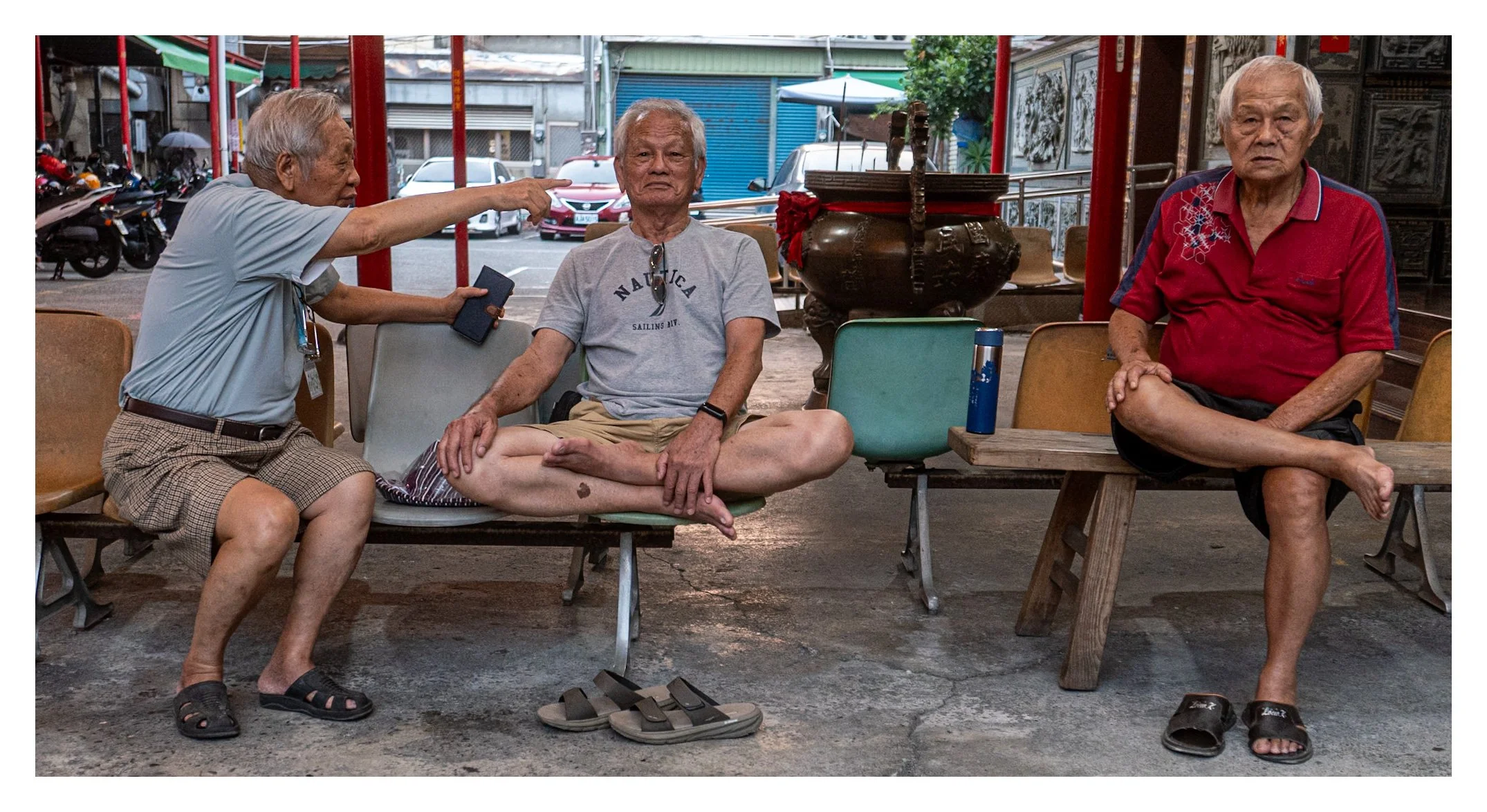
Three elderly men share a bench outside a temple in Lingya District. Two of them are looking directly at the camera, calm and unbothered. The third isn't — his attention, and his pointing finger, are aimed entirely at the friend beside him instead. A small, exact split this blog hasn't caught quite this way before.
METADATA
• Camera Model: Leica D-Lux 8
• Lens: DC VARIO-SUMMILUX 10.9-34mm ASPH.
• Shutter Speed: 1/125 sec
• Aperture: f/2.3
• ISO: 1000
THE CRITIQUE
Two of these three men are looking directly at the camera. The third is not. His attention, and his pointing finger, are aimed at the man beside him instead, mid-conversation, mid-story, entirely unconcerned with the lens. That is the actual structure of this photograph, and it is worth being exact about it: the centre man and the man on the right both hold the camera's gaze steadily, calm and direct, neither performing for it nor resisting it. The man on the left has, for whatever reason, opted out of that shared awareness entirely, absorbed instead in whatever he is telling his friend. What he is actually saying remains unknowable, and it doesn't need resolving. What is genuinely interesting is simply that a candid group portrait can produce exactly this split: a shared, quiet awareness of being seen held by most of a group, and one person entirely outside it, occupied with something private instead.
This is not the first time this blog has noted a photograph built on multiple figures each occupying a different register of attention. It happened with four men on a fishing pier, each caught in his own posture. It happened again with two figures on either side of a marked mirror, one alert, one absorbed elsewhere. This is the third instance, and it takes a slightly different shape than either of the first two: rather than several distinct reactions spread evenly across the frame, this is a clean split — a shared awareness held by two of the three men, and a private exchange running entirely outside that awareness in the third. That two-against-one asymmetry is its own kind of structure, and a genuinely different one from anything this blog has caught before.
The crop deserves its own honest discussion, because it complicates a pattern this blog has been tracking for a while. Until now, this camera's square crops have served multi-element scenes and its portrait-rectangle crops have served single dominant subjects — a clean binary that has held up across several posts. This frame breaks that binary cleanly: three figures, clearly a multi-element scene, and yet the crop is neither square nor portrait but a wide panoramic sweep. The simplest honest explanation is that the binary was always too simple. What actually seems to be happening is that the crop responds to the shape of the subject itself: a single tall figure earns a portrait rectangle, a compact cluster of elements earns a square, and a group of figures spread out horizontally along a bench earns a wide format that gives each of them room without excess empty space above or below. This same tendency toward a wide crop for a horizontally arranged group has shown up on the Ricoh body too, in an earlier post — which suggests this isn't a habit specific to one camera system so much as a compositional instinct that follows the subject regardless of which body happens to be in hand. That's a more useful, more accurate way to describe what's actually happening than forcing every frame into a two-option hypothesis.
There is a real continuity worth naming with recent posts on this blog. The last two entries dealt with objects of devotion — a shrine's carved relief panel, a monk's portrait watching over a restaurant display case. This photograph shows something different: not an object of devotion, but a devotional space being used the way it actually gets used day to day, by people simply sitting, talking, resting their bare feet, drinking from a thermos. The temple's red pillars frame the scene almost like a stage, and the ordinary street beyond — parked motorcycles, a lowered shutter, a market umbrella — sits in full view past that frame, refusing any clean separation between sacred ground and everyday life. That refusal feels true to how these spaces actually function in Taiwan, and it's a meaningful extension of a theme this blog keeps circling back to from a slightly different angle each time.
The late-afternoon light, warm and even with no harsh shadow, renders skin tone and fabric colour cleanly across all three men — the pale blue of the left man's polo, the grey of the centre man's Nautica shirt, the red pattern on the right man's collar. At f/2.3, there's enough separation to let the three figures hold the eye's attention without the background dissolving into total abstraction — a deliberate balance between isolating the subjects and keeping the environmental context that makes this photograph a document of a specific place rather than three anonymous figures against nothing.
HOW THIS IMAGE COULD BE IMPROVED
• The content of the left man's remark to his friend remains genuinely unknown, and that's fine to leave open — but if the opportunity arises on a return visit, it would be worth finding out what was actually being said, purely out of curiosity rather than any need to publish the answer.
• Background clutter — parked motorcycles, shop signage, a lowered shutter — adds valuable context but does compete for attention at the frame's edges. A companion frame at a shallower aperture, isolating the three men more completely from their surroundings, would make an interesting contrast piece against this wider, more contextual version.
• A tighter portrait of the centre man alone — already the frame's literal and psychological midpoint — would be a strong companion image, echoing the wide-and-tight pairing this blog has used effectively before.
• Check the shooting angle on a future version of this kind of scene. A touch lower might strengthen the sense that the two red temple pillars are framing the men like a stage, an effect that is present here but could likely be made more deliberate.
ON BECOMING A BETTER PHOTOGRAPHER: LET THE DATA SPEAK
• This "multiple figures, multiple registers of attention" device has now produced a genuinely new shape: a shared awareness held by most of a group, with one figure entirely outside it. Actively seek out more scenes where that specific asymmetry is likely — a group where most, but not all, are conscious of the camera.
• Treat the crop-ratio hypothesis as genuinely refined rather than settled. Before opening a file from a multi-figure scene going forward, predict the crop based on the subject's own spatial arrangement — tall and single, compact and clustered, or wide and horizontal — and check whether the prediction holds. This is a testable idea now, not just an observation.
• Start logging instances where a devotional or sacred space is shown being used casually and socially by people, as distinct from the "object of devotion" framing used in recent posts. This is a genuine, separate sub-theme worth tracking on its own terms.
• When a deliberate trade-off is made between environmental context and subject isolation — as it likely was here, given the aperture choice — note that reasoning at the time of shooting, so it can be reviewed later with the actual thinking intact rather than reconstructed after the fact.
• Keep treating ambiguous human gestures and expressions with the same restraint already established in this series. A confident story written onto an unverifiable moment is a worse photograph than an honest question left open.
PHOTOGRAPHERS TO RESEARCH
• August Sander — set out to build a complete typological portrait of German society across every class and profession, photographing each subject with the same unflinching, dignified directness regardless of their standing.
• Liu Zheng — documented a China caught between tradition and rapid modernisation, explicitly inspired by Sander's example, seeking out archetypal figures in unexpected, often startling circumstances.
• Fan Ho — captured Hong Kong's streets across six decades with a dramatic command of light and shadow, later turning his late-career archive toward a more direct, documentary account of the same city.
• Shen Chao-liang — has spent years documenting Taiwan's temple-adjacent festival and performance culture, finding the specific visual texture of how sacred space and popular entertainment sit side by side.
• Weegee — worked New York's streets at night with an unflinching flash and an eye for the full range of human reaction, from raw fear to open curiosity, often within a single crowded frame.
BOOKS TO READ
• "People of the 20th Century" — August Sander. A monumental, unfinished attempt to typologically document an entire society, one dignified portrait at a time.
• "The Chinese" — Liu Zheng. Archetypal figures encountered in extreme and unexpected circumstances across a rapidly changing China.
• "Portrait of Hong Kong" — Fan Ho. A more documentary, less stylised late-career look at the city he spent decades photographing.
• "Stage" — Shen Chao-liang. Taiwan's mobile temple-festival performance trucks, photographed with a keen eye for the surreal collision of sacred and popular culture.
• "Naked City" — Weegee. The book that turned tabloid crime photography into a genuine, lasting art form.
VIDEOS TO WATCH
• August Sander: Portrait Of A Society (With English Subtitles)
https://www.youtube.com/watch?v=9MJZPFmulK8
• 6 Things Fan Ho Taught Me About Street Photography
https://www.youtube.com/watch?v=RGFqJwkbb8s
• The Real Weegee — 1 Hour Documentary