

Day 333/365 A Temple With No Backstage
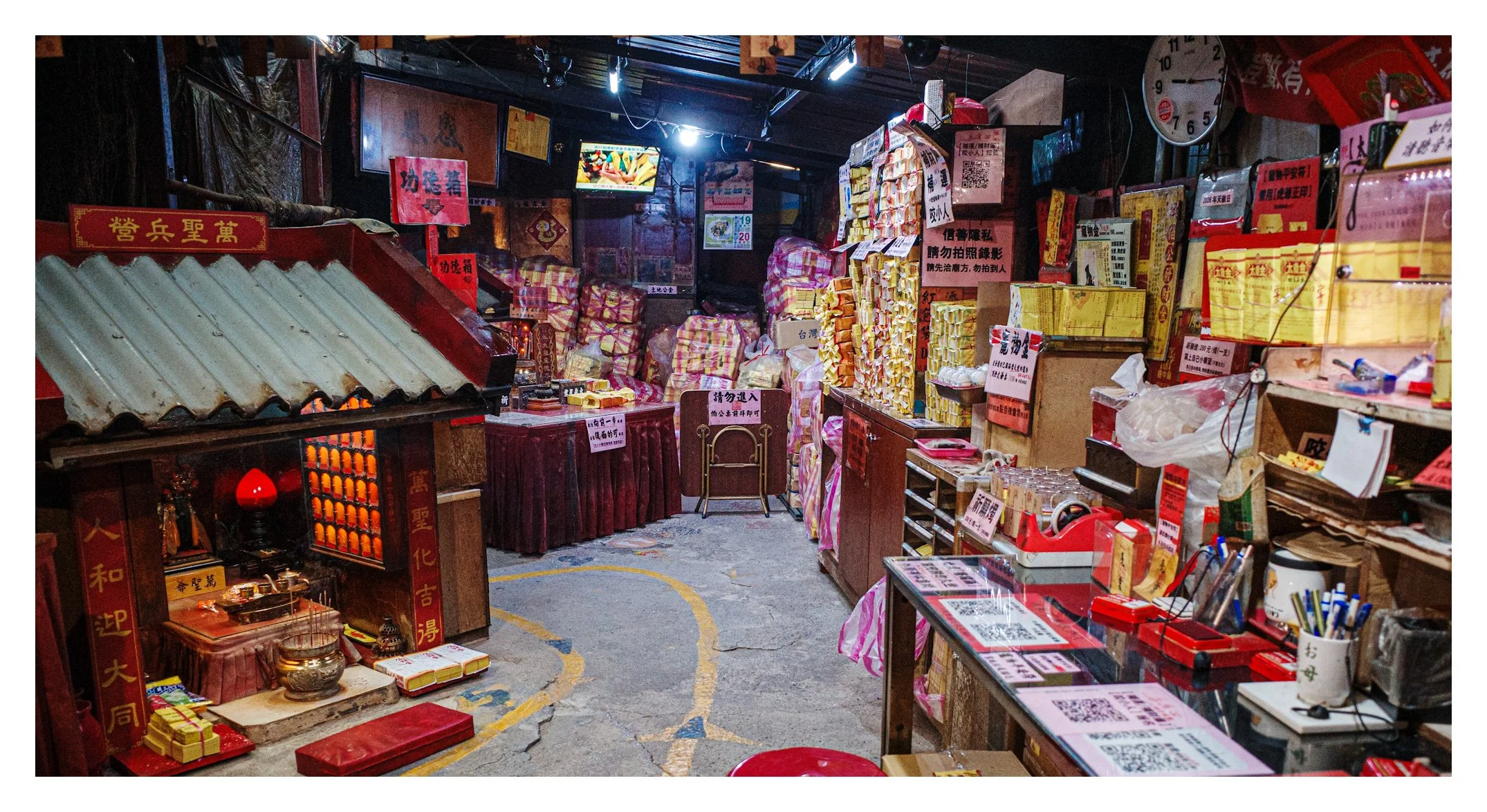
This looks, at first glance, like a working supply room tucked behind some larger, more formal temple hall — the kind of practical back-of-house space a bigger complex keeps out of sight. It isn't. This small, old temple, built into the trees near where the photograph was taken, doesn't have a separate hall elsewhere holding a grander version of what's shown here. This modest, cluttered space is close to the whole thing. A wide, warm, genuinely lived-in frame that shows exactly what a small local temple actually looks like when it doesn't have the luxury of separating its altar from its own supplies.
METADATA
• Camera Model: Ricoh GR III
• Lens: GR LENS 18.3mm F2.8
• Shutter Speed: 1/100 sec
• Aperture: f/2.8
• ISO: 3200
THE CRITIQUE
The natural assumption on first viewing this frame is that it shows a supply room feeding some larger, more formal temple elsewhere — the practical back-of-house most visitors to a big complex never see. That assumption is wrong, and correcting it changes what the photograph is actually about. This is a small, old temple built into the trees near where it was photographed, and there is no separate, grander hall it feeds. What's visible here is close to the entire thing. A large temple complex can afford to separate its devotional hall from its storage, keeping one register for show and another for logistics. A temple this size doesn't have that option, and doesn't pretend to. The shrine glowing on the left, with its grid of votive lights, is the altar — not a satellite tucked into someone else's supply closet. The stacked paper money and incense on the right aren't stock waiting to be moved elsewhere; they're simply what this temple keeps on hand, stored exactly where it gets used, because there's nowhere else for it to go.
This blog has now spent three posts circling the same broad question from three genuinely different angles: how the sacred sits inside ordinary Taiwanese daily life. The first showed a finished object of devotion — a street shrine's carved relief panel, watched over by its own quiet ceremony. The second showed people using sacred ground socially, sandals off, resting their feet, a temple courtyard doubling as a place to simply sit. This one shows something neither of those did: a temple too small and too old to separate devotion from the practical business of sustaining it, everything sharing one modest, cluttered room because that's the actual scale it operates at.
The wide frame earns its width here. On the left, the shrine glows warm red and gold, its grid of electric votive lights burning in neat rows, incense smoking in front of it — an intimate, cared-for space no larger than a cupboard, and the genuine devotional heart of the place. Follow the frame right and that intimacy sits directly alongside the temple's own practical stock: tall stacks of joss paper wrapped in pink and red patterned paper, yellow bundles shelved and priced for whoever visits, a counter cluttered with pens, tape, red ink stamps, and a scale. Devotion and its own supply chain occupy the same few metres, captured in a single continuous sweep rather than two separate photographs, and that continuity is the whole point. Nobody has tidied this space to present a single, legible idea to a photographer. It simply is both things at once, because a temple this size never had the room to make them two things in the first place.
A central concrete pathway, marked with a curved yellow line, runs down the middle of the frame toward a small folding stool positioned almost exactly on the composition's vertical axis. Whether that centring reads as a strong, deliberate architectural anchor or a slightly static, overly symmetrical resting point is a fair question with no single correct answer — the pathway does genuine work giving this cluttered, wide scene real depth and a place for the eye to travel toward, even if a viewer could reasonably wish it sat a touch off-centre instead.
Colour here is almost entirely warm — the shrine's red-gold glow, the pink and red paper wrapping, yellow bundles of joss paper, red signage throughout — a near-total saturation rather than a balanced harmony. That's worth distinguishing from the last post's shrine, where warmth and its backdrop sat in a considered, even relationship. Here warmth simply dominates, broken only by small, cooler counterpoints: a television screen's pale glow in the middle distance, a patch of daylight-balanced light near the ceiling. The effect is less composed harmony and more a genuinely accurate record of what artificial temple lighting actually looks like at night, unfiltered.
There's a small, ready-made irony sitting in plain sight on the right-hand shelving, worth naming exactly once and moving on: a printed sign among the stock explicitly requests no photography. A photograph that contains, in legible text, an instruction against the very act producing it is the same kind of found irony this blog has caught before — a "no parking" sign once buried in a pile of parked bicycles — and it belongs in the same category here: a genuine visual detail worth noting, not a verdict on the photograph itself.
Technically, this was a difficult scene to hold together. At ISO 3200 in genuinely mixed, dim interior light — warm votive glow, a cooler television screen, functional overhead spotlights — getting both the shrine's detail and the shelving's clutter legible within one exposure is no small thing, and f/2.8 at this focal length keeps enough depth of field to manage it. The wide, roughly 1.91:1 crop is now a familiar shape on this blog for exactly this kind of horizontally arranged, information-dense scene — the same treatment already given to a long shadow stretching across a plaza and to three men spread along a temple bench, on two different camera bodies. Wide subjects keep earning wide crops here, regardless of which camera took them.
HOW THIS IMAGE COULD BE IMPROVED
• The centred stool and pathway sign are a fair but debatable choice. A slightly off-axis position for the camera, shifting that element a touch left or right of true centre, would be worth testing against this version to see which reads as the stronger anchor.
• The overhead ceiling clutter — hanging tags, exposed wiring, a wall clock — adds to the genuine "working space" feel but does compete for attention at the top of the frame. A slightly lower shooting position might let the shrine and shelving carry more of that visual weight instead.
• Given how much visual information this wide crop holds, a companion tighter shot of just the shrine's grid of votive lights, or just the counter's cluttered surface, would add valuable close-up richness this wide establishing view necessarily sacrifices for breadth.
• At ISO 3200, expect some visible grain in the darkest shadow areas, particularly toward the ceiling. Worth reviewing at full size to check whether that grain reads as texture in keeping with the scene's rough, working-space character, or whether it's simply noise worth managing differently next time.
• If a return visit is possible, a frame taken when the small shrine is actively being attended to — someone lighting incense, restocking the votive lights — would pair well with this quieter, unattended version.
ON BECOMING A BETTER PHOTOGRAPHER: LET THE DATA SPEAK
• This is now a third, distinct angle on the "sacred inside ordinary life" theme running through this blog — a finished object of devotion, sacred ground used socially, and now a temple too small to separate devotion from its own upkeep at all. Consider this a genuine three-part structure worth continuing deliberately rather than by accident, actively seeking out a fourth angle rather than repeating one of the first three.
• The wide panoramic crop has now confirmed itself across two camera bodies for horizontally arranged, information-dense scenes. Treat this as settled enough to predict confidently before opening a file, and start paying attention to what happens when a similarly wide scene doesn't get this treatment, to test the hypothesis's limits rather than only its confirmations.
• When a difficult, mixed-light interior scene like this one is handled successfully, note the specific ISO and aperture combination as a working benchmark, the same way this blog has started doing for other demanding light situations.
• Continue treating any found, ready-made irony in a frame — a sign, a coincidence of placement — as worth naming once, cleanly, within the critique itself, rather than either ignoring it or dwelling on it past the point of usefulness.
• Keep the habit, now established across several posts, of pausing to read any legible signage in a frame before publishing it. It has mattered more than once in this series, and it costs nothing to check.
PHOTOGRAPHERS TO RESEARCH
• Stephen Shore — found genuine visual interest in America's most unglamorous commercial spaces, treating banal, overlooked interiors and roadside clutter as worthy of the same serious attention as any grand landscape.
• Greg Girard — spent years documenting the dense, cluttered, self-built interiors of Hong Kong's Kowloon Walled City, finding real human order inside spaces that looked, from outside, like pure chaos.
• Naoya Hatakeyama — has spent three decades examining the built environment's practical, working infrastructure, finding a strange beauty in quarries, tunnels, and the unglamorous machinery that keeps cities running.
• Luigi Ghirri — photographed Italy's shop windows, signage, and small-town commercial vernacular with a dry, deadpan wit, treating the ordinary retail landscape as genuinely worth close study.
• Joel Sternfeld — documented America's roadside and commercial landscape with a large-format camera and a keen eye for the quiet ironies sitting in plain sight within ordinary, overlooked places.
BOOKS TO READ
• "Uncommon Places" — Stephen Shore. The book that made banal American commercial spaces a legitimate, serious photographic subject.
• "City of Darkness: Life in Kowloon Walled City" — Greg Girard and Ian Lambot. A dense, self-built community documented from the inside, before its demolition erased it entirely.
• "Excavating the Future City" — Naoya Hatakeyama. Three decades of photographing the practical, often invisible machinery behind how cities are actually built and maintained.
• "Kodachrome" — Luigi Ghirri. Shop windows, signage, and small-town Italian commercial life, photographed with dry, deadpan precision.
• "American Prospects" — Joel Sternfeld. Large-format colour studies of ordinary American places, quietly full of irony most viewers only notice on a second look.
VIDEOS TO WATCH
• Uncommon Places — A Photo Book By Stephen Shore
https://www.youtube.com/watch?v=Bk5-SNgC6dU
• Naoya Hatakeyama: Excavating The Future City