

Day 334/365 Where The Metal Meets The Leaf
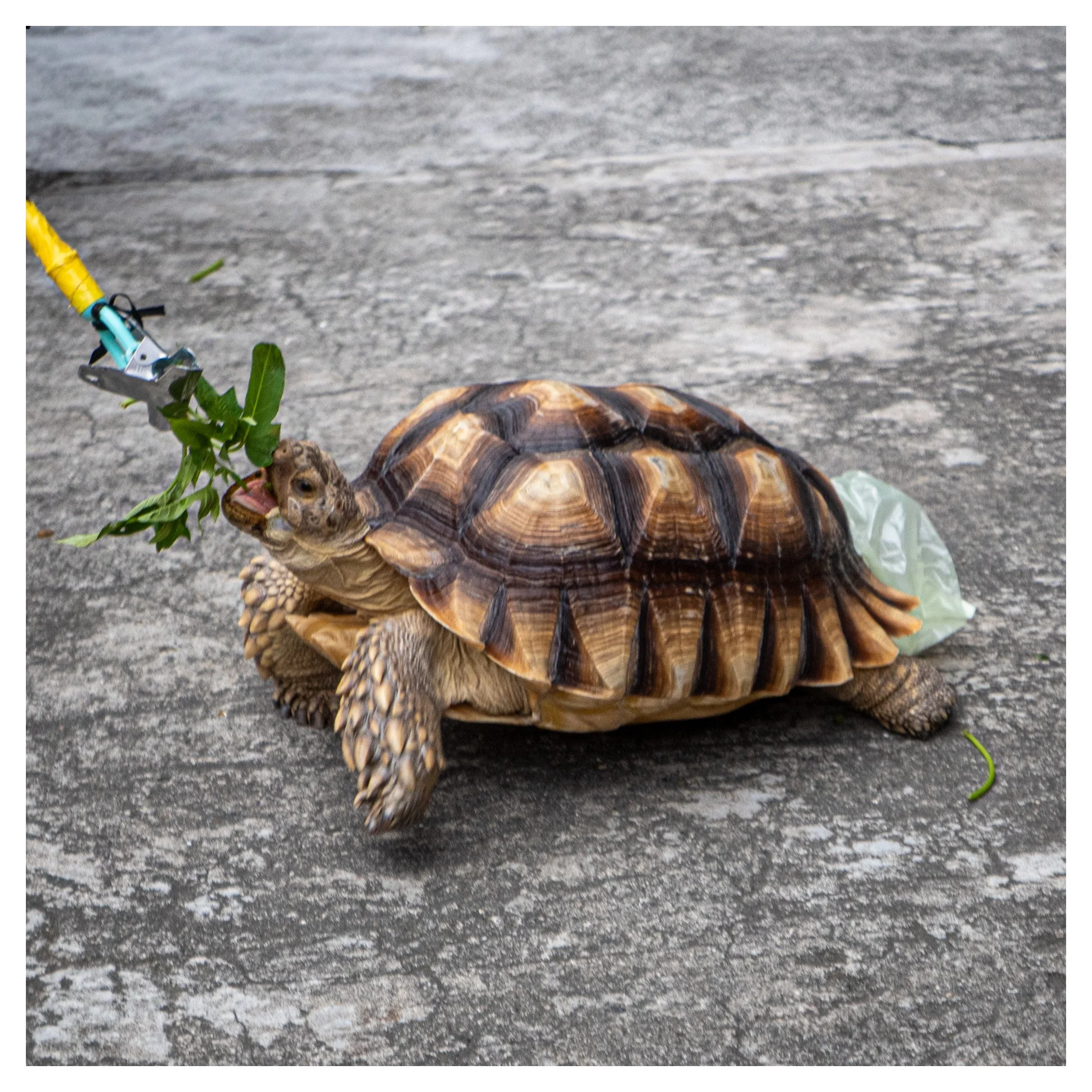
A tortoise's mouth closes on a leaf, held out on a long pair of tongs by someone standing just outside the frame. One clean diagonal line runs from an unseen hand to the exact instant of contact. A small, warm, quietly funny study in patience — both the tortoise's and whoever built the tool to feed it.
METADATA
• Camera Model: Leica D-Lux 8
• Lens: DC VARIO-SUMMILUX 10.9-34mm ASPH.
• Shutter Speed: 1/125 sec
• Aperture: f/2.8
• ISO: 200
THE CRITIQUE
The whole photograph runs along a single, clean diagonal, and it's worth appreciating how rare that clarity actually is. A pair of long-handled tongs enters from the top left corner — yellow foam grip, a teal accent, a simple metal clamp at the working end — and travels in an unbroken line straight to the tortoise's open mouth, where a leafy green is caught mid-bite. There is no ambiguity about where to look or how the eye should travel to get there. One tool, one line, one point of contact. It's the kind of compositional device that sounds almost too simple to work, and works precisely because nothing complicates it.
That point of contact is a genuine decisive moment, applied to a creature not typically associated with decisiveness. The mouth is open, the leaf gripped, and small torn fragments of green are visible both near the tool's tip and scattered on the ground by the tortoise's rear foot — real evidence of an active, ongoing feeding session rather than a single staged bite. There's a dry, gentle humour in catching a tortoise at its one moment of real urgency, and the photograph doesn't oversell it. It simply records it.
The shell earns close attention on its own terms, independent of the feeding narrative happening at its front end. Warm brown and gold, each scute ringed with concentric growth lines like a cross-section of a tree, it's a genuinely rich natural texture, and the composition gives it real room to be seen rather than reducing it to a backdrop for the more obviously "eventful" head-and-tool action on the left. A large, old tortoise's shell is one of nature's more striking surfaces, and this photograph treats it as such.
The tool itself is doing more interesting work than a simple food-delivery-mechanism would suggest. It's an unmistakably human, mechanical object — foam tape, a metal clamp, nothing decorative or considered as an object in its own right — inserted into an otherwise entirely organic scene of shell, skin, and leaf. That contrast between the purely biological and the purely practical is genuinely worth naming: somewhere off-frame, a person built or bought a tool for exactly this purpose, and this photograph catches the precise instant that small, unglamorous act of care becomes physical contact with the animal it was made for.
A single raised front foot, slightly blurred with motion, adds a small, welcome bit of evidence that this creature is actually moving with some purpose toward its food rather than sitting for a portrait. The plain grey concrete underfoot, cracked and lightly stained but otherwise unremarkable, does exactly the job a background should do here: it stays out of the way, cool and neutral against the shell's warmth, letting all the visual interest concentrate exactly where it belongs.
One detail resists easy explanation, and it's worth simply naming that rather than guessing at it: a pale, translucent plastic bag is visible near the rear of the shell, its purpose unclear from the frame alone. It could be practical, incidental, or something else entirely. Rather than invent a reason for it, it's more honest to note it as present and unresolved.
Technically, the 34mm end of this lens — the telephoto side of its range — combined with f/2.8 at close subject distance gives clean separation between the sharp foreground action and a softened, unremarkable background, exactly the right tool for isolating a small, busy moment like this one. The square crop is consistent with what this camera has done before with a compact, multi-element interaction rather than a single tall subject or a wide horizontal spread — animal and tool, held together in one contained frame.
HOW THIS IMAGE COULD BE IMPROVED
• The unexplained plastic bag near the shell's rear is a minor but real distraction. A slightly different angle excluding it, or a brief note if it does serve some practical purpose, would resolve the small question it currently leaves open.
• Consider a lower shooting position, closer to the tortoise's own eye line, to see whether that increases the sense of scale and weight the shell already carries, or shifts the frame enough to reduce the bag's visibility as a side benefit.
• The concrete background, while appropriately restrained, is fairly flat as far as concrete goes. A version shot where the ground's own cracking or staining plays a slightly more active role, the way it has in other posts on this blog, could add a layer of texture without competing with the main subject.
• A companion frame from directly above or behind, isolating the shell's full growth-ring pattern with no tool or feeding action in view, would make a strong still-life pairing with this more narrative, action-focused version.
• If a similar feeding moment happens again, a frame caught just before contact — leaf approaching, mouth still open, tool not yet touching — would offer a useful comparison between anticipation and arrival within the same sequence.
ON BECOMING A BETTER PHOTOGRAPHER: LET THE DATA SPEAK
• This is one of very few close animal studies in this archive, distinct from the street, architectural, and still-life work that otherwise dominates it. If this kind of subject is available on a recurring basis, consider it a legitimate fourth register for this blog rather than a one-off.
• The instinct already well practised elsewhere in this archive — noticing a mechanical or man-made object intruding into an otherwise organic or human scene — applies just as well to animal photography. This frame's tool-against-shell contrast is a clean example worth building on deliberately.
• When an ambiguous, unexplained element lands in a frame, get in the habit of resolving it at the time, either by asking or by reframing to exclude it. A small, low-effort check in the moment saves guessing about it later.
• The single, clean diagonal line running from an off-frame source to a clear point of contact worked cleanly here precisely because nothing else competed with it. Actively look for more scenes built on exactly one directional line rather than several competing ones.
• Keep testing this lens's telephoto end for close subject isolation specifically. It did real work here separating a busy foreground from an unremarkable background, and it's worth returning to deliberately for similar subjects.
PHOTOGRAPHERS TO RESEARCH
• Joel Sartore — has spent over two decades photographing individual animal species against plain, neutral backgrounds, treating every creature, however common or overlooked, with the same careful, dignified attention.
• Frans Lanting — built a career on genuinely intimate animal encounters, seeking not conventional wildlife beauty but the specific character and dignity of individual creatures caught close.
• Tim Flach — photographs animals in controlled conditions to reveal texture, expression, and personality with an almost uncanny, portrait-like intimacy rarely applied to non-human subjects.
• Elliott Erwitt — spent decades photographing dogs not as a dedicated subject but as a recurring, irresistible presence in his street photography, finding real wit and warmth in ordinary human-animal moments.
• Traer Scott — photographs individual animals with the same seriousness and dignity typically reserved for human portraiture, finding genuine character and personality in every subject she photographs.
BOOKS TO READ
• "The Photo Ark" — Joel Sartore. A multi-decade project to portray individual animal species with dignity, against plain backgrounds that let each creature's own character carry the image.
• "Eye to Eye: Intimate Encounters with the Animal World" — Frans Lanting. Genuinely close animal encounters built around dignity and individual character rather than conventional wildlife spectacle.
• "More Than Human" — Tim Flach. Studio animal portraits that reveal texture, expression, and personality with startling, almost uncomfortable intimacy.
• "Dog Dogs" — Elliott Erwitt. Decades of dogs caught not as a dedicated project but as a recurring, irresistible presence in an otherwise unrelated career.
• "Radiant: Farm Animals Up Close and Personal" — Traer Scott. Individual animals photographed with the same dignity and seriousness typically reserved for human portrait sitters.
VIDEOS TO WATCH
• National Geographic Explorer Joel Sartore Discusses His Inspiration For The Photo Ark
https://www.youtube.com/watch?v=InAFc6UNeG0
• The Best Photobook About Dogs Of All Time? Elliott Erwitt — Dog Dogs