

Day 335/365 A Shelf Of Advice, Still Mostly Unopened
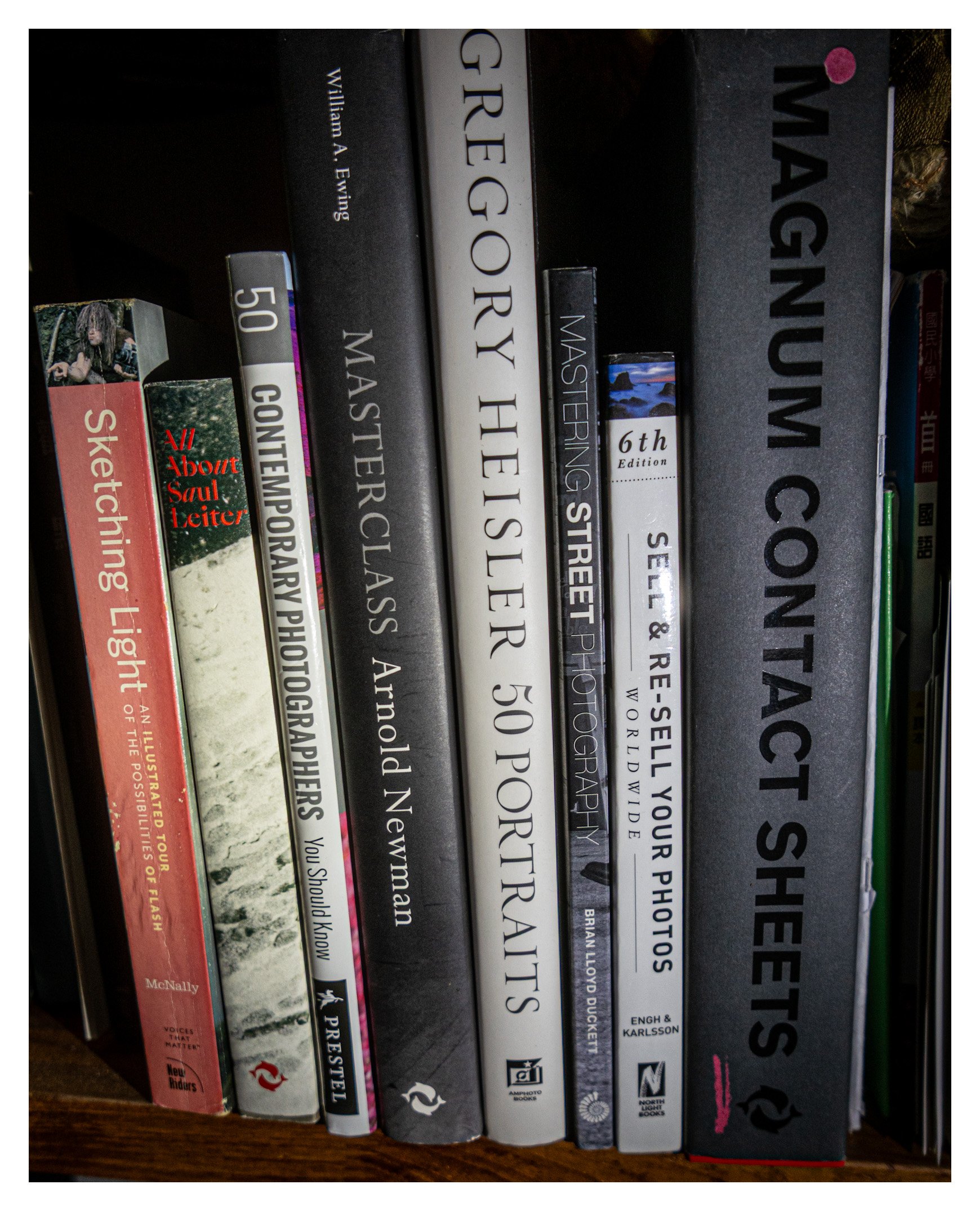
A close, warmly lit row of spines: technique manuals beside major monographs beside one of the medium's defining reference works. A small, honest study in what's already within reach, and what it actually takes to reach for it.
METADATA
• Camera Model: Leica D-Lux 8
• Lens: DC VARIO-SUMMILUX 10.9-34mm ASPH.
• Shutter Speed: 1/125 sec
• Aperture: f/1.8
• ISO: 200
THE CRITIQUE
This is a photograph of a shelf, taken close and low enough at the wide end of this lens that the row of spines tapers slightly as it recedes, each book leaning gently into its neighbour the way books left long enough on a shelf always do. There's no scene here in the usual sense of this archive — no street, no stranger, no found tableau — just a personal library, photographed at night under a warm lamp, with the frankness of something not staged for the camera at all.
What's actually legible is worth naming, because it's a genuinely good, well-chosen spread: a lighting technique manual, a book specifically about Saul Leiter, a survey of contemporary photographers, dedicated monographs on both Arnold Newman and Gregory Heisler, a street photography guide, a business-of-photography manual, and a major, well-known survey of Magnum's own contact sheets. That's not a random accumulation. That's a working collection, built with some care, covering craft, history, business, and reference in roughly equal measure.
The typography does real, if unplanned, work of its own. Most spines run dark and restrained — black, grey, white, the appropriately serious palette of a serious collection — but a handful of small colour accents break the pattern: warm red on the flash-lighting book, a small blue seascape image tucked onto the business manual's spine, a pink dot and pink scrawl on the Magnum book, pink lettering on the survey volume. It's a quieter, more understated colour rhythm than most of what's appeared in this series, and it's a nice change of register: this blog has spent plenty of time admiring found typography on shopfronts and signage; here's the same instinct, turned for once on something entirely domestic.
To the right, the shelf keeps going into spines with Chinese text, a small, specific, honest detail that this is a real, actively used, mixed-language library and not a curated prop.
The crop is portrait rectangle, and it's worth a brief, genuine addition to something this blog has tracked for a while now: technically, this frame contains eight separate objects, yet the crop treats them as one continuous vertical form. That's a small, useful refinement — the crop seems to respond to the subject's overall silhouette, not strictly to whether it's one object or several. A row of upright spines reads as a single tall shape, and the framing follows that shape rather than the count.
And then there's the thing worth saying plainly, because the photograph raises it whether or not the caption does: this is exactly the kind of resource this blog keeps recommending, post after post — technique manuals, dedicated monographs, a defining reference work on the medium's most significant agency. The shelf is already there. It's already good. Nothing about the growth section below is asking for more of it.
HOW THIS IMAGE COULD BE IMPROVED
• At f/1.8 and this close a distance, the spines at the edges of the row likely fall off in sharpness compared to the centre. A touch more depth of field — f/4 or so — would probably hold the whole row consistently sharp, which matters here since the row as a whole is the actual subject, not any single spine.
• A more directly front-on angle would reduce the natural taper this close focal distance creates, presenting the titles as a flatter, more evenly legible "wall of text" rather than a gently receding row.
• Given how much of this photograph's interest depends on actually being able to read the spines, a future version built deliberately around legibility — level, even lighting corner to corner — would let that work do even more.
• A wider companion frame showing where this shelf actually sits would give this closer, more abstracted crop some useful context.
ON BECOMING A BETTER PHOTOGRAPHER: LET THE DATA SPEAK
• This is a genuinely rare kind of photograph for this archive: a picture of the act of preparing to learn, rather than a record of something already out in the world. Worth treating as legitimate, occasional subject matter rather than a one-off curiosity.
• More directly: the shelf is already doing its job. What this particular photograph actually points to isn't acquisition — it's the gap between owning something and opening it, which is worth naming honestly rather than working around.
• Given how many names this blog has already recommended across recent posts, it may be worth treating the list less as something that keeps growing and more as a rotation: finish one already on hand before adding a ninth or tenth.
• The small, deliberate bursts of colour against an otherwise restrained palette are worth returning to on purpose — this blog has found real interest in found typography before, and a personal library is simply the same instinct turned inward.
PHOTOGRAPHERS TO RESEARCH
• Abelardo Morell — has spent decades photographing books themselves as physical, sensory objects: spines, stacks, water-damaged pages, the material presence of the printed word.
• Robert Dawson — spent eighteen years documenting American public libraries, treating them as one of the last genuinely shared civic spaces left.
• Larry Sultan — built a landmark, deeply personal body of work photographing his own parents' home, blending documentary and staged images with his own writing.
• Massimo Listri — travels the world photographing the grandest historic libraries in existence, treating their architecture with the same reverence usually reserved for cathedrals.
• JoAnn Verburg — returns often to a recurring, quietly loaded image: someone close to her, reading, the newspaper or book held between their face and the camera.
BOOKS TO READ
• "A Book of Books" — Abelardo Morell. Photographs that treat books themselves as the subject, finding grace and texture in spines, stacks, and worn pages.
• "The Public Library: A Photographic Essay" — Robert Dawson. An eighteen-year survey of American public libraries as shared civic space, grand and modest alike.
• "Pictures from Home" — Larry Sultan. A personal, decade-long photographic and written portrait of his own parents and their home.
• "The World's Most Beautiful Libraries" — Massimo Listri. Grand, symmetrical photographs of the world's oldest and finest libraries, from medieval to nineteenth-century.
• "Present Tense" — JoAnn Verburg. A survey of warm, large-format domestic still lifes and portraits, often returning to the simple act of someone reading.
VIDEOS TO WATCH
• A Book of Books, Abelardo Morell — Book of the Week
https://www.youtube.com/watch?v=1aEWSRBu0iQ
• Massimo Listri: The World's Most Beautiful Libraries