

Day 336/365 The Long Way Up
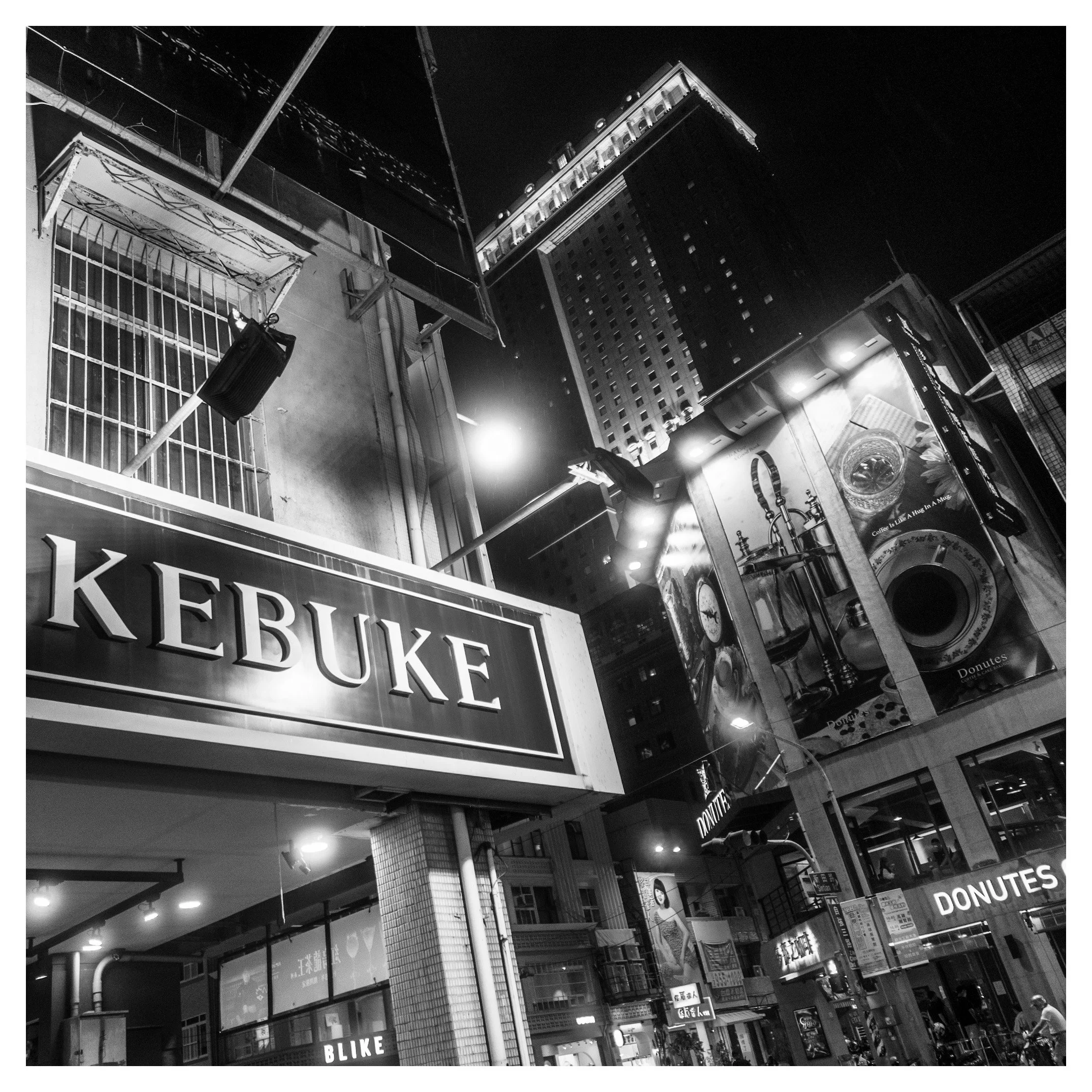
A single sign, tilted hard into frame at street level, beneath a tower that keeps rising long after the eye expects it to stop. Taken wide open, handheld, at night — the kind of shot that either falls apart or holds together, with very little room in between.
METADATA
• Camera Model: Leica D-Lux 8
• Lens: DC VARIO-SUMMILUX 10.9-34mm ASPH.
• Shutter Speed: 1/125 sec
• Aperture: f/1.7
• ISO: 400
THE CRITIQUE
This is a worm's-eye shot, taken from low on the ground looking almost straight up, and at 11mm that angle does exactly what it always does: the buildings lean inward as they rise, converging toward a vanishing point somewhere above the frame. In the lower left, a large sign reads KEBUKE in bold serif capitals, mounted on an awning and thrust diagonally into the frame by the angle of the shot. Behind and above it, a backlit coffee-shop advertisement — cups, a siphon brewer, a clock, the line "Coffee Is Like A Hug In A Mug" — sits at a second depth plane, and behind that, a high-rise tower keeps climbing into a black night sky, its upper cornice picked out in light long after the eye expects the frame to have run out of building. Overhead, a tangle of mounting brackets and exposed wiring crosses the top of the frame, the ordinary infrastructure of a dense commercial street. Small, distant streetlights soften into glowing orbs. At the bottom right, barely legible at this scale, a single human figure gives the whole looming arrangement something to be measured against.
What makes this work is not the angle alone — a wide lens pointed up is not, by itself, a photograph — but the fact that four genuinely distinct depth planes, each with its own scale, its own light source, and its own competing typography, hold together as one legible composition rather than collapsing into visual noise. That's a specific, learnable, and not especially forgiving skill. It requires knowing in advance how this lens will distort verticals at this focal length, trusting that f/1.7 at 11mm still holds enough depth of field to keep a foreground sign and a background tower both readable, and choosing a shutter speed that freezes handheld motion at night without pushing the ISO high enough to eat the shadow detail this image depends on. None of that is visible in the finished frame. It's only visible in whether the frame holds together, and this one does.
The square crop here is a slightly different case than most of what this camera has produced in this series. This isn't a single tall subject calling for a portrait rectangle, nor a compact cluster calling for a square, nor a clean wide horizontal spread. It's a frame where the vertical climb and the horizontal spread of signage both carry real weight, and the square crop, trimmed in from a wider native capture, seems to be doing the simplest possible job: keeping everything that matters, without letting either dimension dominate. Worth naming honestly as a case that doesn't fit the pattern quite as cleanly as some of the others have.
HOW THIS IMAGE COULD BE IMPROVED
• The bottom right of the frame, where the small human figure sits, is dense with competing signage (DONUTES, the woman's portrait poster, assorted Chinese-language text) that slightly crowds that one point of human scale. A version with a touch more breathing room around that figure would let it do its job more clearly.
• The tangle of wiring across the top of the frame is authentic to the street, but it currently reads as visual noise rather than a deliberate compositional layer. A slightly different standing position might resolve it into cleaner negative space against the dark sky.
• Given how much is happening across four depth planes, a second frame at a narrower aperture — f/4 or f/5.6, accepting a higher ISO or a tripod — would test whether every plane can be rendered with fully even sharpness rather than relying on this lens's inherent wide-angle depth of field to do the work.
ON BECOMING A BETTER PHOTOGRAPHER: LET THE DATA SPEAK
This project runs on a different kind of arithmetic than the platforms it gets posted to. A large number achieved in one day, from an account built on reposting or trend-chasing content that already worked somewhere else, isn't evidence of a better approach — it's evidence of a different game, one with no skill compounding underneath it and nothing durable once the format stops being novel. What produced this specific frame is the other kind of arithmetic entirely: an accumulated, mostly invisible fluency with exactly how this lens behaves at 11mm, exactly what this sensor can hold at f/1.7 and ISO 400 after dark, and which street corners actually offer four legible planes of signage worth the awkward, neck-craning angle it takes to find them. None of that shows up as a number anywhere. It shows up as this.
That also means the archive behind this blog has plenty of ordinary days in it, frames that were useful practice and nothing more, and that unevenness isn't a flaw in the project. It's what building a real, cumulative skill actually looks like from the inside, as opposed to a feed that only ever shows the highlights. Worth remembering on the days this one photograph is easy to forget.
PHOTOGRAPHERS TO RESEARCH
• William Klein — pioneered a raw, high-contrast, wide-angle approach to photographing New York's crowded street life, deliberately blowing out grain and contrast to invent a new visual language for urban chaos.
• Daidō Moriyama — brought Klein's influence into postwar Tokyo, producing stark, high-contrast, often tilted black-and-white street photography that became foundational to the Japanese Provoke movement.
• Ken Schles — documented 1980s New York after dark in stark, moody black and white, treating the city itself as a single, continuous, half-lit character.
• Michael Ackerman — works in extreme high-contrast, blurred, grainy black and white, favoring atmosphere and feeling over documentary clarity.
• Lewis Hine — photographed the construction of the Empire State Building from precarious heights, documenting the dignity and risk of the men who physically built a skyline upward, beam by beam.
BOOKS TO READ
• "Life Is Good & Good For You In New York" — William Klein. A raw, grainy, deliberately unrefined portrait of 1950s New York that reinvented what a street photography book could look like.
• "Tokyo" — Daidō Moriyama. High-contrast, blurred, tilted black-and-white images of postwar Tokyo's neon-lit, crowded streets.
• "Invisible City" — Ken Schles. A stark black-and-white record of a specific New York neighbourhood at night, in the 1980s.
• "End Time City" — Michael Ackerman. Grainy, high-contrast, emotionally charged black-and-white images shot in Benares, India.
• "Men at Work: Photographic Studies of Modern Men and Machines" — Lewis Hine. Includes his iconic photographs of construction workers on the unfinished Empire State Building, hundreds of feet above the street.
VIDEOS TO WATCH
• William Klein: In Pictures
https://www.youtube.com/watch?v=7g9IksGqiUM
• Daido Moriyama — Near Equal: Photographic Documentaries