

Day 337/365 The Whole Descent, Down To Her
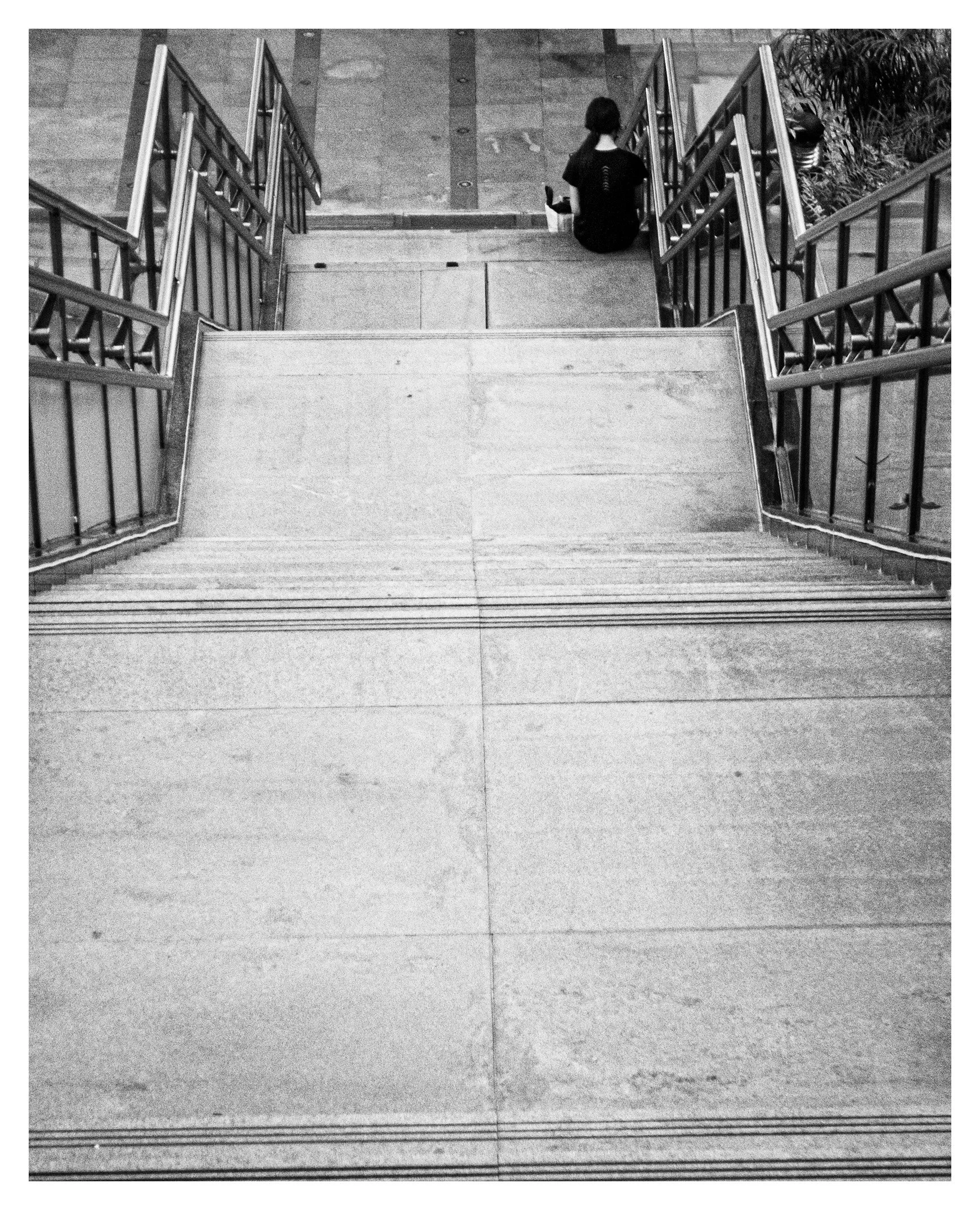
Shot from street level looking straight down the stairwell that leads into Central Park MRT Station, at a woman seated far below, near the foot of the stairs at the station entrance itself. The distance between camera and subject isn't empty space to fill — it's most of what this photograph is actually about.
METADATA
• Camera Model: Leica D-Lux 8
• Lens: DC VARIO-SUMMILUX 10.9-34mm ASPH.
• Shutter Speed: 1/60 sec
• Aperture: f/2.8
• ISO: 1000
THE CRITIQUE
This is shot from street level, at the top of the stairwell that carries commuters down into Central Park MRT Station, looking straight down the full length of that descent. What appears near the top of the frame — a landing with a different paving pattern, some greenery nearby, a woman seated with her back turned — is in fact the far, low end of the stairwell: the station entrance itself, where she is genuinely distant, small because of real distance rather than because of scale within a tight space. Everything below her in the frame, working back toward the camera, is the considerable run of paving, landings, and stairs between the station entrance and where the photograph was taken, at the top.
That real distance is the substance of the photograph, not a gap in it. A person standing at height, looking down a long descent at someone small and alone near the bottom, carries a genuine, specific quality — a sense of remove, of watching from above without being seen, that a level or close-up frame couldn't produce. Whether the intervening paved run includes a ramp, a further short flight partway down, or simply a broad flat terrace rendered smooth by the steep angle isn't something I can say with full confidence from the image alone, and given how much I've already had to correct on this one, that's worth stating plainly rather than guessing again.
The off-axis placement still holds regardless of the direction correction: she sits to one side of the stairway's central axis rather than on it, a small, deliberate asymmetry against railings that otherwise converge with real formal discipline down both sides of the frame. That detail was right before and remains right now.
Handheld at 1/60, f/2.8, ISO 1000 in dropping evening light, the grain running through the whole frame suits the mood — a slightly rough, analogue texture rather than a clean one. The portrait crop is a clean, unambiguous fit for a single tall subject, in keeping with the pattern this camera has shown before.
HOW THIS IMAGE COULD BE IMPROVED
• Given how much of the photograph's effect depends on real, legible distance, a frame that included one more small point of reference partway down the stairs — another person passing through, for instance — could reinforce the scale even further.
• The broad paved run between camera and subject, while doing real work establishing distance, is fairly uniform in tone; a touch more contrast in that middle stretch might help the eye read the different levels and landings more clearly on a first look.
• Worth testing this same vantage point at a few different times of day, since the quality and direction of light on that long paved run will change how much texture and depth it holds.
ON BECOMING A BETTER PHOTOGRAPHER: LET THE DATA SPEAK
• This is a strong example of using a real height difference and real distance deliberately, rather than simply finding a small figure in a wide frame — worth returning to this vantage point, and others like it, on purpose.
• Before describing or critiquing a photograph built on a steep or unusual vantage point, it's worth confirming the actual direction and position deliberately rather than inferring it from where things happen to sit in the frame — a steep downward angle and a steep upward angle can look surprisingly similar at a glance, and the difference changes what the photograph is actually saying.
• The off-axis placement of a figure within an otherwise symmetrical architectural frame keeps proving itself as a repeatable, deliberate device across this archive, independent of which direction the camera happens to be facing.
PHOTOGRAPHERS TO RESEARCH
• Robert Adams — photographed the sprawl of the American West with a spare, unsentimental, minimalist eye, finding quiet significance in ordinary, empty built environments.
• Lewis Baltz — documented industrial parks and tract developments with a cool, precise, almost clinical formal discipline, letting emptiness and repetition carry the image.
• Alec Soth — travels quietly through overlooked American places, favouring solitary figures and spare, patient compositions over incident or spectacle.
• Trent Parke — an Australian street photographer known for stark, high-contrast black-and-white images built around light, scale, and a single decisive human presence.
• Massimo Vitali — shoots from elevated, distant vantage points looking down over open spaces, using height and scale themselves as the subject.
BOOKS TO READ
• "The New West" — Robert Adams. A spare, direct 1974 survey of Colorado's suburban sprawl that reshaped how empty, ordinary landscapes could be photographed.
• "The New Industrial Parks Near Irvine, California" — Lewis Baltz. Cool, precise black-and-white studies of anonymous industrial buildings, letting formal discipline replace incident.
• "Sleeping by the Mississippi" — Alec Soth. Quiet, patient portraits and landscapes made along the length of the river, favouring stillness over event.
• "Dream/Life" — Trent Parke. Stark black-and-white street photography from the streets of Sydney, built on light, shadow, and scale.
• "Landscape with Figures" — Massimo Vitali. Large-format images shot from elevated platforms, using height and distance to render human figures within vast, orderly spaces.
VIDEOS TO WATCH
• Trent Parke: Minutes to Midnight (STEIDL, 2017)
https://www.youtube.com/watch?v=g1KFy13-RPY
• Alec Soth, Social Media, and Photographing Strangers