

Day 338/365 Warm Skin, Cold Light
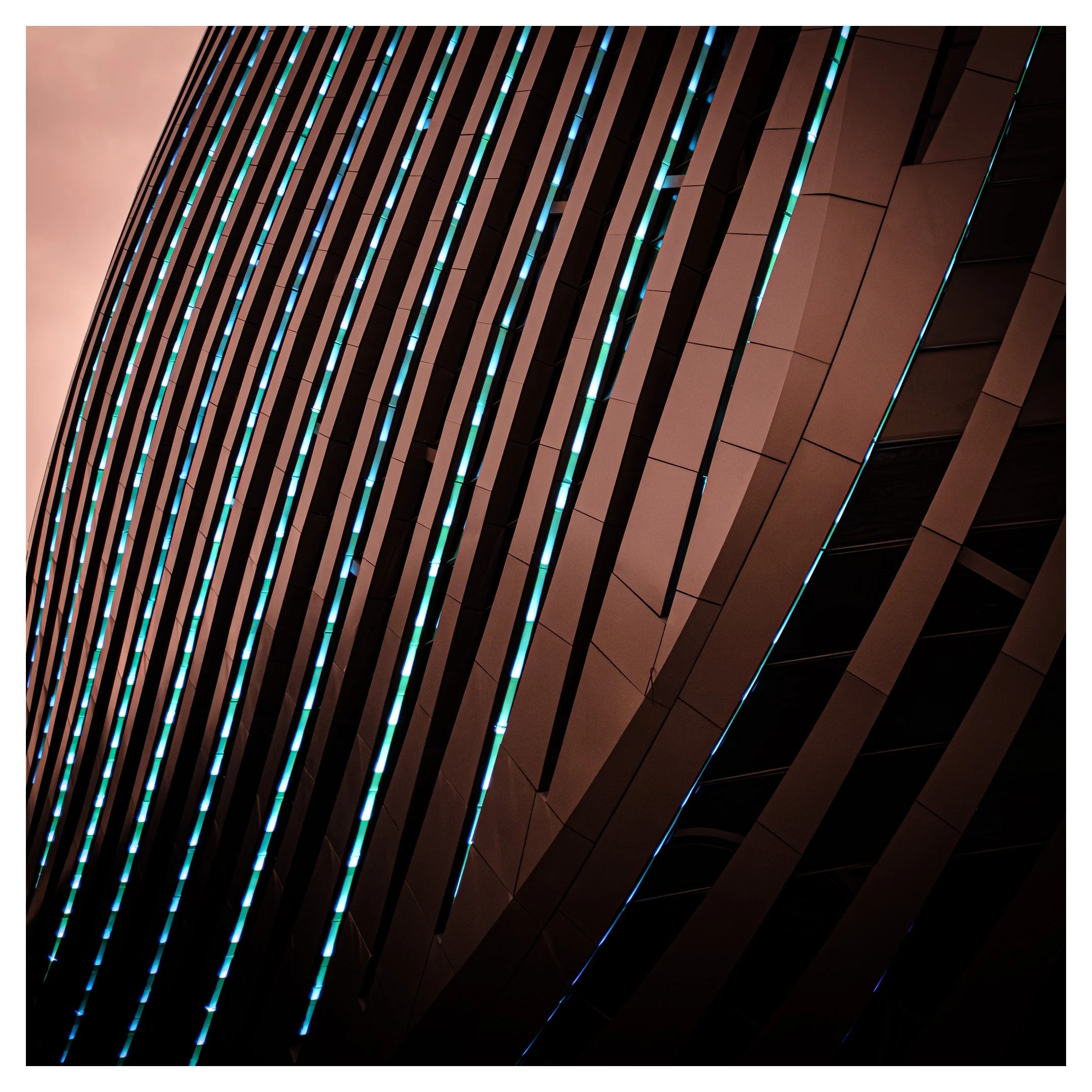
A curved wall of vertical fins, tilted into the frame at a steep angle, each one lit along a thin channel of blue-green LED against a warm dusk sky. No figure, no signage, nothing to read — just rhythm, colour, and the slow, subtle curve of a building revealing itself one line at a time.
METADATA
• Camera Model: Fujifilm X-Pro2
• Lens: XF23mmF2 R WR
• Shutter Speed: 1/125 sec
• Aperture: f/2
• ISO: 2500
THE CRITIQUE
This is a close, tilted detail shot of the Cruise Terminal's curved facade in Kaohsiung, taken low and at an angle steep enough that the building's vertical fins read as a field of diagonal lines sweeping across the frame. There's no single subject in the usual sense — no figure, no sign, nothing to read — just pattern, colour, and the way a curved surface makes an otherwise rigid, repeating structure feel like it's genuinely moving.
The colour relationship is the real content here, and it's worth naming precisely because it runs backwards from the pattern this archive has tracked before. Elsewhere, the warmth has usually come from artificial light — a lamp, a shopfront — set against a cooler ambient blue. Here it's reversed: the warmth is ambient, a dusk sky and its last light catching the flat faces of the fins in a soft salmon-terracotta, while the artificial element — a thin strip of LED embedded in each recessed channel — runs cool, blue fading to green. Worth watching for both directions of this relationship going forward rather than assuming it only runs one way.
The curve does quiet, genuinely interesting work if you look for it. The fins aren't uniformly parallel across the frame; their angle and spacing shift subtly as the surface bends away, so the building's actual three-dimensional form comes through in the rhythm of the lines themselves rather than through any more obvious cue like a visible edge or a change in scale. On the right side of the frame, the fins fall into near-total shadow, the pattern trailing off into black before the frame runs out.
This is also, worth saying plainly, a genuine first for the archive on two counts: the first frame shot on a Fujifilm X-Pro2 rather than the Leica that's carried most of this series, and the first entirely abstract, non-figurative image in it. Both are worth judging on their own terms rather than against habits built on a different camera and a different genre. At f/2, ISO 2500, 1/125, the fast prime has done exactly what a fast prime is for here — handheld, in dropping light, with enough shutter speed to hold the pattern sharp. The square crop, trimmed in hard from a portrait native frame, suits a subject built on repeating rhythm rather than a single tall or wide form — though with only one frame from this camera in the archive so far, that's an observation about this image, not yet a pattern to compare against.
HOW THIS IMAGE COULD BE IMPROVED
• The transition into near-total black on the right side of the frame could be a deliberate choice or a slightly premature edge — worth testing both a version that includes one more fin's worth of visible detail and a version cropped even tighter, to see which reads better.
• A wider companion frame, taking in more of the building's overall curve even at the cost of some of this close intimacy, would give a viewer more context for what the pattern is actually describing.
• At ISO 2500, the shadow recesses between fins likely carry some visible noise — worth checking at full resolution, and worth testing this same angle on a stabilised, longer exposure at a much lower ISO for comparison, since the subject itself isn't moving.
ON BECOMING A BETTER PHOTOGRAPHER: LET THE DATA SPEAK
• This is a deliberate step outside two well-worn habits at once — a different camera, and a genre without a human figure or a legible narrative — and it's worth treating as a real, recurring category for this archive rather than a one-off experiment.
• Worth tracking, from here on, whether this camera develops its own habitual crop behaviour the way the Leica has, now that there's a first data point on record to eventually compare against.
• The warm/cool relationship that's shown up repeatedly in this archive just ran in the opposite direction from usual. Worth actively looking for both versions of that device going forward, rather than expecting it to always resolve the same way.
PHOTOGRAPHERS TO RESEARCH
• Roland Fischer — photographs building facades from around the world, transforming their geometry and colour into images that read as abstract paintings rather than documentary records.
• Ola Kolehmainen — a leading figure of the Helsinki School, known for reducing modern architecture to minimalist fields of colour, light, and geometric rhythm.
• Hélène Binet — one of the world's most respected architectural photographers, known for a deep, exacting sensitivity to how light defines built form.
• Michael Eastman — works in richly saturated colour, using facades and interiors across the world's cities to build painterly, narrative studies of surface and light.
• Iwan Baan — worth studying specifically as a contrast: his architectural photography insists on people and everyday life as part of every frame, the opposite instinct from an image this deliberately empty of both.
BOOKS TO READ
• "Façades" — Roland Fischer. A survey of building exteriors from cities around the world, transformed through the camera into near-abstract compositions of colour and geometry.
• "Fraction Abstraction Recreation" — Ola Kolehmainen. Minimalist, near-abstract studies of contemporary architectural facades, reduced to colour, light, and geometric order.
• "Composing Space: The Photographs of Hélène Binet" — Hélène Binet. A major survey of her decades-long study of how light and shadow give architecture its emotional force.
• "Vanishing America" — Michael Eastman. Richly coloured studies of American vernacular architecture and signage, unified by a painterly attention to surface and decay.
• "Iwan Baan: Moments in Architecture" — Iwan Baan. A comprehensive retrospective insisting that architecture is best understood as the setting of everyday life, not an abstract ideal.
VIDEOS TO WATCH
• Arts.21 | Minimalist Monumentalism: Ola Kolehmainen