

Day 339/365 The Temple That Just Got Its Colour Back
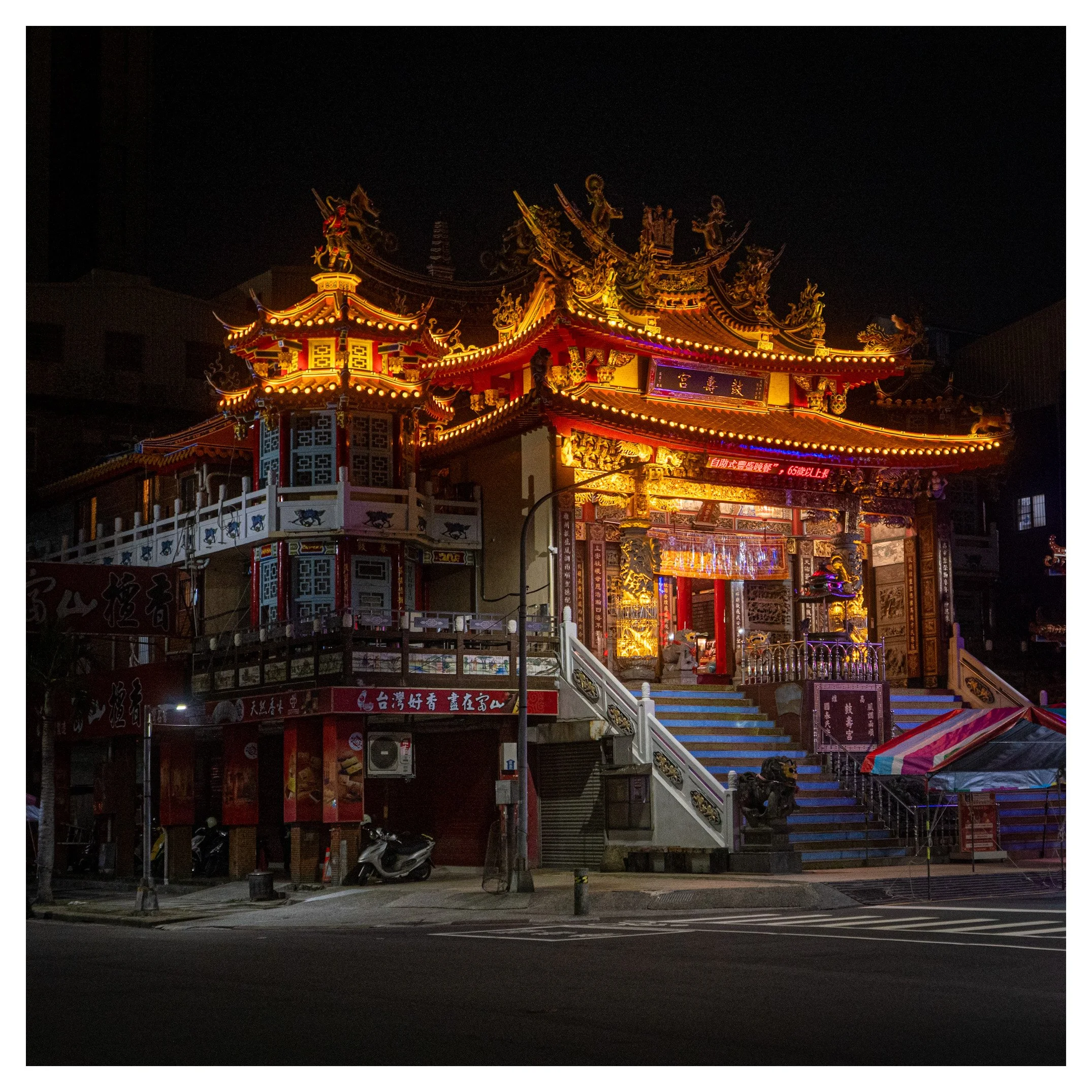
A grand temple at a street corner, fully lit against total darkness, every surface of gold and red looking freshly made rather than merely maintained. One detail breaks the warmth deliberately: a run of blue-tiled steps leading up to the door. Recently renovated, and it shows in every inch of the frame.
METADATA
• Camera Model: Leica D-Lux 8
• Lens: DC VARIO-SUMMILUX 22mm
• Shutter Speed: 1/60 sec
• Aperture: f/2.7
• ISO: 640
THE CRITIQUE
This is 大港埔鼓壽宮, a temple to Tianshang Shengmu — Mazu, the sea goddess — photographed from a street corner at a three-quarter angle, the main hall and its corner tower both visible, roofline traced in warm string lights against a sky gone completely black. Nothing else in the frame competes with it for colour or light. The street, the shop beside it, the parked scooter, the striped edge of a stall at the right — all of it sits in near-darkness, so the temple reads almost as if it's the only thing generating light for blocks around.
The caption notes this temple was recently renovated, and that fact is legible in the photograph itself, not just stated alongside it. The gold leaf, the red lacquer, the ceramic figurines along the ridgeline — none of it looks weathered or faded the way old temple paintwork usually does under night lighting. It looks new. That's the actual subject here: not simply "temple at night," but a temple whose investment and renewal have just been made visible, on public display at a street corner for anyone passing to see.
Colour is handled with more restraint than it might first appear. The whole frame runs warm — gold, amber, red — with exactly one cool interruption: the stair risers leading up to the entrance, tiled in a distinct turquoise blue. It's a single, deliberate accent rather than a broad warm/cool split across the frame, and it does real work, giving the eye a clear place to land amid so much saturated gold. Below the stairs, a pair of stone guardian lions sit in shadow at the base — present, but clearly secondary to the gold and red spectacle above them.
There's no human figure anywhere in this frame, and that's worth naming as a real quality rather than an absence to apologise for. At just past ten at night, the street is empty, the shops closed, and what's left is a significant civic landmark standing alone in the dark, fully lit for no one in particular. That's a quietly different mood from the crowd and conversation this blog usually finds around temples.
Technically, the temple's own lighting is doing most of the exposure work — ISO 640 and 1/60 sec at f/2.7 are modest, appropriate settings for a well-lit subject rather than evidence of straining against darkness. The square crop, again, suits a compact architectural cluster — the main hall, tower, and stairs read as one self-contained subject even at this wider, more establishing framing than the archive's recent close-up work.
HOW THIS IMAGE COULD BE IMPROVED
• The red illuminated announcement strip below the main roofline sits in an awkward middle ground — too small to read, too present to ignore. Worth trying a frame that either includes it clearly enough to matter or crops it out entirely.
• The striped tent at the right edge is only partially in frame. Either bring it in fully as a secondary point of interest, or tighten the crop to lose it.
• Given how much ornamental detail exists on the roofline and the carved entrance pillars, a second, tighter frame focused purely on that detail would make a strong companion piece to this wider view.
• The blue stair risers are a genuinely strong colour accent — worth a separate frame taken more directly from the base of the stairs, letting that blue do even more of the compositional work.
ON BECOMING A BETTER PHOTOGRAPHER: LET THE DATA SPEAK
• This is a clean example of a stated fact actually showing up as visible evidence in the frame — the renovation isn't just mentioned, it's legible in the paintwork itself. Worth continuing to check that captions and content genuinely line up rather than sitting side by side.
• This is a fourth, distinct angle on this archive's recurring interest in sacred space: not a finished object of devotion, not a courtyard used socially, not a modest temple too humble to separate worship from its own upkeep — but investment and civic pride, made visible. Worth naming that range explicitly as it grows.
• The single cool accent against a broad warm field, rather than an even warm/cool split, is a variant worth actively looking for again — a more selective, targeted way to use colour contrast than this archive has mostly relied on so far.
PHOTOGRAPHERS TO RESEARCH
• Fan Ho — often called the Cartier-Bresson of the East, built entire compositions from geometry, light, and shadow on the streets of mid-century Hong Kong.
• Werner Bischof — a founding-era Magnum photographer whose work in postwar Asia, including Japan and India, is defined by quiet formal control and genuine respect for the cultures he photographed.
• Aaron Siskind — read the roofline and the carved entrance here the way he read weathered urban surfaces: as pure shape, gesture, and abstraction, independent of subject.
• Trey Ratcliff — a pioneer of high dynamic range photography, useful specifically for anyone working with a single high-contrast light source against total darkness, exactly this frame's technical problem.
• Chien-Chi Chang — worth knowing for a different reason entirely: arguably Taiwan's most significant internationally recognised photographer, though his subject is the psychology of relationships rather than architecture. A deliberate broadening, not a stylistic match.
BOOKS TO READ
• "Hong Kong Yesterday" — Fan Ho. Black-and-white photographs of 1950s and 60s Hong Kong, built on geometry, shadow, and a deeply humanist eye.
• "Japan" — Werner Bischof. Awarded the Prix Nadar in 1955, a landmark early colour and black-and-white document of postwar Japan.
• "Aaron Siskind: Photographs" — Aaron Siskind. His first monograph, showing how ordinary surfaces become abstract compositions once you stop looking for a subject.
• "A World in HDR" — Trey Ratcliff. Part portfolio, part technical guide, useful for anyone working through the exact challenge of a bright subject against a dark sky.
• "The Chain" — Chien-Chi Chang. Portraits made in a Taiwanese psychiatric institution; a very different kind of intensity than tonight's frame, and worth knowing regardless.
VIDEOS TO WATCH
• Fan Ho | the art of light, shadow, and humanism
https://www.youtube.com/watch?v=tjQNFr4FCfI
• Leica & Magnum Photos Present: Generation X — Werner Bischof in India and Japan