

Day 340/365 The Sky Almost Didn't Let This Happen
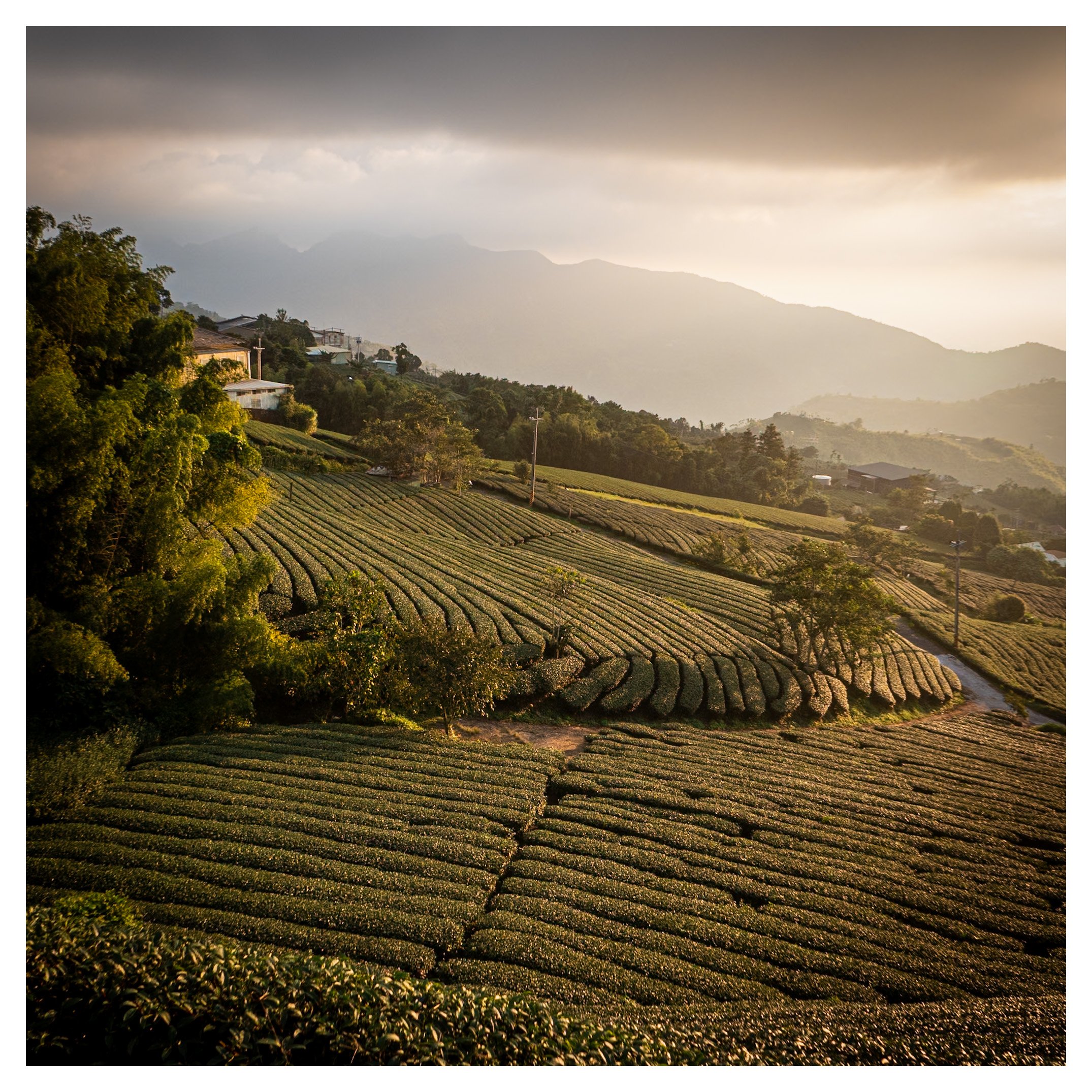
Heavy, brooding cloud cover fills most of the sky above these tea terraces — until a narrow break lets the low sun through, catching every curving row in gold. A companion, of sorts, to a much quieter frame from the same general country. This one holds nothing back.
METADATA
• Camera Model: Leica D-Lux 8
• Lens: DC VARIO-SUMMILUX 11mm
• Shutter Speed: 1/160 sec
• Aperture: f/5.6
• ISO: 200
THE CRITIQUE
This is tea country near Alishan, and unlike the last frame from that general region, there is nothing dissolved or withheld about it. The rows of tea bushes curve and sweep across the hillside in clean, rhythmic lines, catching a low, warm, late-afternoon light that turns their tops gold and drops hard shadow into the gaps between them. A dense stand of trees on the left holds a small building among its branches, more scattered structures sit further back among the terraces, and behind all of it a range of hazy blue mountains recedes into the distance. Above everything, a heavy bank of dark, brooding cloud takes up most of the sky — except for one narrow, glowing break, exactly where the light needed to come through for this photograph to work.
That break is doing real work here, and it's worth naming as the actual subject rather than treating it as scenery: the entire golden cast over the tea rows exists only because of it. Moody, changeable weather like this rewards patience and timing more than almost anything else in landscape photography — being on the hillside at the right minute, not the right hour, and this frame is evidence that patience paid off.
Worth saying plainly: this is close to a direct answer to something the last Alishan post was missing. That frame was mist and one hard tree line, tea plantations mentioned in the caption but nowhere actually visible in the image. This one shows the rows themselves, in full, legible detail, catching real light. Where the last frame worked by dissolving almost everything, this one works by including almost everything — density and specificity instead of absence. Seen together, they're a genuine study in two opposite ways of photographing the same stretch of country.
The composition holds a lot of competing information without feeling cluttered: the curving tea rows function as clear leading lines pulling the eye up and back through the frame, the tree-and-building mass on the left acts as a vertical counterweight to all that horizontal sweep, and the layering — sharp foreground, softer middle distance, hazy mountains, dramatic sky — builds real depth. At 11mm, essentially the widest this lens goes, there was room to take in the full sweep of the terracing and still hold the sky's drama without cropping either one out.
HOW THIS IMAGE COULD BE IMPROVED
• The tree-and-building cluster on the left is cut by the frame edge rather than fully resolved — worth trying a version with slightly more room on that side.
• The sky-to-land balance here is close to even; it's worth testing a version that commits further one way — more sky, to let the cloud drama lead, or less, to put full weight on the tea-row pattern.
• There's a utility pole and wires visible among the terraces in the middle distance — a small, familiar kind of frame intrusion worth scanning for on a return visit.
• At this wide a focal length, worth checking the frame edges for any barrel distortion, particularly along the horizon and the vertical building on the left.
ON BECOMING A BETTER PHOTOGRAPHER: LET THE DATA SPEAK
• Treat this frame and the previous Alishan post as a deliberate pair if the chance comes up to present them together — dissolution versus density, the same country handled two completely different ways.
• This complicates the ongoing note on this camera's crop choices in a useful way: it isn't simply that wide horizontal scenes get a wide crop. A composition built on one dominant axis calls for a crop that follows it; a composition working two directions at once — the diagonal sweep of the rows against the vertical mass of the trees — can be held together by a square frame instead of favouring either one. Worth carrying that more precise version forward.
• Landscape is shaping up as a real, distinct thread in this archive now, with two entries in quick succession that look almost nothing alike. Worth continuing to develop it as its own category rather than a one-off detour from street and architectural work.
PHOTOGRAPHERS TO RESEARCH
• Yann Arthus-Bertrand — best known for aerial work, but his eye for the graphic patterns agriculture leaves on land is exactly what these curving tea rows are doing at ground level.
• Steve McCurry — worth knowing for the warmth and golden light he finds across rural and working Asia, even where this specific photograph isn't about a person.
• Art Wolfe — his own dedicated body of work on terraced agriculture makes him about as direct a match as this list gets.
• Galen Rowell — built an entire career and a signature book around exactly this: chasing the brief, dramatic light that breaks through changeable mountain weather.
BOOKS TO READ
• "Earth from the Air" — Yann Arthus-Bertrand. Aerial photography that reveals the graphic patterns human agriculture leaves across the land.
• "South Southeast" — Steve McCurry. Warm, richly coloured documentary work across South and Southeast Asia.
• "Rice Terraces" — Art Wolfe. A dedicated study of terraced agricultural landscapes and the rhythm they create across hillsides.
• "Mountain Light: In Search of the Dynamic Landscape" — Galen Rowell. Part memoir, part masterclass, built entirely around the pursuit of fleeting, dramatic natural light.
VIDEOS TO WATCH
• Steve McCurry: The Secret to Great Photos