

Day 341/365 One Small Plane, One Long Queue
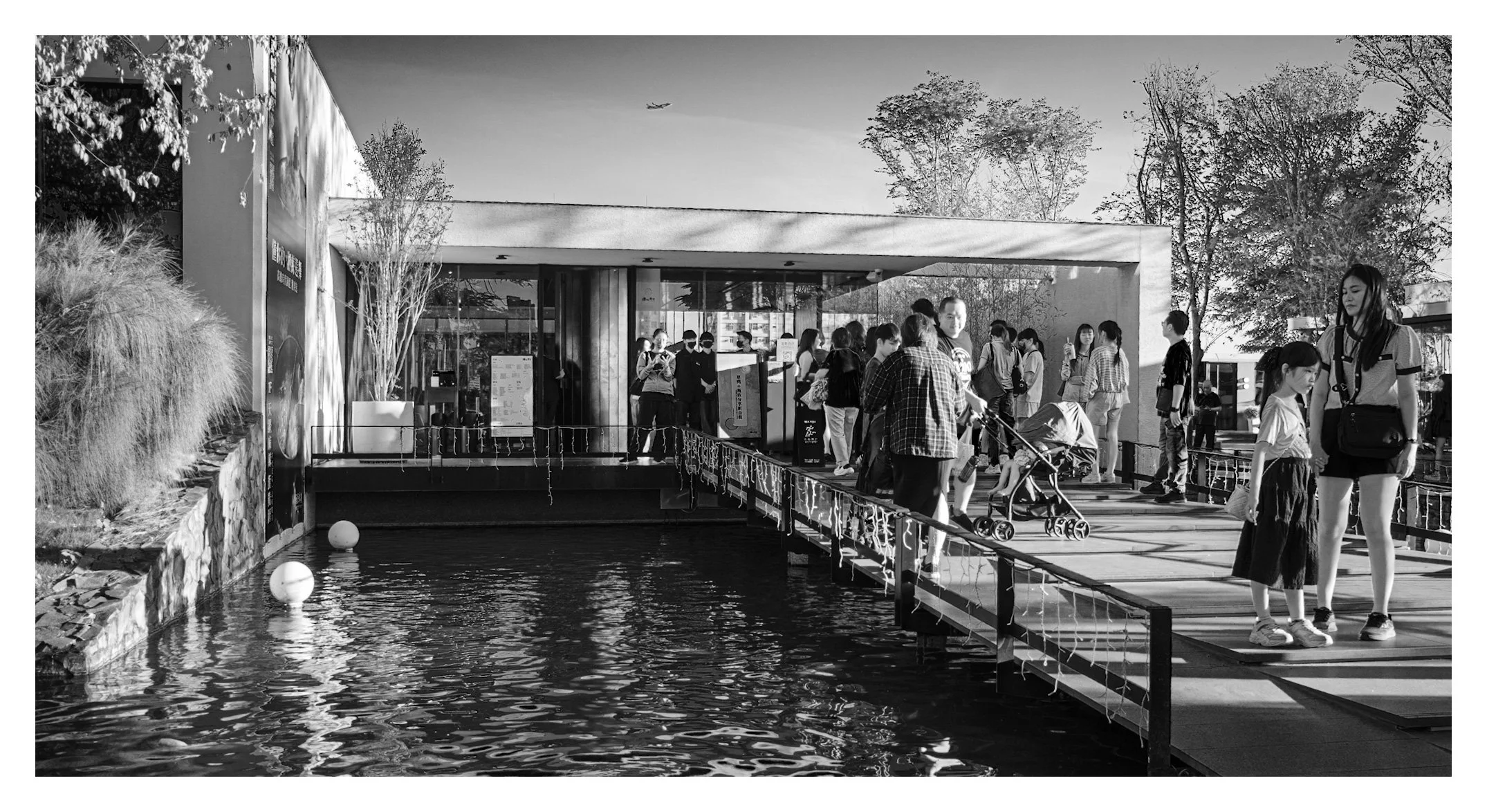
A long queue for BBQ supplies stretches along a walkway during Moon Festival, while two figures closer to camera stand entirely apart from it, facing the other way. Overhead, barely visible, a single plane cuts across the sky. Three completely different scales of attention, all in one frame.
METADATA
• Camera Model: Ricoh GR III
• Lens: GR Lens 18.3mm F2.8 (fixed prime, no zoom)
• Shutter Speed: 1/250 sec
• Aperture: f/4
• ISO: 200
THE CRITIQUE
Moon Festival, and this is the queue for BBQ supplies — a long line of people strung out along a raised walkway that crosses a reflecting pool, running toward the glass entrance of a modern building with a flat cantilevered roof. Stone-walled water fills the foreground, ornamental grass silhouetted against the sky on the left, an airplane crossing overhead almost too small to notice on a first look. Two figures — a woman and a girl in what looks like a school uniform — stand much closer to the camera than anyone else in frame, facing away from all of it.
That last detail is the one worth building the whole read around. This archive keeps returning to a specific device: a crowd collectively oriented toward one thing, while somewhere else in the same frame, one or two figures are having an entirely separate, disconnected moment. It showed up on the fishing pier, in the graffiti mirror, on the temple bench. Here it's doing it again, and cleanly — the queue is a single social phenomenon, a line of strangers all wanting the same thing on the same day; the two figures nearer the camera are simply standing, apparently unconnected to any of it, facing the other way entirely.
The scale relationship does real work here too. The queue reads as a collective — smaller in the frame, individual faces not quite resolved, a crowd rather than a set of people. The two closer figures are large enough to read as specific individuals, not types. That contrast, collective versus particular, is doing more compositional labour than it might look like at first glance. And then there's the plane — a third scale entirely, someone moving through the sky at a completely different speed and distance from everything happening at ground level, in the same fraction of a second as the shutter.
The water reflecting the building and walkway is worth being precise about: this is a natural feature of the location, not a staged reflection device the way an earlier post's mirror was. It adds real depth and a second, slightly softened version of the same scene, but it's incidental rather than authored — worth keeping that distinction honest rather than treating every reflective surface in this archive the same way.
HOW THIS IMAGE COULD BE IMPROVED
• Moon Festival has its own specific colour register — lantern light, warm night gatherings, the whole occasion built around colour and light. Black and white removes all of that. Worth asking honestly whether colour might have carried more of what this particular event actually feels like, rather than defaulting to the monochrome treatment this archive has been using heavily of late.
• The decorative strands draped along the walkway railing read as texture in black and white but aren't fully legible as anything specific. If they're festival decoration, colour would likely make that a lot clearer.
• The woman in the foreground pair is cut somewhat awkwardly at the frame's right edge. A touch more room on that side would let both figures resolve more comfortably.
• The poster on the building's exterior wall carries an image and text that never quite comes into focus at this distance — worth a closer, separate frame if its content connects meaningfully to the Moon Festival context.
ON BECOMING A BETTER PHOTOGRAPHER: LET THE DATA SPEAK
• This is at least the fourth confirmed instance of the "multiple registers of attention" device in this archive. It's a genuinely strong tool, and it's earning its keep — but four uses in is exactly the point where a device risks becoming a reflex rather than a choice. Worth deliberately going looking for a different organising principle on the next few busy, crowded frames, just to keep the toolkit from narrowing.
• Worth testing the black-and-white-versus-colour question specifically on anything tied to a named cultural event going forward, rather than applying whichever treatment happens to be in favour that week. A festival's colour is often part of its actual content, not just its surface.
• This is a return to the Ricoh GR after a run of Leica posts — a fixed 28mm-equivalent prime against the Leica's zoom range. Worth treating the two cameras as an ongoing, deliberate point of comparison rather than letting whichever one has been used most recently quietly set the house style.
PHOTOGRAPHERS TO RESEARCH
• Martin Parr (1952–2025) — no photographer has written more precisely or more fondly about queues specifically than Parr did; his loss to the field this past year is worth acknowledging, and his eye for crowds without quite connecting to them is exactly the territory this photograph sits in.
• Matt Stuart — twenty years of London street work built on wit, timing, and finding the accidental relationships between strangers who share a frame but not a moment.
• Bruce Gilden — close, unflinching, crowd-and-individual work from the streets of New York, useful for studying how much can be said about a person standing apart from everyone around them.
• Melanie Einzig — her New York street work, collected in Street Photography Now among other places, is quietly excellent at catching the small, spontaneous scenes that erupt at the edge of a crowd's attention.
BOOKS TO READ
• "The Last Resort" — Martin Parr. His best-known and most influential book, documenting a British seaside town's crowds with wit and genuine warmth.
• "All That Life Can Afford" — Matt Stuart. Two decades of London street photography built on timing, coincidence, and finding the funny, human overlap between strangers.
• "Facing New York" — Bruce Gilden. Close, candid, unsentimental portraits of New Yorkers on the street.
• "Street Photography Now" — various, including Melanie Einzig. A strong survey anthology if a single photographer's book isn't the right entry point.
VIDEOS TO WATCH
• Matt Stuart on Failure in Street Photography — How I See (Leica podcast)
https://www.youtube.com/watch?v=lcPaF23TD_Q
• Bruce Gilden On The Street, Part 1