

Day 342/365 CHASING A SCOOTER AT 1/30: A LESSON IN LETTING GO
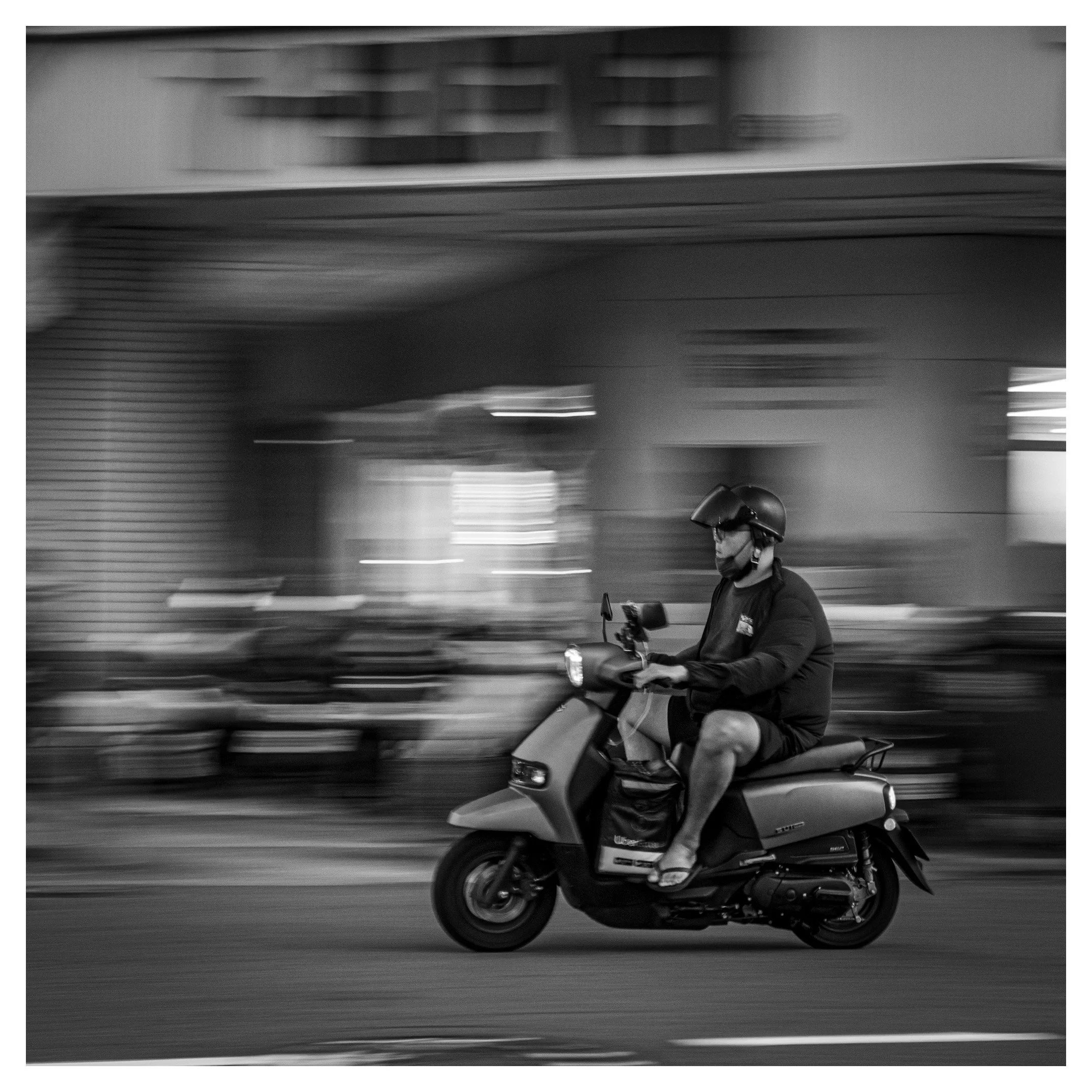
A rider streaks past in black and white while the city dissolves around him. Theo Marr examines a Leica D-Lux 8 panning study at 1/30 second, explains what works, what stays stubbornly still, and how one slow shutter speed can teach you more than a hundred sharp frames.
METADATA
Camera Model: Leica D-Lux 8
Lens: DC Vario-Summilux 10.9-34mm f/1.7-2.8 ASPH., set to 33mm
Shutter Speed: 1/30 sec
Aperture: f/2.8
ISO: 320
Captured 28 September 2026 at 17:50, cropped to a 3065 x 3065 pixel square.
THE CRITIQUE
Panning is one of the oldest bargains in photography. You give up the sharp background you would normally want, and in return you get speed, direction and a sense of the moment passing. This frame honours that bargain well.
The rider is the clear anchor. He sits in the lower right, helmet visor flipped up, mask pulled below his chin, shorts and flip-flops, a phone mounted on the handlebar. Everything about him says routine. He is not performing for a camera, and he is not rushing. The ordinary posture set against the violent streaking of the background is the picture's quiet joke, and I rather like it.
The pan itself is convincing. The shopfronts and awnings have been pulled into long horizontal bands, and the pale rectangles of lit windows in the middle distance become smears of light that read as speed rather than mess. The rider's head, torso and the scooter's body hold their sharpness, which is the hardest part of the technique. At 1/30 second you had very little margin, and you kept the subject locked to the frame while your body swept through the arc.
The square crop is a good decision. The rider moves left and there is open road and blur ahead of him, so he has room to go. The white road markings at the bottom reinforce the direction of travel without competing with him. Monochrome also helps, because colour would have turned those blurred windows into a distraction. In black and white they become tone and rhythm.
There are weaknesses. The wheels are the giveaway: both are rendered quite crisply, and at this shutter speed I would expect a touch more rotational blur in the spokes and tyre. It suggests you caught the scooter at a moment when the pan and the subject matched almost too perfectly, or that the wheels were simply moving slowly. The result is a slight stiffness in the lower third, as if the scooter has been placed on the road rather than propelled along it.
The brightest streaks sit in the centre of the frame, close to the rider's head height, and they draw the eye away from him for a beat. The upper third, a large expanse of grey blur, feels heavier than it needs to be. The grain is visible but not unpleasant, and it suits the mood.
HOW TO IMPROVE IT
• Try 1/15 or 1/20 second on the next outing. You will lose some keepers, but the wheels will gain motion and the background will become more painterly.
• Watch the background before you press the shutter. A dark, even backdrop behind the rider would let him separate more cleanly, and a bright window behind his head will always compete with him.
• Consider a slightly lower crop or a tighter square so the empty upper band does not carry so much weight.
• Keep ISO as low as the light allows. Once you are at 1/30 you have room to drop below 320 in stronger light, and the cleaner tonal gradation would help the smooth blur.
• Shoot bursts. Panning is a percentage game, and the difference between a good frame and a great one is often a single frame in the sequence.
GROWING AS A PHOTOGRAPHER: WHAT THE DATA SAYS
Two frames are a small sample, but they already show a pattern. You are choosing a slow shutter deliberately (1/30), shooting wide open (f/2.8), keeping ISO modest (320) and finishing in monochrome with a square crop. That is a coherent set of decisions, not random settings. Your instinct is to work with motion and tone rather than sharp detail.
To make that measurable over time:
• Keep a simple log of shutter speed against keeper rate. If your best panning frames cluster at 1/30 to 1/60, you will know where your hand is most reliable.
• Note the subject speed for each frame. A cyclist and a scooter at 40 km/h need different shutter speeds.
• Track how often you crop to a square, and whether the crop improves or rescues the frame. If you rescue often, the framing at capture needs work.
• Compare ISO against time of day. The 17:50 light in late September is a lovely window for this kind of work, and knowing your ISO ceiling there gives you confidence at dusk.
PHOTOGRAPHERS TO RESEARCH
• Alex Webb. Layering and complexity in colour and light, useful for learning how to control what happens behind a subject.
• Joel Meyerowitz. A pioneer of colour street photography who is generous about method. Study how he reads a street before the moment arrives.
• Ilse Bing. Known in her day as the Queen of the Leica. She used the small, fast camera to experiment boldly with angles, cropping and movement.
• Ray K. Metzker. A master of black and white abstraction who treated the city as shapes, lines and light. Relevant to how you already handle tone.
• Masahisa Fukase. A Japanese photographer whose work shows how far grain, blur and darkness can push mood and emotion.
BOOKS TO READ
• The Suffering of Light: Thirty Years of Photographs by Alex Webb
• Cape Light by Joel Meyerowitz
• Ilse Bing: Three Decades of Photography by Nancy C. Barrett
• Unknown Territory: Photographs by Ray K. Metzker
• Ravens (Karasu) by Masahisa Fukase
VIDEOS TO WATCH
• Alex Webb, Aperture artist talk on The Suffering of Light: https://www.youtube.com/watch?v=DCHeVfiE1r4
• Joel Meyerowitz, photographer talk: https://www.youtube.com/watch?v=u8eXa9rhCzM
• Ilse Bing, "All Paris in a Box": https://www.youtube.com/watch?v=i49A2Hhauh4
• Ray K. Metzker, "The Photographs of Ray K. Metzker": https://www.youtube.com/watch?v=3DAj62Cgb88
• Masahisa Fukase is represented by the book only, as I could not find a suitable English-language video.
MANUFACTURER NOTE
Leica's D-Lux 8 is a compact with a fast zoom lens, and this frame shows the case for it: a bright f/2.8 aperture at the long end, a usable slow shutter and clean enough files at ISO 320. Leica Camera Taiwan is the natural contact for a conversation about a partnership, given the Taiwanese subject matter and the consistent use of the camera.