

Day 343/365 Gold, Glass and the Blue Hour: A Kaohsiung Harbour Study
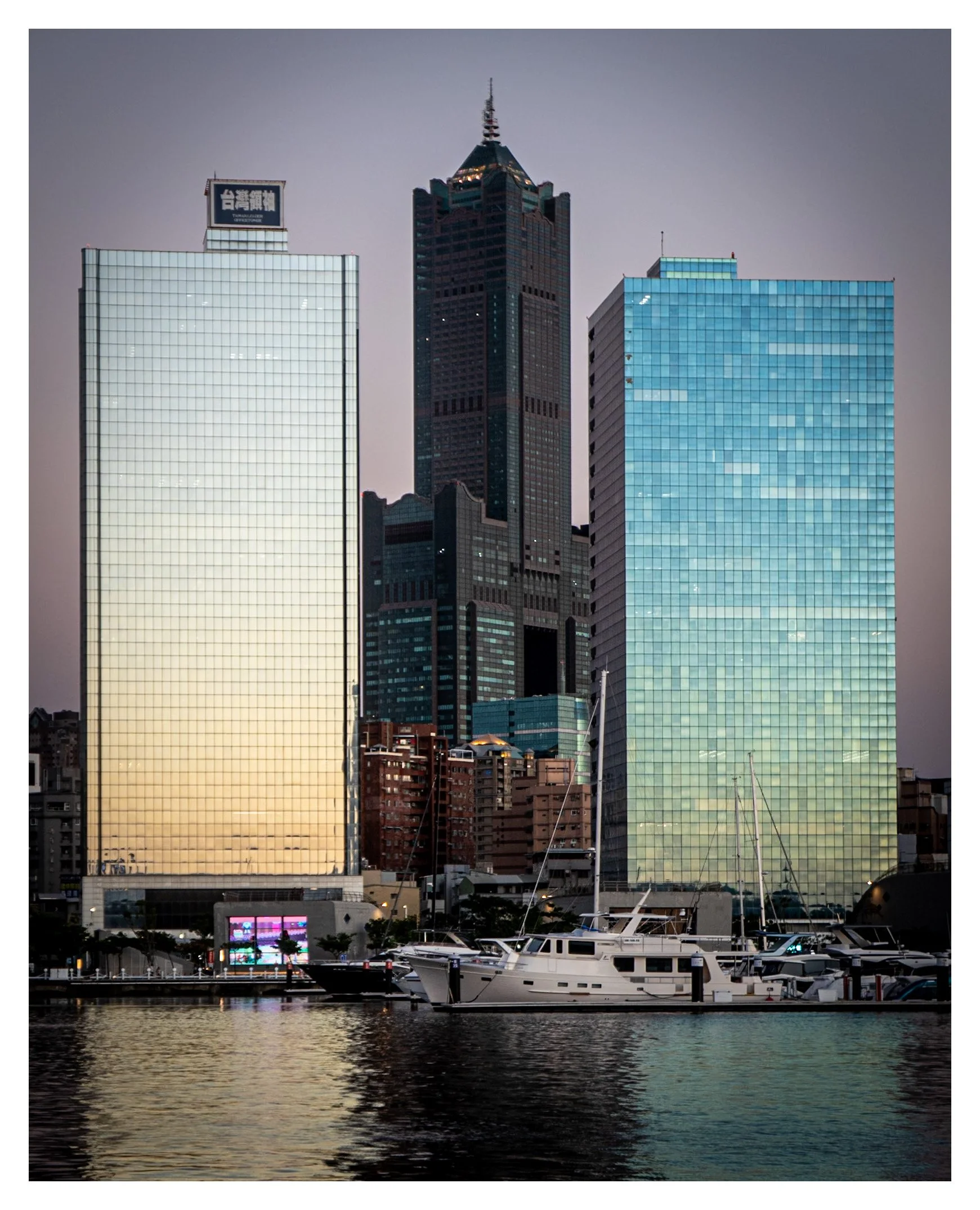
Three towers catch the last colour of the day differently: one turned to gold, one dark, one cooled to glass blue, with a marina full of yachts waiting below. Theo Marr looks at what a Leica D-Lux 8 caught in that narrow window between sunset and night, and where the frame could have gone further.
METADATA
Camera Model: Leica D-Lux 8
Lens: DC Vario-Summilux 10.9-34mm f/1.7-2.8 ASPH., set to 34mm
Shutter Speed: 1/125 sec
Aperture: f/2.8
ISO: 200
Captured 29 September 2026 at 17:52, cropped to 2957 x 3696 pixels, portrait orientation.
THE CRITIQUE
This is a harbour skyline built on a colour argument rather than a documentary one, and that argument is the reason it works. The left tower has caught the low sun full on its glass face and turned almost entirely to gold, its rooftop signage sitting like a crown on top of the burn. The right tower, similar in height and material, has cooled to teal and pale blue, untouched by the same light. Between them sits a darker, more angular structure with a distinctive crowned top, held back in shadow. Three towers, three temperatures. That is the picture.
The vertical crop earns its keep. A wide frame would have flattened this into a generic skyline; the tall, narrow format forces the eye up the glass faces and gives the buildings the scale they are asking for. The marina in the foreground, its yachts and masts catching the last of the light, does real work too. It grounds the image in a human, leisurely register that contrasts with the corporate glass above, and the still water doubles all three towers as soft reflections, which adds a second, quieter rhythm at the bottom of the frame.
The timing shows discipline. This is the "blue moment," the brief window after sunset when artificial and ambient light sit in balance and a city can look genuinely otherworldly. That window lasts only a couple of minutes, and getting a static architectural subject to hold across three distinct light qualities within it is not luck.
Now the weaknesses. The sky is the single largest tonal area in the frame and it is doing almost nothing: a flat, slightly hazy mauve-grey that does not reward a second look. Because so much of the top third is given to it, the picture's energy sags exactly where the eye lands first. The central dark tower, structurally the picture's fulcrum, has gone murky enough that its own detail is lost; it is reading as a silhouette rather than a third full character in the story, and the crown at its top barely survives the shadow. At street level, a small lit kiosk sign at bottom left is a genuine distraction — the eye keeps sliding down to it, away from the three-tower composition that is meant to be the subject. And the middle-distance apartment blocks between the two outer towers add visual noise without adding meaning; they are neither part of the argument nor removed from the frame.
Taken together, this reads as a strong observation that has not quite been pushed into a strong photograph. The ingredients — colour contrast, timing, reflection, scale — are all correct. What is missing is a final editorial decision about what to keep and what to cut.
HOW TO IMPROVE IT
• Pull exposure down by around a third of a stop next time. A slightly darker sky will deepen the mauve into something with more presence, and it will make the gold tower punch harder by contrast rather than competing with a washed-out background.
• Reconsider the crop. Either tighten further to exclude some of the cluttered apartment blocks between the towers, or open up to include more of the marina and commit to the boats as a proper secondary subject. The current crop sits between the two and gets the full benefit of neither.
• Deal with the kiosk light directly. Recompose to exclude it, or move position so it sits fully behind a foreground mast and stops competing for attention.
• Return to this vantage point across several evenings rather than treating one visit as definitive. Cloud cover changes the sky completely on a shot like this, and the "blue moment" is short enough that a series across a week will give you far more to choose from than one evening will.
• Consider a slight lift in shadow detail on the central tower in post, enough to bring back its crown and texture without disturbing the two outer towers' colour separation.
GROWING AS A PHOTOGRAPHER: WHAT THE DATA SAYS
Two images in, and already a useful contrast is showing. Your recent work spans a fast panning shot at 1/30 with the aperture wide open, and this static architectural study at 1/125 and f/2.8 with a calm, deliberate build. That range — motion versus stillness, monochrome versus colour, street subject versus skyline — is worth protecting rather than narrowing. It suggests you are not settling into a single mode too early, which is a good sign at this stage.
To make that pattern something you can actually use:
• Start logging conditions alongside settings for any dusk or "blue moment" work specifically: time of sunset, cloud cover, and how long the usable colour window actually lasted. That data will tell you, over a season, exactly when to arrive at a given spot.
• Track your crop ratio choices (square, portrait, landscape) against subject type. If a pattern emerges — square for motion, portrait for architecture — that is useful self-knowledge, not just habit.
• Note which frames needed rescuing in the crop versus which were composed correctly at capture. Right now you have one of each type across two posts. Watch whether that ratio improves.
• Where a shot depends on a narrow light window like this one, plan to return rather than accept the first attempt as final. Build a short list of "revisit" locations and note the best time window for each.
PHOTOGRAPHERS TO RESEARCH
• Naoya Hatakeyama. A Japanese photographer working at the edge of landscape and architecture, especially strong on the life cycle of cities and built environments in transition.
• Greg Girard. A Canadian photographer who has spent decades documenting Asia's changing cities at night and dusk, particularly Hong Kong and Tokyo, in colour.
• Thomas Struth. Trained under the Bechers in Düsseldorf, known for formally precise, large-scale cityscape and architectural photographs.
• Romain Jacquet-Lagrèze. A French photographer based in Hong Kong whose series "The Blue Moment" is built entirely around the exact light transition captured here.
• Hiroshi Sugimoto. Known for extreme patience and stillness in his Seascapes and Architecture series, and for treating water and horizon as subjects in their own right.
BOOKS TO READ
• Naoya Hatakeyama: Excavating the Future City, Aperture, 2018
• HK:PM Hong Kong 1974-1989 by Greg Girard
• Archive, Matrix, Assembly: The Photographs of Thomas Struth 1978-2018
• The Blue Moment by Romain Jacquet-Lagrèze, Asia One Books, 2016
• Seascapes by Hiroshi Sugimoto, Damiani
VIDEOS TO WATCH
• Naoya Hatakeyama, on his large-scale colour landscape and city work: https://www.youtube.com/watch?v=wyO0UxxM2HI
• Greg Girard, "The Atmospheric Landscapes of Greg Girard": https://www.youtube.com/watch?v=Ss1L7SaMnAU
• Thomas Struth, "My work is about the theatre of life," Louisiana Channel: https://www.youtube.com/watch?v=OqAA6QLw6yo
• Romain Jacquet-Lagrèze, Artist Talk on THE BLUE MOMENT: https://www.youtube.com/watch?v=qf7ilo58n-A
• Hiroshi Sugimoto, "Between Sea and Sky": https://www.youtube.com/watch?v=JWh4t67e5GM
MANUFACTURER NOTE
The D-Lux 8's zoom holds f/2.8 out to the long end and stays clean at ISO 200 in falling light, which is exactly what a fast-changing dusk scene like this demands. Leica Camera Taiwan is the natural contact for a sponsorship conversation, given the consistent camera use and the Taiwanese subject matter across this series.