

Day 344/365 Walking the Line: A Solitary Figure Against Kaohsiung's Industrial Edge
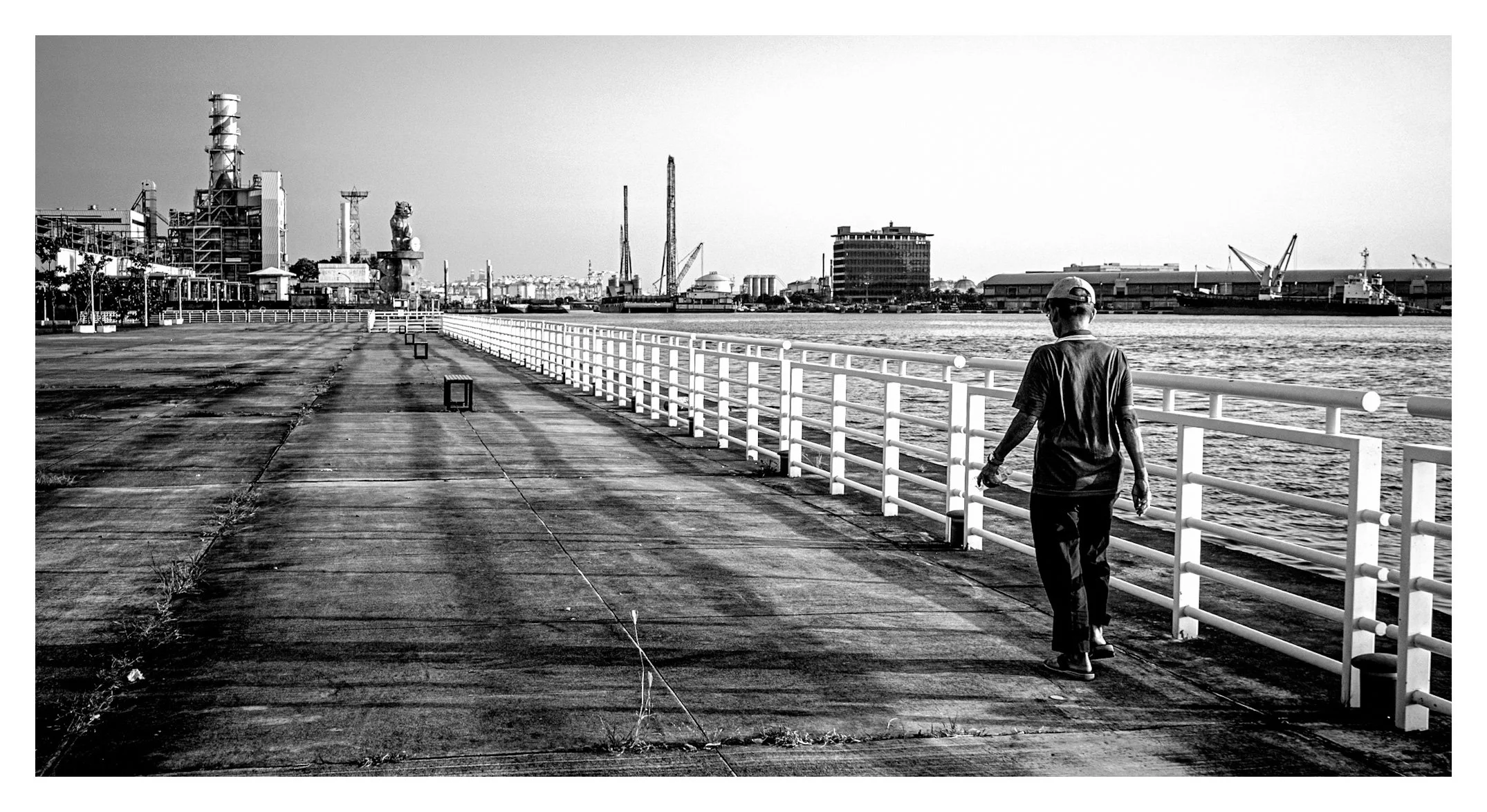
A lone man walks a long harbour pier as railings and pavement seams pull the eye straight into a skyline of cranes, tanks and moored freighters. Theo Marr examines a Ricoh GR III study in deep perspective and black and white, and asks whether the frame has quite decided what to do with all that space.
METADATA
Camera Model: Ricoh GR III
Lens: GR Lens 18.3mm F2.8 (28mm equivalent)
Shutter Speed: 1/320 sec
Aperture: f/8
ISO: 320
Captured 30 September 2026 at 17:06, cropped to a widescreen 4767 x 2496 pixels.
THE CRITIQUE
This is a picture built almost entirely on lines, and it is worth naming them before anything else. The white pipe railing runs the full depth of the frame on the right, the pavement's expansion joints do the same underfoot, and the shadows thrown by the bollards fall in parallel with both. Every element in the image is conspiring to pull the eye down that pier and out into the harbour. It is one-point perspective used with real discipline, and it is the reason the photograph holds together at all.
Against that converging geometry sits a single man, walking away from the camera near the railing, cap on, one hand resting lightly on the rail as he looks out at the water. He is small enough to register as a figure rather than a portrait, but large enough in the frame to read as the picture's actual subject rather than an incidental passer-by. That balance is not easy to get right, and here it mostly is. He gives the vast industrial setting — the chimney stack and scaffolding on the left, the crane arms, the tiger statue on its plinth, the tankers moored along the far shore — a human scale it would otherwise lack entirely. Without him, this is a study of infrastructure. With him, it becomes a study of a man's relationship to infrastructure, which is the more interesting picture.
The wide, cinematic crop is the right call for this subject. It suits the horizontal sprawl of the dockside and gives the image a documentary, almost reportage widescreen quality that a standard frame would not.
Now the problems. The sky is close to entirely blown out — a flat, textureless white that occupies a large share of the upper frame and gives back nothing for the attention it takes up. At f/8 and 1/320, the exposure has clearly been set for the pavement and the man rather than the highlights, which is a defensible choice, but the cost is a sky with no cloud, no gradient, nothing. It leaves the top of the frame feeling slightly hollow next to the density of information below it. The man is also sitting close to the right edge of the frame; there is a real chance that one more step takes him out of it entirely, and the small imbalance between his tight margin and the generous space given to the foreground pavement on the left makes the composition feel slightly undecided about its own centre of gravity. And on the left, the refinery structure is doing a lot of visual work — chimneys, scaffolding, a tower — competing for attention in a way the cleaner shapes on the right do not.
This is a genuinely strong composition let down by two things that are both fixable: an exposure decision that sacrificed too much sky, and a framing decision around the man that has not quite committed either way.
HOW TO IMPROVE IT
• Pull back highlight detail in post, or better, shoot with slight negative exposure compensation next time so the sky holds some texture rather than clipping to white. Given even a hint of cloud, it would do far more work for the composition.
• Decide, deliberately, how much room the man needs. Either give him clear space to walk into on the right, or crop in tighter behind him so the tight margin reads as intentional rather than accidental.
• Return to this pier at a lower sun angle. Raking light along those railings and shadows would add texture to the sky and could put a rim of light on his shoulder or cap, separating him from the railing behind him more cleanly.
• Watch his position relative to the railing posts as he walks. A moment where his silhouette sits cleanly between two posts, rather than overlapping one, will read more crisply against that repeating pattern.
• Check the horizon line carefully on a shot this dependent on parallel geometry — a fraction of a degree of tilt becomes very visible once you have this many horizontal railings in frame.
GROWING AS A PHOTOGRAPHER: WHAT THE DATA SAYS
Three images in, a genuine division of labour is starting to show between your two cameras. The Leica D-Lux 8 work so far has been about colour, longer focal lengths and softer, more deliberate stillness or motion. This Ricoh GR III frame is the opposite instinct entirely: wide, deep-focus, high-contrast monochrome, built on geometry rather than colour or blur. That is not a contradiction — it looks like two distinct working modes, each suited to a different kind of subject.
Worth tracking from here:
• Note which camera you reach for and why, at the moment of reaching for it. If the pattern holds — GR III for wide documentary geometry, D-Lux 8 for colour and controlled exposure play — that is a genuinely useful piece of self-knowledge, not just habit.
• For any frame built on strong leading lines like this one, log whether the horizon and verticals needed correcting afterward. Small errors compound quickly in geometry-driven compositions.
• Track how often a human figure is the deciding factor in whether an industrial or architectural frame works. Compare this pier shot with the previous harbour skyline: one had no figure and relied on colour contrast; this one has a figure and relies on scale contrast. Both are valid, but knowing which you reach for by instinct will sharpen your eye for when a frame is missing one.
• Keep logging exposure choices in high-contrast conditions specifically. You are consistently protecting midtones over highlights; it would be worth testing the opposite on a similar scene to compare results.
PHOTOGRAPHERS TO RESEARCH
• Chris Killip. A British documentary photographer whose black and white work set solitary and working-class figures against the industrial landscapes of North East England with real emotional weight.
• John Davies. A British landscape photographer whose large-format black and white images document the tension between people and post-industrial infrastructure across Britain.
• Robert Adams. A key figure of the New Topographics movement, known for a deadpan, unsentimental eye on the man-altered American landscape.
• Lewis Baltz. Also central to New Topographics, best known for his studies of industrial parks — flat, geometric, and stripped of drama.
• Alec Soth. An American photographer whose work places solitary figures within vast, quiet American landscapes, often near water.
BOOKS TO READ
• In Flagrante by Chris Killip
• The British Landscape by John Davies, Chris Boot, 2006
• The New West by Robert Adams, 1974
• The New Industrial Parks Near Irvine, California by Lewis Baltz, 1975
• Sleeping by the Mississippi by Alec Soth, 2004
VIDEOS TO WATCH
• Chris Killip, "Chris Killip on Photographing People and Places": https://www.youtube.com/watch?v=s2uvFLdZFto
• John Davies, on his exhibition "The British Landscape": https://www.youtube.com/watch?v=BW44iNga8Fk
• Robert Adams, "Photographing a 'landscape of mistakes'": https://www.youtube.com/watch?v=XuhxlLv_f2k
• Lewis Baltz, TateShots interview: https://www.youtube.com/watch?v=dqsk9c-XVRg
• Alec Soth, "Slowing Down — A conversation with Alec Soth": https://www.youtube.com/watch?v=IZs6my9XP3A
MANUFACTURER NOTE
The GR III's 28mm lens and deep-focus rendering at f/8 are exactly what a shot like this needs: everything from the pavement joints underfoot to the tankers on the horizon stays legible. This is the camera Ian knows best, and the kind of frame that makes the case for it plainly. Ricoh GR Taiwan is the natural contact for a sponsorship conversation here.