

Day 34/365 The Brutalist Beauty: Abstraction in Concrete and Light
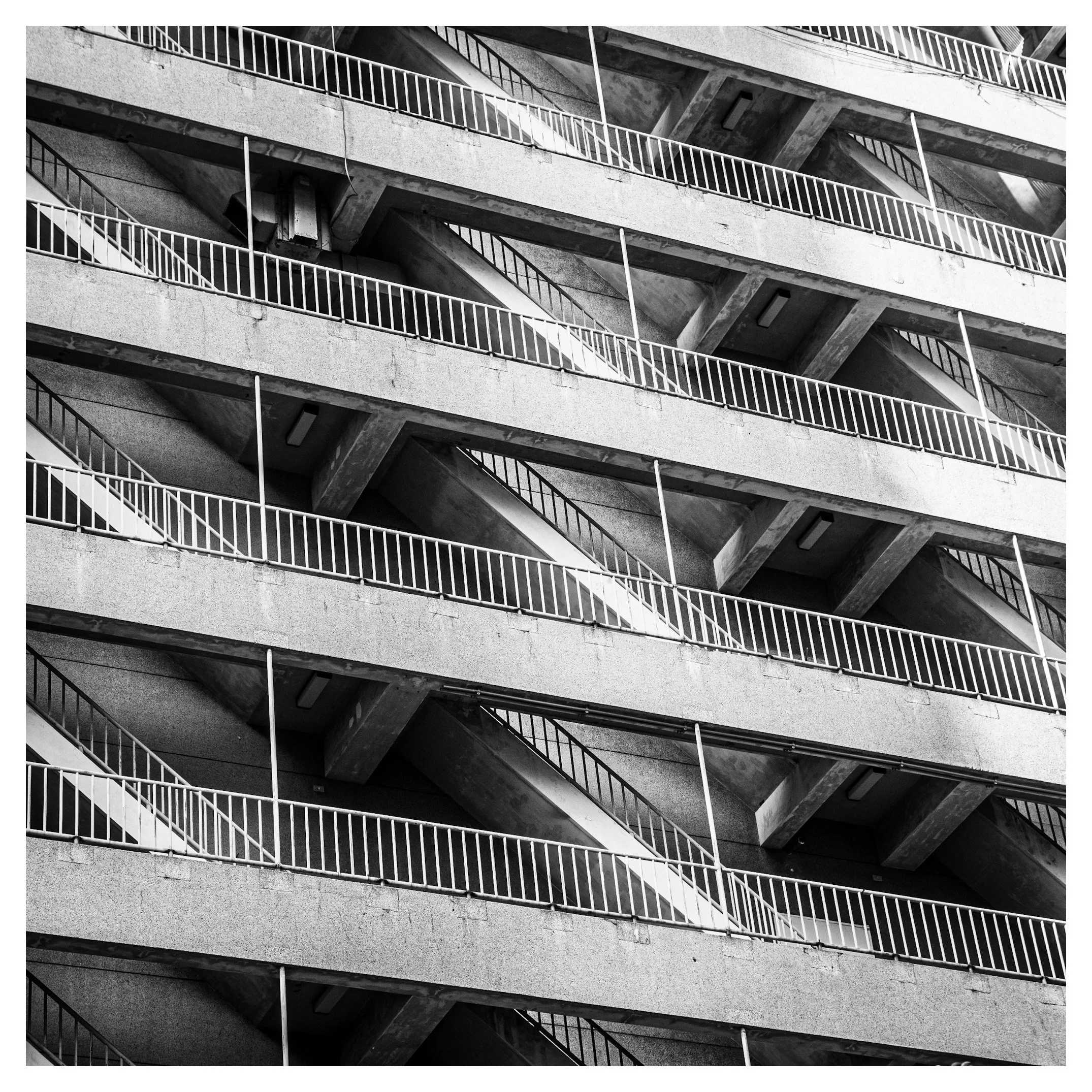
This critique delves into the stark, geometric world of your black and white architectural photograph. We will analyze its strengths, suggest pathways for refinement, and provide a curriculum of master photographers and essential reads to elevate your photographic eye over time.
Image Analysis and Critique
The image you have presented—a high-contrast black and white study of a multi-tiered building façade—is a strong exercise in abstraction and structural rhythm .
• Strengths: The photograph succeeds brilliantly in transforming a functional architectural subject into a purely graphic composition . The repetitive pattern of the diagonal staircases and the horizontal railings creates a powerful, relentless visual rhythm . The choice of black and white is highly effective, stripping the scene of distracting color and emphasizing the mass, texture, and geometry of the concrete and metal . The raking light enhances the concrete texture and generates stark triangular shadows beneath the staircases, which are crucial elements of the abstraction .
• Avenues for Improvement: While the image is formally strong, the critique of abstract work often centers on pushing its emotional or conceptual resonance.
• Tonal Range Refinement: The image leans towards high contrast, which is effective, but a subtle expansion of the mid-tones could reveal more detail in the shadowed concrete areas, enhancing the sense of mass and volume without sacrificing the graphic impact. Joel Tjintjelaar often exaggerates luminance differences to amplify visual depth in his monochrome architecture, a technique you could explore in post-processing.
• Introducing a Focal Element: While the abstraction is the subject, the repeated pattern can become purely decorative. Consider what one unique element might disrupt the rhythm or act as a conceptual anchor. This could be a solitary human figure (a fleeting presence on one of the staircases), a piece of exposed piping, or an unexpected detail that introduces a narrative tension to the relentless pattern.
• Framing and Perspective: The current perspective is head-on, which reinforces the grid. Experimenting with an ultra-wide lens or a more extreme angle, shooting sharply up or down, can introduce distortion that further abstracts the structure and plays with the viewer's sense of spatial logic.
A Curriculum for the Aspiring Photographer
To evolve your work from strong formal exercise to resonant art, you must immerse yourself in the canon of masters who have explored the urban environment and abstraction.
Photographers to Research and Study
Your current work shows an affinity for architectural geometry, high contrast, and the black and white medium.
• For Architectural Abstraction:
• Hélène Binet: Study her mastery of monochrome film and large-format cameras to capture the light, shadow, and materiality of modernist and contemporary architecture. Her work is a deep meditation on form and texture.
• Joel Tjintjelaar: An award-winning contemporary photographer whose digital black and white architectural work focuses on using an absence of color to create profound visual depth and a sense of timelessness.
• For Urban Poetry and Contrast:
• Fan Ho: Known for his masterful use of light and shadow in 1950s and 60s Hong Kong street photography. His use of geometric framing and diagonals to create cinematic compositions offers a potent lesson in making the ordinary structure a stage for human drama.
• For Conceptual Density:
• Michael Wolf: Your work shares an affinity with Wolf's documentation of urban density. His architectural series, like the highly compressed buildings of Hong Kong, demonstrate how relentless repetition and close cropping can push architecture into a state of pure pattern and comment on the social impact of the urban form.
Books to Read
To deepen your understanding of the concepts at play, I recommend the following essential reads:
• Uncommon Places by Stephen Shore: While known for color, Shore’s large-format work teaches impeccable technical control and a profound understanding of composition, elevating mundane scenes to art. This will sharpen your eye for detail within your own abstract frames.
• Architecture and Abstraction by Pier Vittorio Aureli: This theoretical study challenges the purely aesthetic interpretation of abstraction in architecture, arguing that it arises from material conditions and social systems. A deeper theoretical grounding will inform your conceptual choices.
• Bystander: A History of Street Photography by Colin Westerbeck and Joel Meyerowitz: Although focused on the street, this book offers an encyclopedic view of the evolution of capturing life in public. Your subjects exist in a public space, and understanding the history of the gaze is vital.
Videos to Watch
Visual learning is indispensable. These videos will provide practical and conceptual guidance:
• Exploring the Abstract in Urban Environments | Urban Abstract Photography: This guide offers an excellent overview of how to find beauty in unexpected places and use light, texture, and pattern to create abstract compositions in the city.
• Link: https://www.youtube.com/watch?v=S_Qcfpj_xMc
• Fan Ho | the art of light, shadow, and humanism: A short documentary exploring Fan Ho's signature style: his masterful use of light, shadow, and geometry to infuse his urban scenes with poetry and humanism.
• Link: https://www.youtube.com/watch?v=tjQNFr4FCfI
• 7 Tips For Amazing Angular Architectural Photography: This video offers practical tips on using angles, color (or the lack thereof), and perspective to maximize the graphic impact of architectural lines.
• Link: https://www.youtube.com/watch?v=XkDKjARcZjw