

Day 345/365 Eyes Open in the Blur
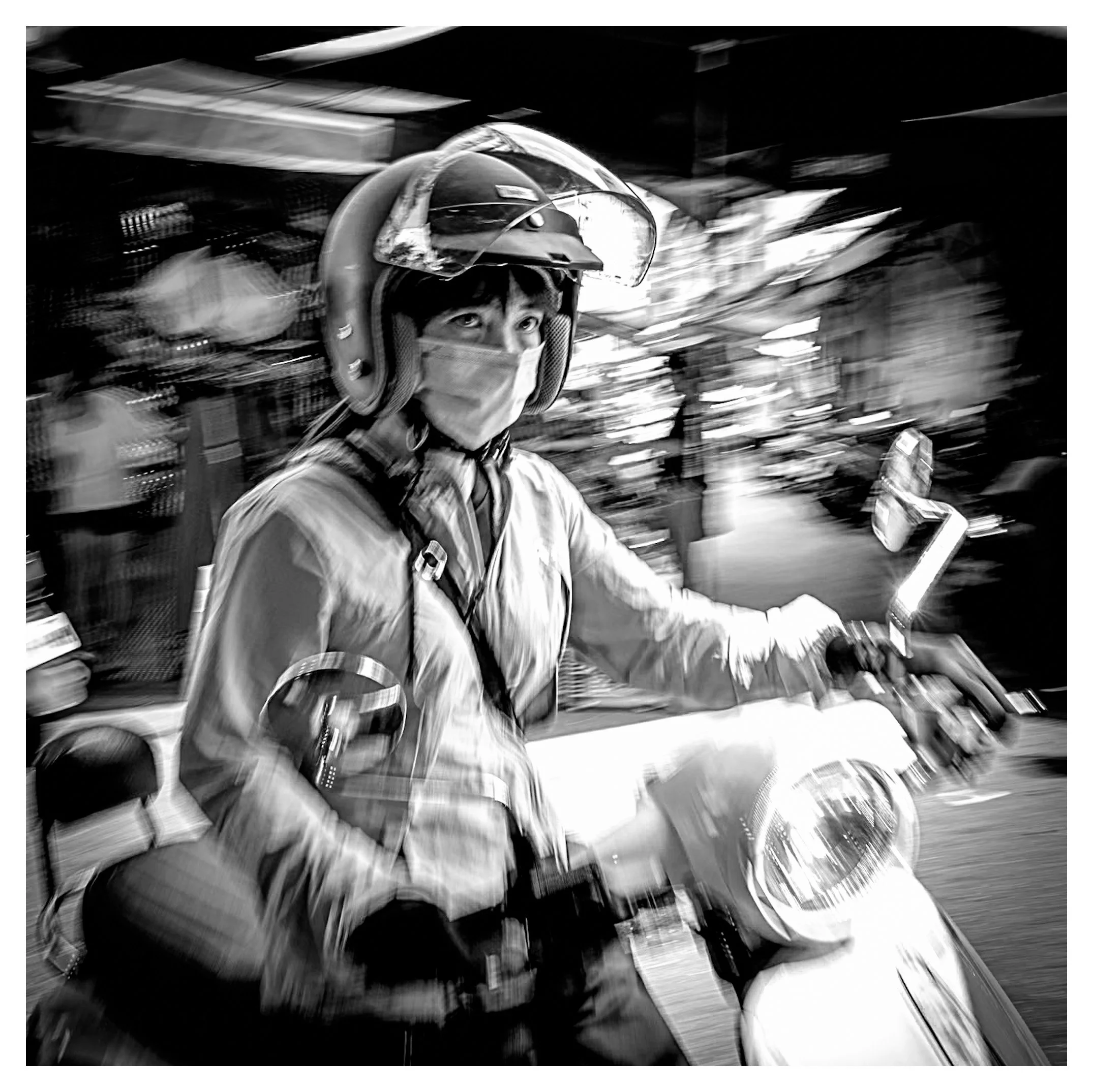
While the street smears into streaks, one pair of eyes stays sharp. Theo Marr looks at a close-range Ricoh GR III scooter portrait shot at 1/20 second in natural light, and asks how much chaos a frame can carry before the calm at its centre starts to get lost.
METADATA
Camera Model: Ricoh GR III
Lens: GR Lens 18.3mm F2.8 (28mm equivalent)
Shutter Speed: 1/20 sec
Aperture: f/13
ISO: 100
Captured 1 October 2026 at 12:06, cropped to a square of 3494 x 3493 pixels.
THE CRITIQUE
This is the opposite of the first scooter picture on this blog. That frame kept its distance and let a sharp rider cross a calm blurred street. This one is at arm's length, and the whole world has been thrown into motion around a single point of stillness: the rider's eyes.
The eyes are the picture. They are sharp, direct and fixed on the road ahead, framed by the open visor of the helmet and the pale mask below. Everything else is violence. The jacket smears into silver ribbons, the mirror at right shoots a streak of light, the headlamp at the bottom is dragged into a glowing disc, and the shopfronts behind have dissolved into slashes of black and white. The contrast between a face that is composed and a world that is coming apart is the whole idea, and it works. The rider looks calm, almost bored, in the middle of the commotion. That is a very Taiwanese kind of calm, and it is the best thing in the frame.
The technical achievement deserves credit. With no flash to freeze anything, the sharpness in the face at 1/20 second has to come from tracking the rider through the exposure, so that the camera and the subject move together while everything else slips past. At 28mm equivalent and this distance, that is hard to do, and the eyes landing sharp is not luck. Stopping down to f/13 helps by giving you depth of field to absorb small errors in distance, which matters when you cannot refocus.
The slight tilt helps. The helmet and shoulders lean along a diagonal that runs up to the left, which gives the picture speed even before you read the blur. The square crop is tight and confident, and the mirror and headlamp sit at opposite corners as counterweights to the face.
The cost shows in the middle of the picture. The pale jacket and the scooter's front body have burned out into large areas of pure white, with no texture left in either. They occupy nearly half the frame, so the lower half reads as a bright smear while the upper half carries all the detail. Because the rider sits in shade against dark shopfronts while those pale surfaces catch the brightest light, the scene has more contrast than a single exposure holds comfortably. The processing is also heavy. The contrast and clarity are pushed far enough that the edges around the helmet and mirror show halos, and a hard-edged shape at the far left, which looks like part of another rider, adds clutter without adding meaning.
It is a bold, memorable frame with real nerve. What it lacks is restraint in the highlights and in the edit, and a clearer decision about how much of the lower frame needs to be sacrificed to the blur.
HOW TO IMPROVE IT
• Expose for the highlights. The pale jacket and scooter body are the first things to clip, and the base ISO of 100 leaves you only the shutter and exposure compensation to protect them. Dial in a stop of negative compensation and recover the shadows afterwards, since the DNG will give you far more room that way than the reverse.
• Try 1/30 or 1/40 next time. You will keep most of the streaking in the background but lose a little of the smearing across the rider's body, which makes the sharp zone feel larger and more convincing.
• Back off the clarity and contrast in the edit. The halos around the helmet and mirror are the clearest sign the picture has been pushed past its natural limit, and a gentler curve would let the eyes carry more of the drama.
• Watch the edges when you compose. The partial figure at the far left pulls attention away from the rider, and a half step to the right or a tighter crop would remove it.
• Pre-focus with snap focus at around 1.5 metres and stay at that distance. At this range and speed, consistency of distance matters more than anything else you can control.
GROWING AS A PHOTOGRAPHER: WHAT THE DATA SAYS
Four images in, a theme is emerging that you may not have planned. Two of the four frames are scooter riders in motion, one at a distance in black and white on the Leica, one at close range on the Ricoh. That is the beginning of a series, and scooter culture is about as Taiwanese a subject as exists. If you treat it as a deliberate project rather than a recurring accident, the sharp-subject-in-a-blurred-world idea gives you a consistent visual language across both cameras.
Worth tracking from here:
• Log distance and shutter speed for every scooter frame. The two frames so far sit at very different ends of the range, and a log will show you which combination gives the best ratio of keepers.
• Count how often the rider's eyes are sharp. In this frame they are, and that is why it works. If it is the deciding factor in your keepers, build your technique around it.
• Note when you choose to shoot close and when to stay back. A pattern in those decisions will tell you whether your instinct is to observe or to confront.
• Keep recording which camera you pick for which kind of motion. The Ricoh at 28mm is now handling both static geometry and close-range action, which is a broader role than the Leica has had so far.
PHOTOGRAPHERS TO RESEARCH
• Takuma Nakahira. A co-founder of the Japanese Provoke movement, whose grainy, blurred, tilted black and white frames argued that a photograph does not have to be sharp to be truthful.
• Mark Cohen. An American street photographer who worked at very close range in Pennsylvania, producing cropped, abrupt and unsettling frames. He used flash to freeze his subjects; it is worth noting how much of that intensity you achieved without it.
• Ed van der Elsken. A Dutch photographer and filmmaker whose gritty, subjective, snapshot-like work set a model for raw personal street photography.
• Jacob Aue Sobol. A Danish Magnum photographer known for expressive, instinctive black and white work, including a celebrated body of work made in Tokyo.
• Gueorgui Pinkhassov. A Magnum photographer who works with reflections, distortion and light, often approaching abstraction.
BOOKS TO READ
• For a Language to Come by Takuma Nakahira, 1970
• Grim Street by Mark Cohen, 2005
• Love on the Left Bank by Ed van der Elsken, 1956
• I, Tokyo by Jacob Aue Sobol
• Sightwalk by Gueorgui Pinkhassov
VIDEOS TO WATCH
• Takuma Nakahira, a video profile of his work and life: https://www.youtube.com/watch?v=oICT9cAtH9s
• Mark Cohen, "Mark Cohen's invasive photographic style": https://www.youtube.com/watch?v=kkTQ-Qeea4E
• Ed van der Elsken, "Camera in Love" mini documentary: https://www.youtube.com/watch?v=qH6PehR0Db0
• Jacob Aue Sobol, "My work is about what we have in common," Louisiana Channel: https://www.youtube.com/watch?v=gWiK9cNi9mM
• Gueorgui Pinkhassov, Magnum HOME project: https://www.youtube.com/watch?v=k6TzReR4F6c
MANUFACTURER NOTE
The GR III is a small camera that lets you work at a distance most photographers would not dare to try, and its fast, quiet handling is what makes a frame like this possible. Ricoh GR Taiwan is the natural contact for a sponsorship conversation, given how consistently the camera is being put to work on Taiwanese streets.