

Day 346/365 The Light Left On: A Taiwan Church After Dark
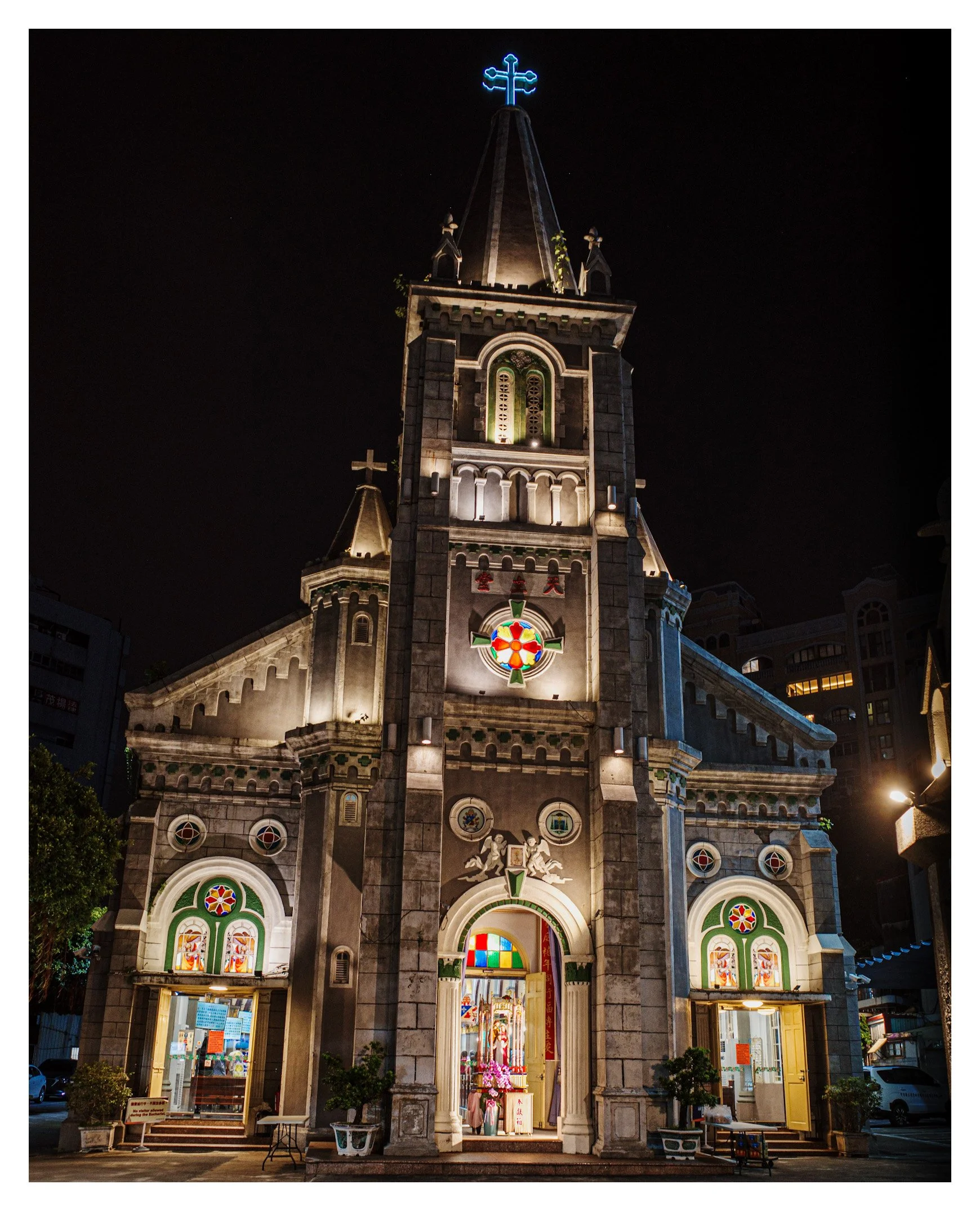
A neon cross hovers over stone and stained glass in this Ricoh GR III night study from Taiwan. Discover how a slow handheld exposure delivered clean blacks, which small distractions chip away at the frame, and the one shooting habit worth changing before your next after-dark walk.
METADATA
- Camera Model: Ricoh GR III
- Shutter Speed: 1/30 sec
- Aperture: f/2.8
- ISO: 400
- Also recorded: 18.3mm lens (28mm equivalent), 2 October 2026 at 20:35, cropped to a 4:5 portrait (4000 x 5000)
THE CRITIQUE
A church facade at night is a gift and a trap. The gift is that the building lights itself. The trap is that everything the floodlights do not reach turns to black, and the eye is left to sort out what remains. This frame handles the gift very well.
The first thing I admire is the sky. It is clean, deep and noise-free, and it works as a stage curtain. Against it the neon cross is a single cold note, and the warm tungsten glow of the doorways and stained glass answers it from below. Cool at the summit, warm at the threshold: that temperature split gives the picture its drama without any help from the sky.
The second is the sharpness. At 1/30 sec on an 18.3mm lens, handheld, the stone texture, the sconces and the rose window are all crisp. That is a stable hold and good use of the camera's shake reduction. Many photographers would have pushed the ISO to 1600 out of fear and paid for it in grain. Holding ISO 400 kept the blacks smooth, and the blacks are the whole picture.
The 4:5 crop suits the subject. A vertical tower wants a vertical frame, and the symmetry of the facade, with its twin side doors and central rose window, reads like a portrait of a face.
Now the weaknesses. The neon cross sits very close to the top edge, and the spire needs a little more room above it to feel finished. The lower third is the busiest part of the frame. A folding table, a sandwich board, potted plants and a parked car at each edge pull attention away from the lit doorway, which should be the emotional centre. On the right, a blown street lamp is the brightest object in the frame, and it competes with the cross. A sliver of dark building also intrudes at the far right.
The central axis sits slightly right of centre, so the verticals feel faintly unsettled. Symmetry is unforgiving: a few pixels of drift is all the eye needs to sense that something is off.
HOW THE IMAGE COULD BE IMPROVED
- Give the cross room. Re-crop or reframe so there is a clear margin of black above it. A wide lens makes you want to cut the top, so check the corners before pressing the shutter.
- Remove the street lamp and the right-edge sliver in post, or step a few paces left so the lamp falls behind the tower. A lamp that bright is a distraction you can solve with your feet, and that is better than cloning it out.
- Correct the verticals. Pointing a 28mm equivalent upward makes the tower lean inward. Use the transform or upright tools to straighten the tower, then fix the axis so the door and spire align.
- Tame the foreground clutter. Wait for the passer-by or car to leave, or shift your angle so the table and sign are hidden behind a pillar. Failing that, darken the lower edges by hand so the doorway glows more than its surroundings.
- Bracket the exposure. The bright doorways and the dark stone want different settings. Shoot one frame to hold the stained glass and one for the stone, then blend them, or at least apply a little negative exposure compensation so the neon cross keeps its colour and does not bloom to white.
- Try a slightly narrower aperture, around f/4, with the same stable hold. At f/2.8 the extreme corners of a wide lens are at their weakest, and architecture rewards edge-to-edge crispness. You have the stabilisation to afford a stop.
- Come earlier. Arrive during blue hour, roughly the thirty minutes after sunset, so the sky holds a deep indigo instead of pure black. The cross and the floodlights will still read, and the sky will gain depth.
BUILDING A BETTER PHOTOGRAPHER: WHAT YOUR RECENT IMAGES SAY
Looking across the five images I have critiqued for you in this run, a pattern emerges.
- Aperture: three of five were shot at f/2.8, one at f/8 and one at f/13. You reach for wide open by default and for narrow apertures only when motion or scale forces it.
- Shutter speed: they range from 1/20 to 1/320 sec. Three of the five are at 1/30 sec or slower, which tells me you are comfortable working at slow speeds, and that is a real strength.
- ISO: always between 100 and 400. You protect image quality, which is a good instinct, but you have never tested what ISO 800 or 1600 would cost you.
- Cameras: two images came from the Leica D-Lux 8 and three from the Ricoh GR III, and your instincts about subject and light are consistent across both.
- Recurring weakness one: edge clutter. In the harbour, pier, scooter and church pictures, something unwanted sits at the border of the frame.
- Recurring weakness two: highlights. Skies and pale surfaces burned out in several frames, and in this one the lamp and the doorway lights lead the same way.
- Recurring strength: you choose subjects with a clear structure, whether a diagonal, a symmetry or a colour contrast, and you compose around it.
What to do with that:
- Run an edge-check ritual. Before every shot, trace the four borders of the frame with your eye and ask what does not belong. It costs three seconds.
- Shoot with negative exposure compensation (minus 0.7 to minus 1.0) as your default for night and bright skies. Raise the shadows later. You cannot recover a burned highlight.
- Test your ISO ceiling on purpose. Photograph the same scene at 400, 800, 1600 and 3200 and compare at full size. Knowing the real cost removes the fear.
- Choose one location and return to it in different light. A single church at blue hour, at night and in rain will teach you more than five different churches.
- Edit harder. Pick the best frame from a scene and make it your only one. Fewer, better images will sharpen your eye faster than volume will.
PHOTOGRAPHERS TO RESEARCH
- Gregory Crewdson: his staged, film-set tableaux of small-town America are lit like cinema, with glowing doorways against dark surroundings. Study how he uses a single warm light source as the emotional centre of a night frame.
- William Eggleston: the pioneer of colour as subject. Look at how he treats ordinary things, such as a ceiling, a car or a doorway, as pure colour relationships, which is the same idea behind your cool cross and warm doors.
- Jeff Wall: his large lightbox pictures treat a photograph as a constructed scene. Study how he builds a frame where every element earns its place, which is the cure for edge clutter.
- Hélène Binet: the Swiss-French architectural photographer who works almost entirely on film and in black and white, and who shoots light and shadow on buildings as abstraction. A model of restraint.
- Stephen Wilkes: his Day to Night series compresses a whole day into one frame. A good study in how time of day transforms a single place, and a prompt for your return-to-one-location exercise.
BOOKS TO READ
- Beneath the Roses by Gregory Crewdson (Abrams): the definitive collection of his cinematic night scenes.
- William Eggleston's Guide by William Eggleston (MoMA): the 1976 book that made colour photography respectable as art.
- Jeff Wall: Selected Essays and Interviews (MoMA): his own account of how and why he builds his pictures.
- Composing Space: The Photographs of Hélène Binet (Phaidon): a masterclass in light, geometry and architecture.
- Day to Night by Stephen Wilkes: how time reshapes one scene, and a source of ideas for a long-term project.
VIDEOS TO WATCH
- Gregory Crewdson: Brief Encounters, official trailer for the documentary on his working process: https://www.youtube.com/watch?v=EdGV-SxZlCs
- William Eggleston in the Real World, the documentary by Michael Almereyda: https://www.youtube.com/watch?v=P-1PrZ5lVzg
- Jeff Wall: "I begin by not photographing", on his artistic process (SFMOMA): https://www.youtube.com/watch?v=2yG2k4C4zrU
- A Conversation with Architectural Photographer Hélène Binet (Geoffrey Bawa Trust): https://www.youtube.com/watch?v=vrjK3_hudYo
- The passing of time, caught in a single photo, Stephen Wilkes (TED): https://www.youtube.com/watch?v=afev0ZjAhUA
A NOTE FOR RICOH
This frame was made with a Ricoh GR III, handheld at 1/30 sec in available light, with no tripod and no flash. It shows what that small camera can do after dark: clean blacks, crisp architectural detail and enough stabilisation to hold a slow shutter in the street. For Ricoh Imaging in Japan and the Taiwan team behind @ricohgr_taiwan, this is the kind of everyday night work that the GR line was built for, and a series of Taiwanese night architecture would make a strong, local, shareable campaign. I would welcome a conversation about a partnership.