

Day 347/365 Wide Open After Dark: Two Walkers on a Lamp-Lit Taiwan Street
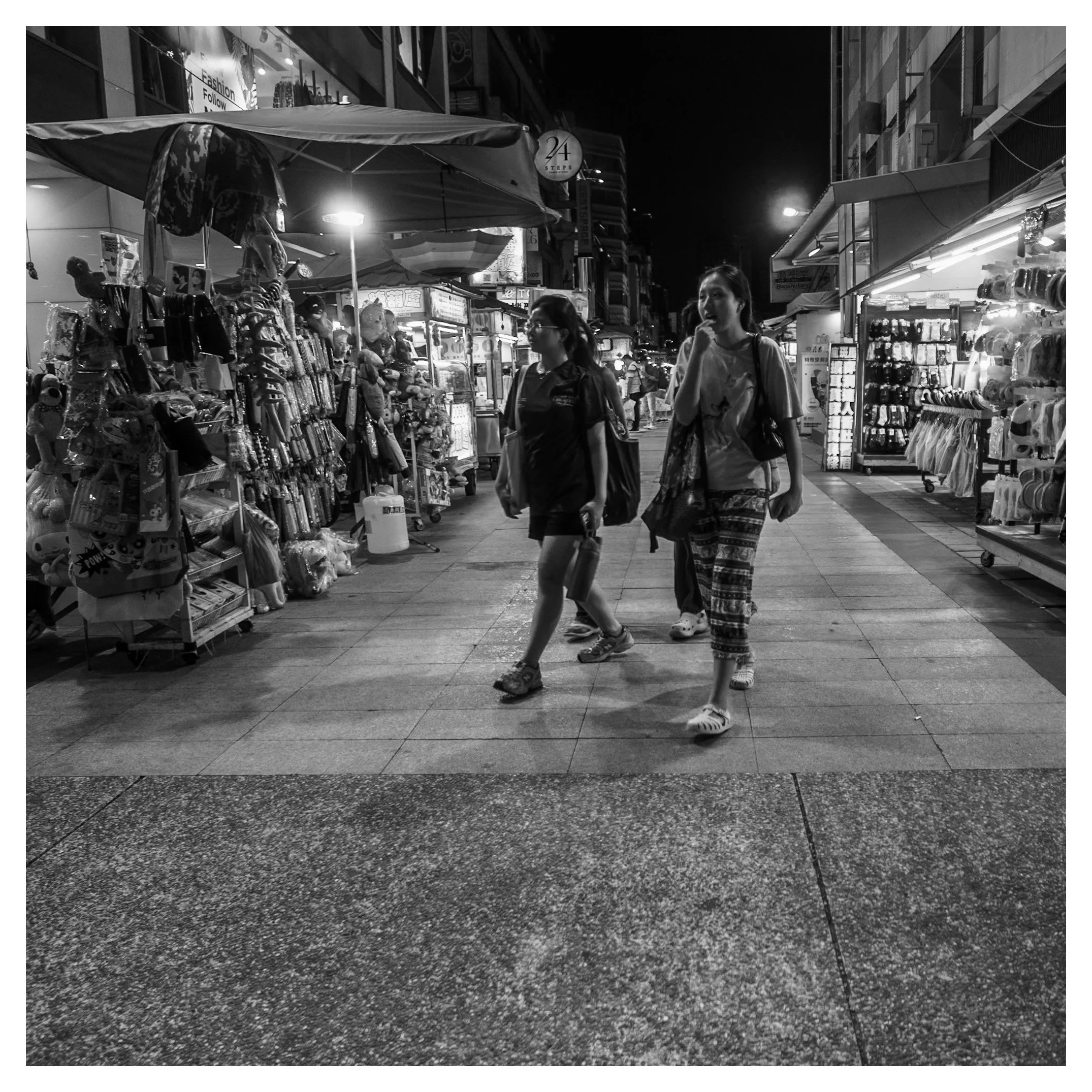
A Leica D-Lux 8 night street photograph, shot wide open: two strangers mid-stride and a lane full of competing light. Find out what this monochrome frame gets right, why the lower quarter of the square does so little, and what six recent images reveal about your cropping habits.
METADATA
- Camera Model: Leica D-Lux 8
- Shutter Speed: 1/125 sec
- Aperture: f/1.7
- ISO: 200
- Also recorded: 11mm lens (roughly 24mm equivalent), 3 October 2026 at 20:47, cropped from 4736 x 3552 to a 3552 x 3552 square
THE CRITIQUE
A pedestrian street at night is a stage with too many actors. Stalls, signs, lamps and strangers all want attention, and the photographer's job is to decide who gets the spotlight. Here you have chosen well, and then given back some of the advantage in the crop.
The picture is built on one good moment. The woman on the left, in glasses, is looking off to a stall. The woman on the right has a hand to her mouth and eyes fixed forward. Their attention goes in two directions, and that small mismatch gives the frame its human interest. Their legs are caught mid-stride, one of them with a foot planted and the other swinging through, and the sharp feet at 1/125 sec tell me the shutter speed was right for a brisk walk at this focal length.
The tonal handling is the second strength. The black wedge of sky between the buildings acts as a vanishing point and pulls the eye down the street. Against it, the lamp and the fluorescent shopfronts give you real highlights, and the grey paving gives you a mid-tone floor. That full range, from pure black to glowing white, is what makes black and white work at night, and the decision to go monochrome was correct. Colour would have fought you here, with signs, umbrellas and toys all shouting at once.
The weaknesses are in the arrangement. The first is the foreground. The lower quarter of the square is a slab of plain paving with nothing in it, and the walkers' feet sit well above the bottom edge. That empty floor does no work. It weakens the sense of the women walking toward you and makes the picture feel loose where it should feel taut.
The second is the overlap. A third figure is half hidden behind the woman on the right, with a head and a pair of white shoes appearing from behind her. It muddies her silhouette and adds a stranger who has no part in the story. On the left, the strap and bag of the other woman crowd her hands and the bottle she is carrying.
The third is competing brightness. The street lamp on the left blooms into a large halo that sits in the top half of the frame and pulls the eye away from the faces. The fluorescent shopfront on the right is also close to blown out. Both are legitimate light sources, but neither should be the brightest thing in a picture about two people.
Finally, f/1.7 was an interesting choice. At 11mm on this sensor, depth of field is enormous even wide open, so the aperture gave you very little background separation, and a lens is generally at its weakest in the corners at its widest setting. The street was bright enough that you did not need it.
HOW THE IMAGE COULD BE IMPROVED
- Recrop. Remove most of the empty paving, which moves the women toward the lower third and tightens the frame. A 4:5 portrait or a slightly wider rectangle would suit this scene better than a square.
- Tame the lamp. Dodge the halo down in editing, or reposition by a step or two so the lamp is hidden behind a stall pole or a figure's head.
- Protect the highlights. Dial in around minus 0.7 of exposure compensation. The blacks are already deep, so you lose nothing, and you keep detail in the shopfront.
- Stop down. Try f/4 at ISO 800, still at 1/125 sec. You will gain sharper corners and a larger safety margin for zone focusing, at a noise cost that is perfectly acceptable on this camera.
- Wait for separation. Two or three more seconds would probably have cleared the third figure from behind the right-hand woman. In a crowded street, patience is cheaper than any edit.
- Mind the hands. A beat earlier or later and the left woman's bottle and bag would not overlap her arm.
- Burn the left stall down slightly. The camouflage canopy and the dense wall of goods are rich, but they are heavy and they compete with the faces.
BUILDING A BETTER PHOTOGRAPHER: WHAT YOUR RECENT IMAGES SAY
Across the six images I have critiqued for you in this run, these are the patterns.
- Aperture: four of the six were shot wide open, at f/1.7 or f/2.8. The other two were f/8 and f/13, both chosen for a reason. You default to wide open, even when the light does not demand it.
- Shutter speed: it ranged from 1/20 to 1/320 sec. Two images were at 1/30 sec and two at 1/125 sec, so you are comfortable shooting slow and handheld.
- ISO: always between 100 and 400. That protects quality, but you have never tested what ISO 800 or 1600 would cost.
- Cameras: three images from the Leica D-Lux 8 and three from the Ricoh GR III. Your eye is consistent across both bodies.
- Cropping: every one of the six was cropped, to square, 4:5 or widescreen. That is a significant finding. It suggests your framing at the moment of capture is looser than the picture you actually want, and this frame shows the cost, since the square kept too much floor.
- Recurring weakness one: edge and foreground clutter, and in this case dead space.
- Recurring weakness two: highlights, where skies, lamps and pale surfaces burn out.
- Recurring strength: you find structure, whether a diagonal, a symmetry or a colour split, and you are not afraid of a slow shutter.
What to do with that:
- Shoot your intended crop. Choose the aspect ratio before you press the shutter, or use a frame overlay, so the picture is composed in the camera and not rescued afterwards.
- Take a step closer. If every frame needs cropping, your feet are the cheapest fix.
- Do an ISO test. Photograph one scene at 200, 400, 800, 1600 and 3200, and look at all of them at full size. You will probably find 800 costs nothing you can see.
- Set minus 0.7 as your default for night work, and lift the shadows later.
- Choose one street and return to it. Different nights, different hours, different weather. One street worked ten times teaches more than ten streets worked once.
PHOTOGRAPHERS TO RESEARCH
- Alan Schaller: a London photographer who shoots only in black and white, with an emphasis on tone, light and graphic structure. Study how he lets the light decide the picture.
- Raghu Rai (1942 to 2026): the great Indian street photographer, whose crowded frames hold many things at once and still work. A lesson in layering and in how to manage a busy scene.
- Harry Gruyaert: the Belgian Magnum photographer and a pioneer of colour. Study how he treats light as the subject, and notice how much his best frames depend on one decisive source.
- Matt Stuart: a London street photographer known for patience, timing and humour. His work is the answer to the third figure in this frame, because he waits for the moment to resolve.
- Richard Kalvar: the Magnum photographer whose street pictures are built on ambiguity and irony. Look at how little he needs in the frame for it to feel complete.
BOOKS TO READ
- Earthlings by Richard Kalvar: decades of street work in which every frame is trimmed to its essentials.
- All That Life Can Afford by Matt Stuart: a masterclass in waiting, timing and wit on a London pavement.
- Raghu Rai's India: Reflections in Black and White: how a crowded scene can be organised in monochrome.
- Edges by Harry Gruyaert: a study of what happens at the borders of a frame, which is directly relevant to your clutter problem.
- Magnum Streetwise: The Ultimate Collection of Street Photography, edited by Stephen McLaren (Thames and Hudson): a wide survey that will give you many more names to chase.
VIDEOS TO WATCH
- 7 tips for black and white street photography with Alan Schaller (COOPH): https://www.youtube.com/watch?v=3CiLTW2wg-Y
- The Street Photographer of India, Raghu Rai: https://www.youtube.com/watch?v=Ri-xWNC_BPQ
- Interview with Harry Gruyaert (Masters of Photography): https://www.youtube.com/watch?v=h7omuKRRdsY
- Street Photography and Beyond with Matt Stuart (Leica Conversations): https://www.youtube.com/watch?v=jO2bT7Oqsgo
- Richard Kalvar on Street Photography, Magnum Photos and Irony (Eyeshot 50mm): https://www.youtube.com/watch?v=WP0IDBCxf98
A NOTE FOR LEICA
This frame was made on a Leica D-Lux 8: a fast, compact, zoom-lens camera used handheld at night, in a crowded street, at a bright f/1.7 and a fast 1/125 sec, with no flash. That is the camera's pitch in a single image: a pocketable body that stays out of the way and still delivers deep blacks and clean highlights after dark. For Leica Camera AG and the team behind @leica_camera_taiwan, a series of Taiwanese night streets shot on the D-Lux 8 would make a credible local campaign, and I would welcome a conversation about a partnership.