

Day 348/365 Rust in Bloom: A Retired Kawasaki and Its Garden of Succulents
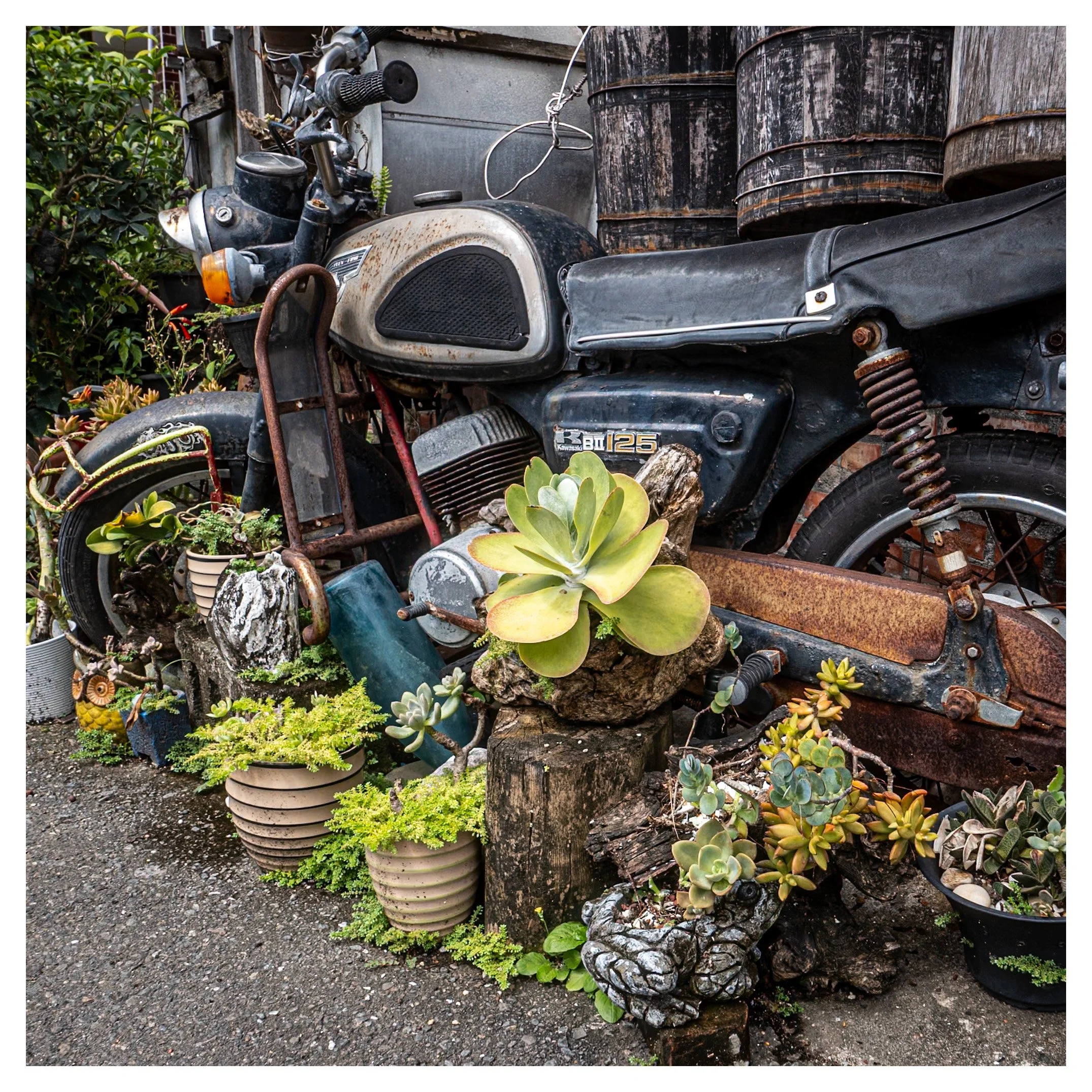
A rusting Kawasaki 125 sits wrapped in succulents in this Leica D-Lux 8 frame from Taiwan. Learn why soft midday light flatters old metal, where the composition tries to say too much, and what seven days of shooting reveal about your habits behind the lens.
METADATA
- Camera Model: Leica D-Lux 8
- Shutter Speed: 1/250 sec
- Aperture: f/5.6
- ISO: 200
- Also recorded: 11mm lens (roughly 24mm equivalent), 4 October 2026 at 12:55, cropped from 4736 x 3552 to a 3137 x 3137 square
THE CRITIQUE
Somebody has decided that a motorbike's working life is over and that its second career is as a plant stand. The bike is a vintage Kawasaki 125, and its side cover still carries the badge. Rust, flaking black paint and a stack of weathered barrels sit behind pots of succulents, a teal glass bottle and a tree stump. It is a tableau that rewards close looking, and you have looked closely.
The best decision in the picture is the placement of the large paddle-leaf succulent. It sits low and just left of centre, directly in front of the badge, and its chartreuse rosette is the one fresh, living shape in a frame of black, grey and rust. Everything else organises itself around it. The same yellow-green is repeated in the foliage at top left and in the small plants along the base, so your eye has a route through the picture.
The palette is disciplined. Black paint, brown rust and orange indicator lamp on one side, green and a single note of teal on the other. That restraint is why a crowded scene still reads as a photograph and not a pile.
Your technical choices are sound. At f/5.6 you have enough depth that the tank, the badge and the near plants are all crisp, and 1/250 sec with ISO 200 is perfectly safe handheld. Best of all, the light is soft and even. Flat light is exactly what rust and cracked paint need, because it shows texture without harsh shadow. The chrome on the tank holds detail instead of burning out. This is the first frame in your recent run shot at a mid-range aperture, and the extra sharpness shows.
Now the problems. This composition has too many things of equal weight. The round pots along the base are all similar in size and tone, so they repeat without building. The barrels at top right are a heavy dark mass pressing down on the frame. The eye never settles, and it bounces between the succulent, the tank, the spring and the pots.
The edges are the second issue. Every side of the frame cuts something awkwardly. The handlebar is chopped by the top edge, with a hanging wire loop left dangling across the tank. The seat, rear wheel and chain guard run out of the right edge. A pot is cut at the bottom right, and the concrete frog planter sits very close to the bottom border. None of it is a disaster, but together it makes the picture feel cropped by accident and not by decision.
The third is dead space. The lower-left corner is an area of plain asphalt with nothing in it, which is the same weakness I have flagged in earlier frames. It pulls weight away from the subject.
Finally, the processing looks pushed. Local contrast is strong, which suits the rust, but it also makes the foliage on the left feel crunchy and a little brittle. A touch less clarity would let the greens breathe.
HOW THE IMAGE COULD BE IMPROVED
- Recrop. Remove most of the empty asphalt at lower left and consider a 4:5 or a tighter square centred on the tank, badge and rosette. That is where the picture actually lives.
- Commit to the edges. Either include the whole front of the bike with room around the handlebar, or go tight and make the cuts deliberate, passing through the middle of a wheel and not a sliver.
- Simplify the foreground. Move a pot or two, or change your angle so that the pots stack behind each other and not in a line. One or two groupings will read better than six evenly spaced.
- Deal with the wire. Shift a step to the right or left so the loop falls off the tank, or clone it out. A stray line across the one clean metal surface is a distraction.
- Reduce the wide-angle exaggeration. At about 11mm the near plants swell and the bike recedes. Step back and zoom to around 18 to 20mm, roughly 40 to 45mm equivalent, and the relationships will feel calmer.
- Take a detail series. The spring and rust, the badge with the rosette, the stack of barrels. Close, tight frames may be stronger than the wide view.
- For a static subject, go lower and sharper. Try f/8, ISO 100 and 1/125 sec. There is no movement to freeze, so you can afford the extra quality.
- Pull back the clarity slider by a few points, especially on the leaves.
BUILDING A BETTER PHOTOGRAPHER: WHAT YOUR RECENT IMAGES SAY
Across the seven images I have critiqued for you in this run, these are the patterns.
- Dates: seven images on seven consecutive days, from 28 September to 4 October. That is the single most valuable habit in this list. Keep it.
- Aperture: f/1.7 once, f/2.8 three times, f/5.6, f/8 and f/13 once each. Four of seven were wide open, though this one proves you can step away from the habit.
- Shutter speed: from 1/20 to 1/320 sec. You work comfortably slow, and this is the first static subject in the run.
- ISO: always 100 to 400. You protect quality, but you still have not tested your ceiling.
- Cameras: four from the Leica D-Lux 8 and three from the Ricoh GR III.
- Cropping: all seven were cropped, and four of the seven are squares. The crop here is mild, but it still leaves the empty asphalt.
- Recurring weakness one: clutter and awkward cuts at the edges, which appears in at least five of the seven.
- Recurring weakness two: dead space, usually at the bottom of the frame.
- Recurring strength: colour and structure. You find a palette or a geometry and build on it.
What to do with that:
- Add a stillness day. You have mostly photographed motion and people. A static subject, like this one, lets you slow down and work the edges properly, so choose one every week.
- Make the corners a checklist. Before you press the shutter, check all four corners and ask whether each cut is deliberate.
- Fill the bottom of the frame, or lose it. If the lower quarter has nothing in it, either move closer or crop it out.
- Test your ISO ceiling. Shoot one scene at 200, 400, 800, 1600 and 3200, and compare at full size.
- Build a series. Return to this bike in different light, or find five more objects retired to gardens in your neighbourhood. A set of eight frames will teach you more than eight single images.
PHOTOGRAPHERS TO RESEARCH
- Edward Weston: his close studies of shells, peppers and rocks turned ordinary things into sculpture. A model for finding the form inside a humble object.
- Josef Sudek: the Czech photographer who made poetry from the view out of his studio window and from the objects on his table. A master of patience, soft light and small subjects.
- Karl Blossfeldt: his magnified plant studies, made with a homemade camera, treat leaves and stems as architecture. Study how he isolates one form and lets it fill the frame.
- Joel Sternfeld: a pioneer of colour whose American Prospects finds irony in ordinary scenes. A lesson in letting a quiet, wide colour frame carry a story.
- Paul Graham: the British photographer whose a shimmer of possibility is built from overlooked moments in daily life. Look at how he trusts the unremarkable.
BOOKS TO READ
- The Daybooks of Edward Weston (Aperture): his own journals on seeing, patience and craft.
- Josef Sudek: The Window of My Studio: a quiet study in what a single window and a few objects can offer.
- Karl Blossfeldt: The Complete Published Work (Taschen): all of his plant studies in one volume.
- American Prospects by Joel Sternfeld: the colour classic on ordinary places and quiet irony.
- a shimmer of possibility by Paul Graham (steidlMACK): twelve small volumes on ordinary life, and a lesson in sequencing.
VIDEOS TO WATCH
- Edward Weston, from Master of Photography, 1948: https://www.youtube.com/watch?v=yjSWgoRTn2Q
- Josef Sudek: A Photographer Who Devoted His Life to Beauty: https://www.youtube.com/watch?v=oe5p3n65R7M
- The Magical World of Karl Blossfeldt: Plants and Flowers: https://www.youtube.com/watch?v=jNMaoo1z-AI
- New York Voices: Joel Sternfeld: https://www.youtube.com/watch?v=lNzr7g8FQgk
- Paul Graham and Nicholas Dawidoff, The Whiteness of the Whale: https://www.youtube.com/watch?v=hax_s9FMG7k
A NOTE FOR LEICA
This frame was made on a Leica D-Lux 8 in ordinary daylight, handheld, at 1/250 sec and f/5.6. It shows the camera at its everyday best: crisp metal texture, faithful greens and clean tonal range in soft light, from a body small enough to carry anywhere. For Leica Camera AG and the team behind @leica_camera_taiwan, a series on the quiet corners of Taiwan, the objects and gardens that locals have given a second life, would suit the D-Lux 8 well, and I would welcome a conversation about a partnership.