

Day 349/365 Split Decision: Kenting's Headland at the Edge of Dusk
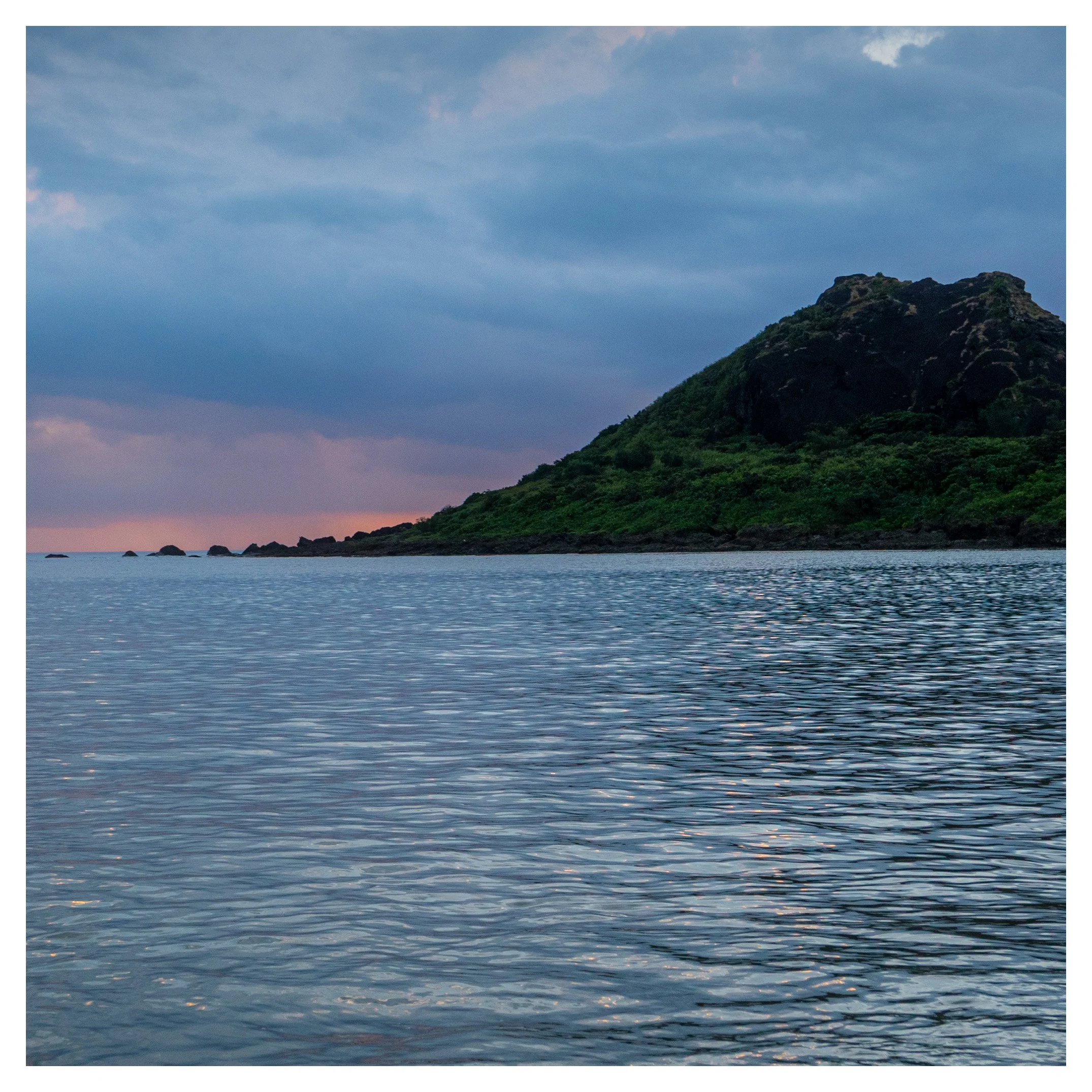
A Kenting headland, a storm-blue sky and a last ribbon of peach light: on paper, everything is here. So why does the picture feel split in two? Theo Marr reads the horizon, the cropping habit and the shadows, and shows how a calm sea becomes a decisive photograph.
Metadata
Camera Model: Leica D-Lux 8
Shutter Speed: 1/125 sec
Aperture: f/4.5
ISO: 200
Also recorded: 18mm (roughly 40mm full-frame equivalent), 5 October 2026, 17:31, DNG, cropped from 4736 x 3552 to a 2487 x 2487 square
Critique
This is the first frame in the series made beyond the city, and the change of subject shows. The palette is the picture's real achievement. A bruised slate-blue sky meets a thin band of peach at the horizon, and the green headland sits between them as a dark, saturated anchor. Blue and orange are complementary colours, and the small orange glints scattered across the ripples repeat the horizon glow into the foreground. Whether you planned it or not, the sea is quietly carrying the sky's colour back toward the viewer.
The headland has a good diagonal. It climbs from the low rocks at left to the crown at right, which gives a still scene a direction of travel. The ripples are also well handled. At 1/125 they are frozen into fine, glittering texture rather than smeared, and the surface reads as cold and alive.
The structure is where the picture loses its nerve. The horizon sits almost exactly halfway up the square, so sky and water divide the frame into two equal slabs. Each is handsome, but neither wins, and the eye bounces between them. The lower half is a large expanse of pleasant texture with no point of arrival. The headland, your only subject, is pressed into the upper right, and its crown appears to run off the right edge, so the strongest shape in the picture is cut at the moment it peaks. Meanwhile the warmest light, that peach glow, is squeezed into the far left corner with almost no room to breathe.
Exposure is largely well judged. The sky holds its detail, which is a clear improvement on the blown skies in the harbour and pier frames earlier this week. The headland's rock face, though, has gone to near-black. If you intended a silhouette, it works. If you wanted the texture of that rock, the information may still be recoverable, since you shot DNG.
Improvement
• Commit the horizon. Place it on the lower third and let the clouds and glow own the frame, or on the upper third and let the ripples own it. Either is stronger than the middle.
• Give the headland room. Step left or reframe so the summit sits fully inside the edge. Check the uncropped file first, because the complete crown may exist in the original frame.
• Add something to the foreground. A wet rock, a tide line or a single figure would give the lower half a reason to exist and give the eye a way in. Crouch to near water level and the ripples become a landscape in their own right.
• Treat the highlight patch. The small white break in the cloud at the top right is the brightest thing in the frame and pulls the eye away from the headland. Burn it down in post, or reframe to exclude it.
• Open the shadows. In Lightroom, lift the shadows on the rock face until the texture returns, then judge whether you prefer the silhouette.
• Slow the water, as an experiment. Bracing the camera on a rock and shooting around 1/10 sec would turn the ripples into a smooth, reflective skin. Both versions are valid, so shoot both and compare.
• Stay longer. This was made at 17:31. The colour in the sky usually builds after the sun drops, so try the same spot again at 17:50 and 18:10.
Growth and Data
Eight images in eight consecutive days is the most important number in this archive. Many photographers never sustain that rhythm. Here is what the pattern shows.
• Aperture: four of the eight frames were at f/2.8 or wider, and four were between f/4.5 and f/13. The last two frames have both been mid-range, which suggests you are beginning to choose aperture for the subject rather than defaulting to wide open.
• Shutter: from 1/20 to 1/320 sec, with 1/125 appearing three times. You are comfortable handheld and slow, which is a real strength.
• ISO: always between 100 and 400, and ISO 200 in four frames. You have not yet tested the camera's ceiling. That test is still owed.
• Cameras: five frames on the Leica D-Lux 8 and three on the Ricoh GR III.
• Cropping: all eight frames are cropped, and five are squares. On the last three D-Lux frames the crop has kept 75 percent, then 58 percent, then 37 percent of the sensor area. This latest frame is the heaviest crop yet. Cropping is not a sin, but it means the camera frame is no longer your composition. It is a rough draft.
• Edges: awkward cuts or clutter at the frame edge now appear in six of eight frames. This is the most persistent weakness in your work.
• Colour: the single most consistent strength. Your tonal and colour structure is reliably good.
Next steps
• Set the D-Lux 8 to the 1:1 aspect ratio in-camera for a week so that you compose the square you intend to publish.
• Before every press of the shutter, run a four-corner check: look at each corner of the frame in turn.
• Run the ISO ceiling test at night: the same scene at ISO 400, 800, 1600, 3200 and 6400.
• Make a return visit to this headland, as above. Photographing one place repeatedly is the fastest way to learn what a place looks like.
• Keep the daily habit going.
Photographers to Study
• Richard Misrach: his Pacific beach and sea work, notably On the Beach, shows how an almost empty frame of water and sky can hold a whole picture.
• Eliot Porter: a pioneer of colour landscape who favoured intimate, carefully chosen fragments over grand views. His colour discipline is a model for your instinct for palette.
• Jem Southam: returns to the same coastal and watery sites for years, and his patience is the cure for the one-visit frame.
• Fay Godwin: black-and-white landscapes of the British coast and countryside, with a strong sense of weather and edge.
• Ansel Adams: the master of exposure and tonal control, which is the discipline you need for that shadowed headland.
Books to Read
• On the Beach, Richard Misrach (Aperture)
• In Wildness Is the Preservation of the World, Eliot Porter (Sierra Club)
• The Shape of Time: Rockfalls, Rivermouths and Ponds, Jem Southam
• Land, Fay Godwin (Aperture)
• The Negative, Ansel Adams (Little, Brown)
Videos to Watch
• Richard Misrach in "Borderlands" (Art21 extended segment): https://www.youtube.com/watch?v=mYjCGYw3HXU
• Ansel Adams, Photographer, 1958 documentary: https://www.youtube.com/watch?v=pG7Ff4qKth8
• Fay Godwin, British Photographer documentary: https://www.youtube.com/watch?v=K1AVlLh4csI
• Minimalist Seascape Photography, Using Long Exposure to Simplify Scenes: https://www.youtube.com/watch?v=bmuKbUxK9y0
• When Only Long Exposure Photography Will Do (Northumberland seascapes): https://www.youtube.com/watch?v=X2reF72A_sc
Manufacturer Note
For Leica Camera Taiwan: this series is shot daily across Taiwan, from city streets to the Kenting coast, and five of the eight frames so far were made on the D-Lux 8. A compact camera that handles dusk colour, slow handheld shutters and a sunlit coastline is the story I would like to tell with Leica, and I would welcome a conversation about a partnership. Contact via photosoftaiwan.com.