

Day 350/365 Roofs Like Waves: Jiadong's Terracotta Courtyard From Above
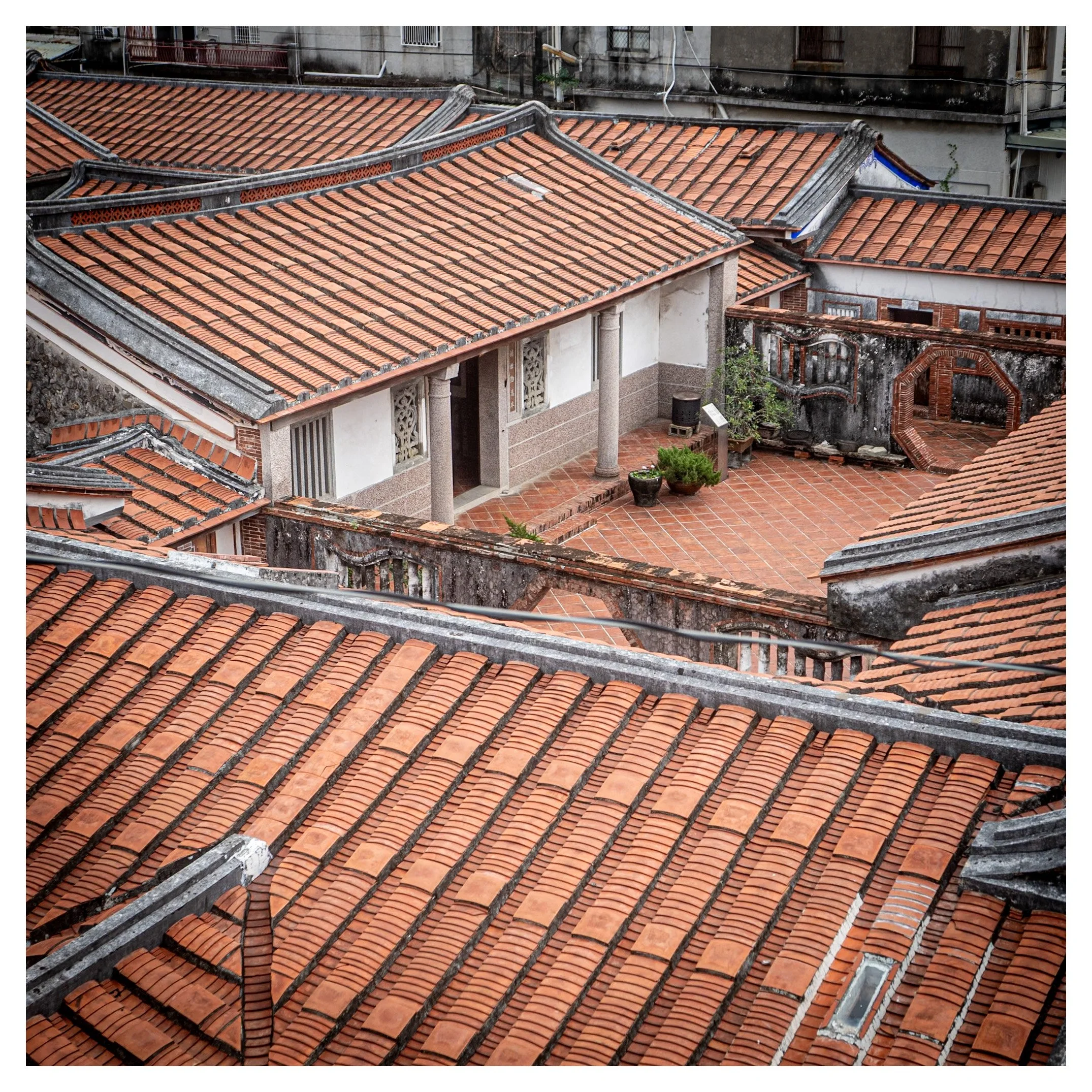
From a high vantage in Jiadong, a sea of terracotta tiles surrounds a quiet courtyard. The colour is superb, the light is soft, and yet something crosses the frame. Theo Marr looks at what works, what intrudes, and how a smaller aperture could pull the whole scene into focus.
Metadata
Camera Model: Leica D-Lux 8
Shutter Speed: 1/2000 sec
Aperture: f/2.7
ISO: 200
Also recorded: 22mm (roughly 48mm full-frame equivalent), 6 October 2026, 12:52, DNG, cropped from 4736 x 3552 to a 3552 x 3552 square
Critique
Looking down on a village of old courtyard houses is one of the best vantage points in documentary photography, and you have used it well. The colour is the first thing that lands. Hundreds of warm terracotta tiles sit against cool grey concrete and weathered stone, and the soft, overcast light keeps every tile saturated without a hard shadow to break the surface. It is a limited palette doing a great deal of work.
The structure is also strong. The rows of tiles run in diagonals that carry the eye from the large foreground roof up toward the courtyard, and the layering of roof over wall over roof gives the scene real depth. The courtyard is the heart of the picture: a tiled floor, granite pillars, a pair of potted plants, and a round opening in the old wall at right that works like a frame within the frame. There is even a small information board in the corner, which tells us this is a place people come to look at.
The trouble is the weight distribution. The foreground roof fills roughly the bottom 40 percent of the square, and because it is a field of repeating tiles, it is the most visually heavy part of the picture, while the real subject sits small in the middle of the frame. A power cable also slashes across the lower third from left to right, directly over the wall that leads the eye to the courtyard. If it is not a deliberate comment on the village's present, it is the single biggest distraction. Along the top, a strip of modern grey buildings with air-conditioners and cables pulls the image back into the twenty-first century, and a small patch of blue paint at the top right pops out of an otherwise warm and grey palette.
There are also small edge problems. A dark stone ridge pokes into the bottom right, and roof edges are clipped at the left and right sides, so the scene feels cropped rather than composed.
Technically, 1/2000 at f/2.7 is far more speed and far less depth of field than a still, overcast rooftop needs. The distant buildings at the top are noticeably soft, and the tile detail would have benefited from a smaller aperture.
Improvement
• Remove or avoid the cable. Move a step or two sideways and its line will shift, or clone it out in post.
• Rebalance the frame. Tilt down less, or reframe so the courtyard sits on a third rather than in the middle, and the foreground roof becomes a supporting pattern rather than the main event.
• Try a landscape frame. A 4:3 crop from the same vantage would take in more of the courtyard and the round opening without the heavy foreground.
• Stop down. For the same light, f/5.6 or f/8 at ISO 100 and about 1/250 sec would hold the tiles, courtyard and rear walls together in focus.
• Wait for a person. The courtyard is a stage waiting for an actor. One visitor crossing the tiles would give scale and a story.
• Calm the blue. Pull back the saturation on that patch of blue paint, or reframe to exclude it.
• Return in low sun. Early or late light rakes across the tiles and gives every ridge a shadow, which would turn a flat pattern into a relief.
Growth and Data
Nine images in nine consecutive days. The habit is strong, and the pattern is getting clearer.
• Aperture: five of the nine frames were at f/2.8 or wider, and four were between f/4.5 and f/13. After two mid-range frames, you have gone back to wide open. Make the choice on purpose each time.
• Shutter: from 1/20 to 1/2000 sec, with 1/125 the most common speed. This is your fastest frame yet, and it was not needed.
• ISO: always between 100 and 400, with ISO 200 in five frames. The ceiling test is still waiting.
• Cameras: six frames on the Leica D-Lux 8 and three on the Ricoh GR III.
• Cropping: all nine frames are cropped, and six are squares. This frame keeps 75 percent of the sensor area, a welcome step back from yesterday's 37 percent. Using the full height of the sensor is a healthier habit.
• Edges: awkward cuts or clutter at the frame edge now appear in seven of nine frames. It remains the most persistent weakness.
• Colour: still the most consistent strength. Yet again the palette does most of the work.
Next steps
• Choose aperture deliberately for every frame this week, and note why.
• Run a four-corner check before each press of the shutter.
• Try a landscape-format frame for every square you shoot, and compare them at home.
• Run the ISO ceiling test at night.
• Keep the daily habit going.
Photographers to Study
• Yasuhiro Ishimoto: his Katsura Villa pictures turn traditional Japanese architecture into pure line, plane and pattern, and are a lesson in how to see a historic building without sentiment.
• Toshio Shibata: photographs dams and retaining walls from above with no horizon, and shows how a man-made surface can become abstract landscape.
• Candida Höfer: large-format, natural-light portraits of public spaces, composed with calm and symmetry. A model of how to let an architectural space be the subject.
• Edward Burtynsky: elevated, large-scale views of human-altered landscapes, and a guide to how a high vantage point creates both beauty and tension.
• Luigi Ghirri: quiet colour studies of ordinary Italian walls, roofs and streets, and a reminder that a muted palette and a tight frame can carry an entire picture.
Books to Read
• Katsura: Tradition and Creation in Japanese Architecture, Yasuhiro Ishimoto
• Still in the Night, Toshio Shibata
• Libraries, Candida Höfer
• Anthropocene, Edward Burtynsky
• Kodachrome, Luigi Ghirri (MACK)
Videos to Watch
• Yasuhiro Ishimoto, Katsura, Villa Imperiale (L'Écho du Bal): https://www.youtube.com/watch?v=byYhJlhds78
• The Landscape Photographer Who Hates the Sky (Toshio Shibata): https://www.youtube.com/watch?v=CpKofdye1eg
• Candida Höfer: Architecture Intériorisée (Pose Café, in French): https://www.youtube.com/watch?v=4wiPu4qgg0I
• Edward Burtynsky: Photographs of the Landscape of Oil (TED Talks): https://www.youtube.com/watch?v=0dL-zw0pD9M
• An Interview with Edward Burtynsky, Part 1 of 3: https://www.youtube.com/watch?v=lJxIIPuezZ4
Manufacturer Note
For Leica Camera Taiwan: this series is shot daily across Taiwan, from city streets to the Kenting coast to the historic houses of Pingtung, and six of the nine frames so far were made on the D-Lux 8. A compact camera that handles heritage architecture, soft light and fast, spontaneous framing is the story I would like to tell with Leica, and I would welcome a conversation about a partnership.