

Day 351/365 The Big Yellow Bet: A Taiwan Lottery Corner at Dusk
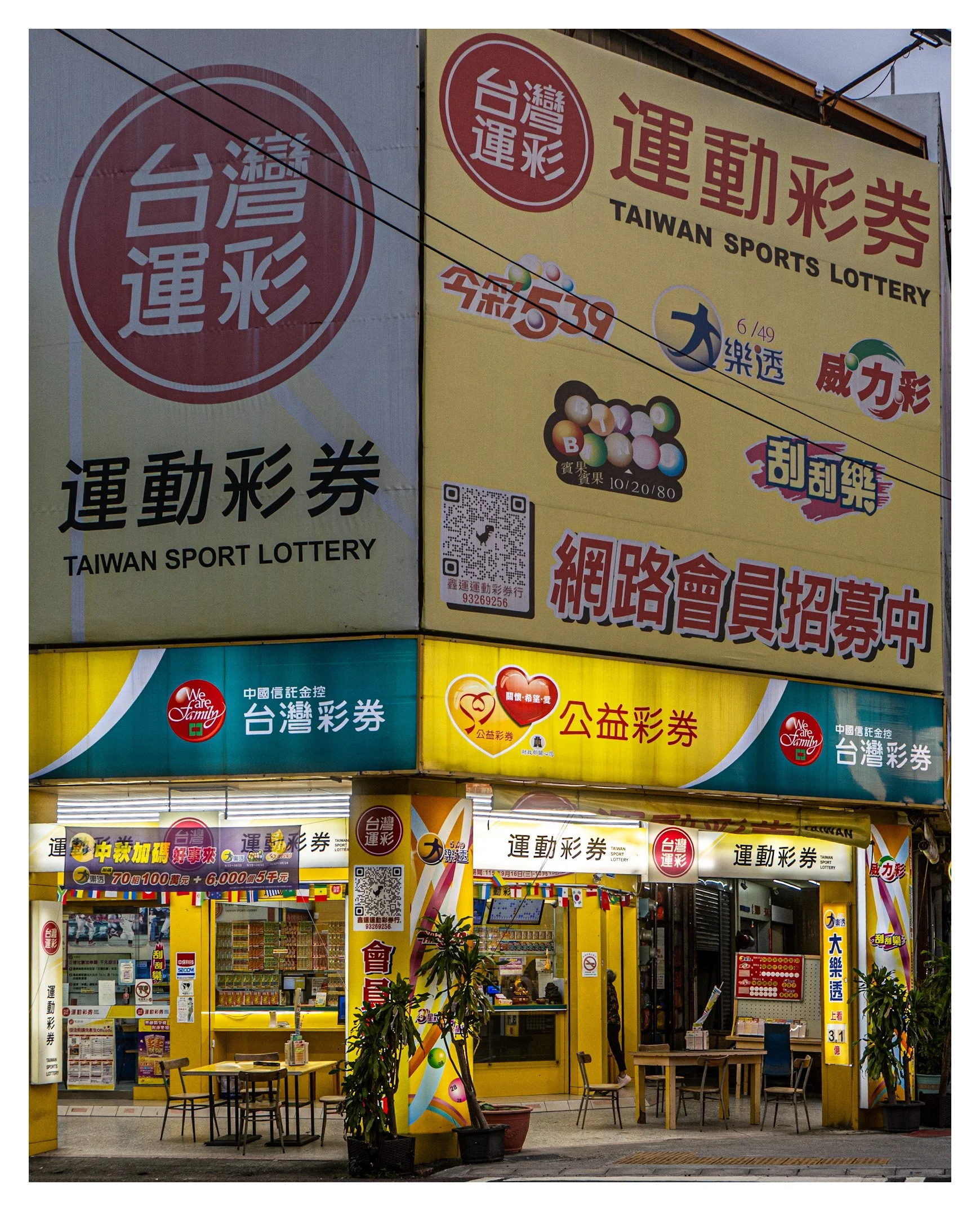
Two enormous billboards, a glowing shopfront and a pair of cables slicing across both. In one frame, Taiwan's lottery culture gets a deadpan portrait at dusk. Theo Marr explains why this is your first uncropped frame, and where the odds could still be improved.
Metadata
Camera Model: Leica D-Lux 8
Shutter Speed: 1/125 sec
Aperture: f/3.2
ISO: 200
Also recorded: 17mm (roughly 37mm full-frame equivalent), 7 October 2026, 17:36, DNG, full frame at 3552 x 4736, no crop
Critique
This is the first frame in the series that has not been cropped, and it shows. The picture feels held together by decisions made at the camera rather than at the computer. The view is frontal and deadpan: a corner building with two huge billboards stacked above a lit shopfront. The left billboard is cream with a big red roundel, and the right is yellow, crowded with lottery logos and a call for new online members. Below them a teal and yellow fascia runs across the building, and under that a bright shop front holds empty tables, chairs and pot plants.
The colour is excellent. Red, yellow and teal are strong primaries, and the cool dusk sky at the top right gives the whole warm block something to push against. The repetition is the second strength. The red roundel logo appears again and again, large on the billboards and small on the lightboxes, and each repeat makes the building feel more like a pattern than a place. The tiny tables and chairs at the bottom add the human scale. A giant promise of fortune sits above a few empty seats, and that contrast is the picture's quiet joke.
The weaknesses are mostly about what crosses the frame. Two parallel cables run diagonally from the upper left across both billboards, straight through the big roundel and the logo cluster. They are the strongest line in the picture. If they are a deliberate comment on the clutter of a Taiwanese street, they are working. If not, they fight the typography and cut the image in two. A lamp bracket pokes in at the top right as well.
The shopfront is a stage with no actor. One figure is barely visible in the doorway, half hidden behind a pillar, and that is the picture's one missed chance. At the base, the pot plants press against the bottom and right edges, the pavement is a very thin strip, and the plant at the right is clipped.
The light is mixed. The warm shop interior and the yellow billboard sit against the cool dusk, and the cream billboard on the left has taken on a yellow-green cast. That may be what you wanted, but it is worth deciding on purpose.
Technically, there is nothing to fix. 1/125 at f/3.2 and ISO 200 is a sensible dusk exposure at 17mm, and the signage is crisp from edge to edge.
Improvement
• Decide about the cables. Move a step sideways or change your height and their line will shift, or clone them out in post.
• Wait for a customer. The lit shopfront asks for a person. Give it ten minutes from the same spot and take several frames as people pass or stop at the counter.
• Give the base room. Step back slightly or tilt up so the pot plants and pavement have space, and the plant at the right is not clipped.
• Check the top right corner. The lamp bracket and the small patch of sky add nothing, so either use them or lose them.
• Set the white balance on purpose. Take one frame at about 4500K and one at 6500K and compare how the cream billboard looks.
• Return fifteen minutes later. The sky will have deepened and the lit signs will dominate even more.
• Make a series. Photograph other lottery shopfronts around Taiwan in exactly this frontal, uncropped manner. Ten of them together would be a typology and a strong body of work.
Growth and Data
Ten images in ten consecutive days. The habit is established, and the numbers are changing in useful ways.
• Crop: this is the first uncropped frame of ten. All previous frames were cropped, and six were squares. Composing to the edges, as you did here, is the direction to keep going.
• Aperture: five frames were at f/2.8 or wider, and five were between f/3.2 and f/13. The split is now even.
• Shutter: from 1/20 to 1/2000 sec, with 1/125 the most common speed at four frames out of ten.
• ISO: always between 100 and 400, with ISO 200 in six frames. The ceiling test is still owed.
• Cameras: seven frames on the Leica D-Lux 8 and three on the Ricoh GR III.
• Edges: awkward cuts or clutter at the frame edge now appear in seven of ten frames. This frame is much cleaner than the rooftop one, with only minor clipping.
• Colour: still the most consistent strength, and your best colour keeps coming at dusk.
Next steps
• Keep composing to the full frame, and treat the crop as a last resort.
• Run the four-corner check before every shot.
• Start the lottery shopfront series.
• Run the ISO ceiling test at night.
• Keep the daily habit going.
Photographers to Study
• Gabriele Basilico: Italian architect-turned-photographer who called himself a measurer of space, and who photographed ordinary city buildings with patient, frontal calm.
• Fred Herzog: pioneer of colour street photography in Vancouver, who found his subjects in shopfronts, signs and storefronts years before colour was taken seriously.
• Mitch Epstein: American colour photographer whose frames of everyday commercial places are layered, precise and quietly ironic.
• Takashi Homma: his Tokyo Suburbia captures a placeless, modern city in soft colour, with a cool and detached eye.
• Guido Guidi: large-format colour studies of overlooked roadside places in Italy, and a model of how to make the humble monumental.
Books to Read
• Beirut 1991, Gabriele Basilico
• Fred Herzog: Photographs (Douglas & McIntyre)
• Recreation: American Photographs 1973-1988, Mitch Epstein (Steidl)
• Tokyo Suburbia, Takashi Homma (Korinsha)
• In Veneto, 1984-89, Guido Guidi (MACK)
Videos to Watch
• Gabriele Basilico, full documentary (2009): https://www.youtube.com/watch?v=9qdiElFp8L0
• Mitch Epstein, interview (2017): https://www.youtube.com/watch?v=4JiLVaNw1f8
• Takashi Homma, Bas Princen and Stefano Graziani visit his Tokyo studio (CCA, The Lives of Documents): https://www.youtube.com/watch?v=No8g1fbjKyA
• Takashi Homma, Tokyo Olympia: https://www.youtube.com/watch?v=GJg4nHvpwiA
• Guido Guidi, In Veneto 1984-1989 (book review): https://www.youtube.com/watch?v=hI0jD6QNA7c
Manufacturer Note
For Leica Camera Taiwan: this series is shot daily across Taiwan, from the Kenting coast to the old houses of Pingtung and now the everyday street corners of the city, and seven of the ten frames so far were made on the D-Lux 8. A compact camera that delivers saturated colour, crisp signage and a clean, uncropped frame at dusk is the story I would like to tell with Leica, and I would welcome a conversation about a partnership. Contact via photosoftaiwan.com.