

Day 352/365 Out of the Dark: A Self-Portrait Built from Light
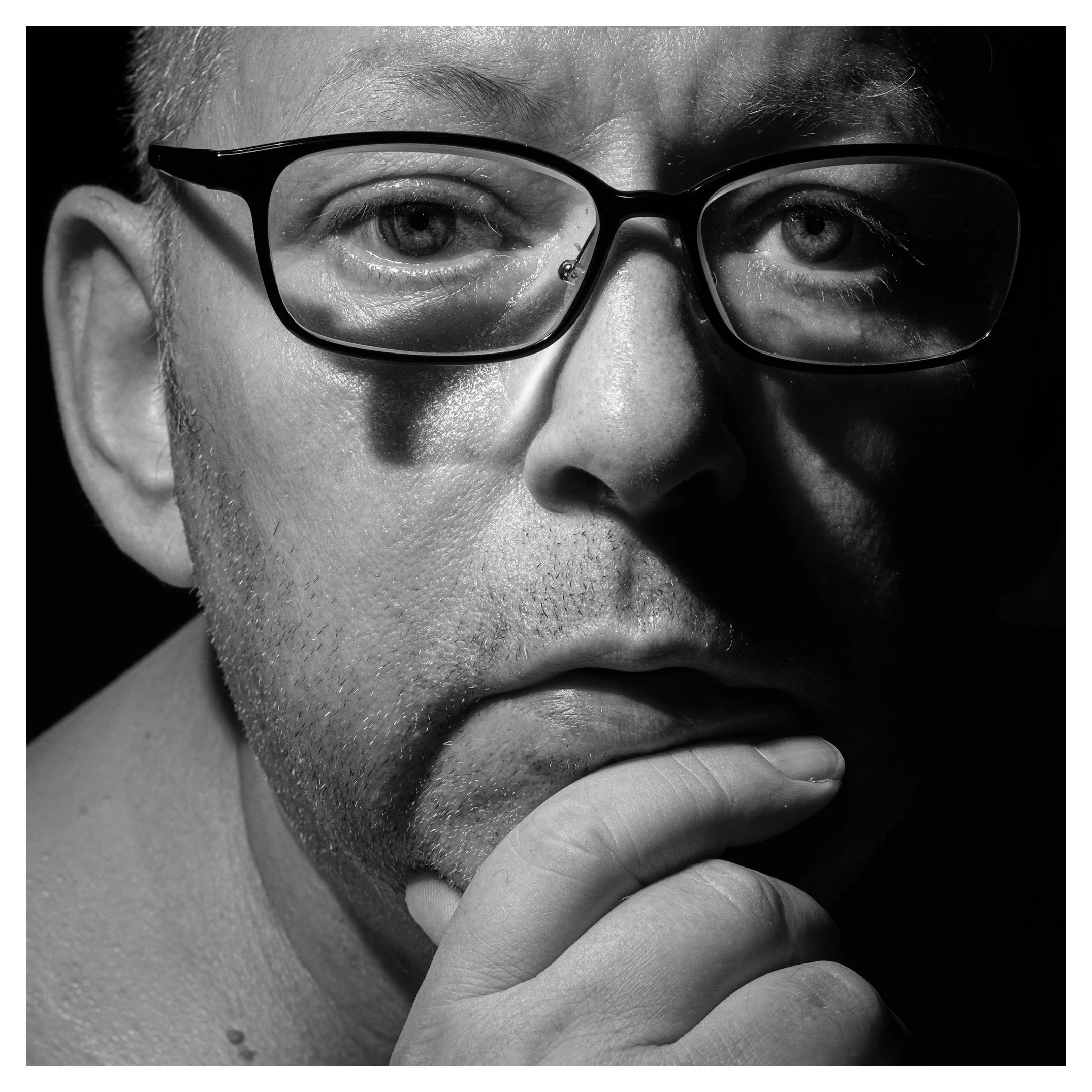
No backdrop, no studio, just a sofa in the middle of a room and a flash shaped by a gobo. Theo Marr looks at how controlled light turns an ordinary room into a black void, and where this self-portrait could go from here.
Metadata
Camera Model: Fujifilm X-Pro2
Shutter Speed: 1/125 sec
Aperture: f/8
ISO: 200
Also recorded: XF50mmF2 R WR at 50mm (roughly 75mm full-frame equivalent), Godox iT32 flash with a gobo, 8 October 2026, 20:37, RAF, cropped from 6000 x 4000 to a 3129 x 3129 square
Critique
This is a frame with nerve, and it is built with skill. The face fills the square, the gaze goes straight into the lens, and a hand rests at the chin. There is no setting and no escape route for the viewer. What makes it more than a close-up is where it was made: on a sofa in the middle of a room, with nothing behind you but air. The black around the head was not painted on a wall. It was made by the exposure, the flash and the gobo working together.
That is the picture's real achievement. At 1/125, f/8 and ISO 200, the room light barely registers, so only the flash exposes the scene. The gobo then decides where that light is allowed to land. The result is a clean split: one side of the face lit, the other falling away into black, with a crisp transition running beside the nose. That reads as shaped light, and it is a long way from the found light of the earlier dusk frames.
The craft is strong where it counts. The eyes are the sharpest point in the frame, with fine detail in the iris and lashes, and the second eye still reads through the lens despite sitting in deep shadow. The skin texture, the stubble and the fine hairs at the ear are rendered with real clarity, and f/8 has held enough of the face in focus while the hand falls softly away. The hand also does useful work. The finger across the lip hides the mouth, so the expression is carried entirely by the eyes.
The questions are about refinement, since the big decisions are clearly yours. The glasses cast a hard, dark wedge of shadow onto the cheek directly under the left eye. If you intended it, it is a graphic detail. To my eye it reads like a bruise or a smudge and pulls attention away from the eyes. On the shadow side everything is lost, including the jaw and the outline of the head, so the face dissolves into the background on the right. That is a strong choice, but that unseen side carries a lot of the portrait's weight.
The highlights are hot. The forehead, the bridge of the nose and the cheekbone show a bright specular sheen, and some areas are close to clipping. That is the nature of a small, hard source close to the face. Finally, the bright bare shoulder at the lower left is a large pale triangle that competes with the face, and a small mark in the corner draws the eye.
Improvement
• Move the gobo. Small changes in its position will slide the edge of the light across the face. Try placing the cut-off so it falls exactly along the nose, or just past it, and compare.
• Check the glasses shadow. If the wedge is not intended, tilt the head slightly down or raise the flash a few centimetres and it will slide off the cheek.
• Soften the edge. A little more distance between the gobo and the face would feather the transition, and a closer gobo would harden it. Shoot both.
• Control the shine. A diffuser or a bounce on the flash would calm the specular sheen on the forehead and nose without losing the drama.
• Hold the shadow side. If you want a hint of jaw, place a white card out of frame on the dark side and take it down until the black still feels deep.
• Or add a rim. A second light behind and to the right would draw a thin edge along the head and separate it from the dark.
• Tame the shoulder. Wear a dark top, lower the shoulder, or tilt your head so the pale triangle at the lower left shrinks.
• Shoot closer, crop less. This frame keeps only 41 percent of the sensor. Move in, or use a 1:1 aspect ratio so you compose the square you intend to publish.
• Edit harder. Take 50 frames with small changes of head angle and expression, then choose three.
• Make it a study. Photograph yourself again with different lighting, such as loop, Rembrandt and butterfly, and compare.
Growth and Data
Eleven images in eleven consecutive days. The habit is remarkable, and this frame changes the picture.
• Light: this is the first frame in the series where you made the light rather than found it. Your dusk colour work shows you read natural light well, and this shows you can also build it. Combining the two is where this goes next.
• Crop: ten of eleven frames are cropped. Yesterday's uncropped lottery frame was the one exception, and today you are back to a 41 percent crop.
• Aperture: five frames at f/2.8 or wider and six between f/3.2 and f/13. f/8 has now appeared twice.
• Shutter: from 1/20 to 1/2000 sec, with 1/125 the most common speed at five frames out of eleven.
• ISO: always between 100 and 400, with ISO 200 in seven frames. The ceiling test is still owed.
• Cameras: seven frames on the Leica D-Lux 8, three on the Ricoh GR III and one on the Fujifilm X-Pro2.
• Subject: your first portrait, your first indoor frame, and your first self-portrait.
Next steps
• Set the camera to 1:1 and compose to the edges.
• Run a small lighting study with the gobo: three positions, same pose.
• Bring the flash outdoors at dusk as a fill, to hold a face against the colours you already shoot so well.
• Run the ISO ceiling test at night.
• Keep the daily habit going.
Photographers to Study
• Richard Avedon: stripped his subjects against a plain white ground and made the face the whole picture, and he wrote about the moral weight of the portrait.
• Martin Schoeller: his extreme close-ups use even, frontal light and show every pore. A direct contrast to your hard, dramatic approach, and worth studying for that reason.
• Yousuf Karsh: master of dramatic, theatrical portrait lighting, and the best teacher of how a single light can shape a face.
• Robert Mapplethorpe: a rigorous black-and-white portraitist, and a maker of unflinching self-portraits.
• Cindy Sherman: shows that a self-portrait can be a construction rather than a confession, and is the best argument for planning the picture before you take it.
Books to Read
• Richard Avedon: An Autobiography
• Close Up: Portraits 1998-2005, Martin Schoeller (teNeues)
• Karsh: A Fifty-Year Retrospective
• Just Kids, Patti Smith (on her years with Robert Mapplethorpe)
• Cindy Sherman: The Complete Untitled Film Stills (MoMA)
Videos to Watch
• Richard Avedon: Darkness and Light, full documentary: https://www.youtube.com/watch?v=kt3rCqGuzSA
• Behind the Scenes: Acumen and Martin Schoeller: https://www.youtube.com/watch?v=kJ2EF-kQfrg
• Yousuf Karsh interview: https://www.youtube.com/watch?v=QxJoUMj1fXw
• Mapplethorpe: Look at the Pictures, official trailer: https://www.youtube.com/watch?v=KrVYqB0geMo
• Cindy Sherman in "Transformation" (Art21): https://www.youtube.com/watch?v=61gkZUOYRlk
Manufacturer Note
For Fujifilm Taiwan and Fujifilm Japan: this series is shot daily across Taiwan, and the X-Pro2 with the XF50mm f/2 delivered the sharpest eyes and finest skin detail in the whole run. An X-Pro2 paired with a flash and a gobo, in an ordinary room, is a modest, honest portrait kit, and I would like to tell that story with Fujifilm. I would welcome a conversation about a partnership. Contact via photosoftaiwan.com.